
Rabbit Nail Clippers: How to Choose the Right Clippers and Trim Safely
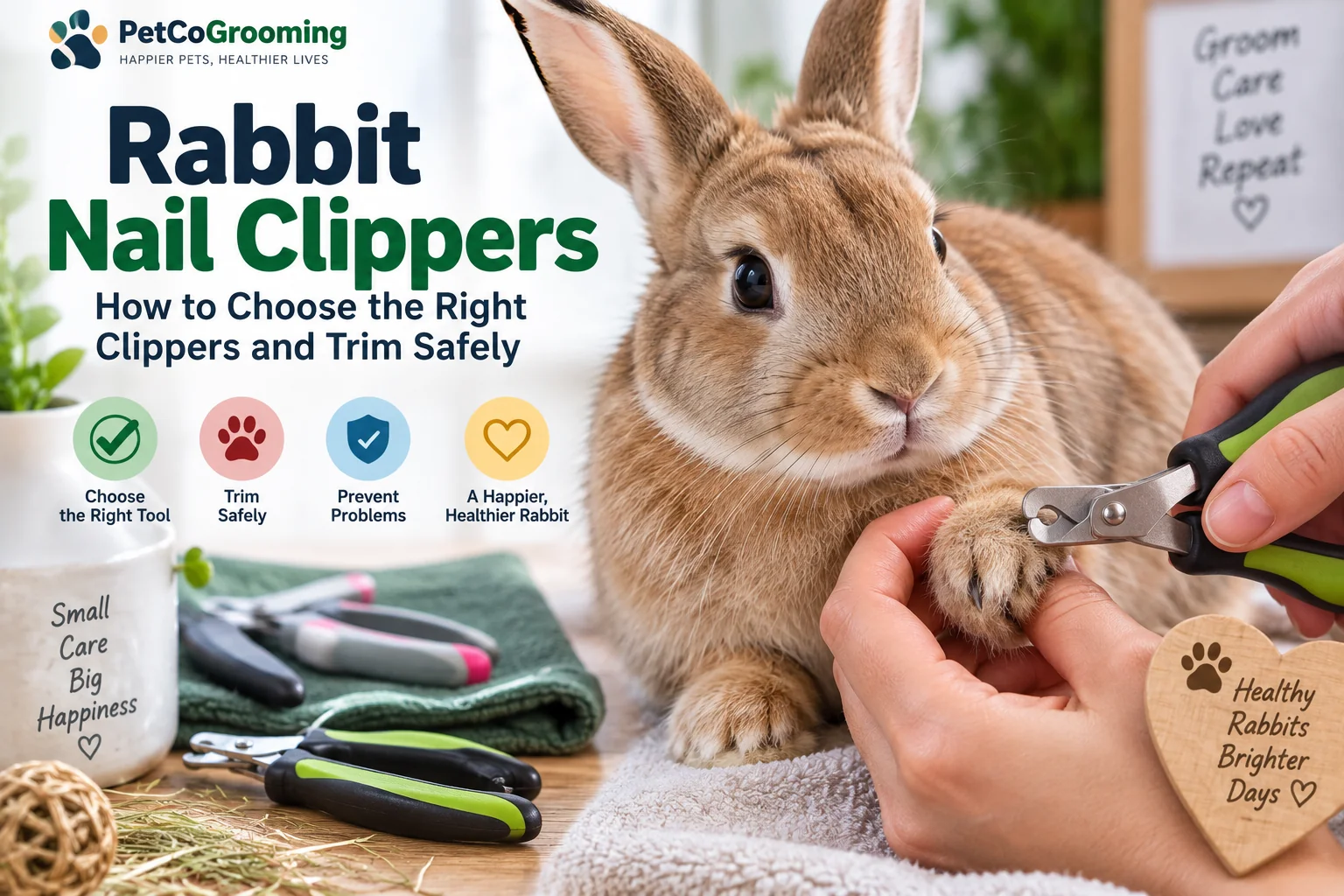
The best rabbit nail clippers are small, sharp, easy to control, and shaped for a rabbit’s tiny, rounded nails. For most pet rabbits, a compact scissor-style small-animal clipper is a practical choice because it gives you good visibility and control. The most important part, however, is not the brand or price—it is being able to identify the quick, keep your rabbit calmly supported, and remove only a small amount of nail at a time.
Trimming rabbit nails can feel intimidating at first, especially when you are worried about cutting the quick. With the right rabbit nail clippers, preparation, and technique, routine nail care can become a much calmer part of your rabbit’s grooming routine.
Why Do Pet Rabbits Need Their Nails Trimmed?
Pet rabbits often need regular nail checks because their nails may not receive enough natural wear to stay at a comfortable length.
Wild rabbits spend considerable time moving, digging, and navigating hard or uneven surfaces. Pet rabbits generally live in very different environments, so their nails may become longer than they would naturally. Overgrown nails can snag on bedding or other surfaces and may change how a rabbit places its feet.
Long nails can also become difficult to trim safely because the quick—the blood vessel and nerve inside the nail—may extend farther toward the tip.
That creates an important grooming rule:
The longer the nail becomes, the more carefully it should be trimmed.
If your rabbit’s nails are severely overgrown, curled, injured, or difficult to manage, having a veterinarian or experienced rabbit professional handle the first trim can be the safest option.
What Should You Look for in Rabbit Nail Clippers?
You do not necessarily need a clipper labeled specifically for rabbits. A small-animal or cat nail clipper can work well when it is appropriately sized and easy for you to control. PetMD specifically recommends small-animal trimmers for rabbit nails rather than human nail clippers.
If you’re also looking for nail-clipping tools for dogs, see our guide to the [best dog nail clippers].
When comparing rabbit nail clippers, focus on these features.
1. Small Size
Rabbit nails are much smaller than dog nails.
A bulky dog nail clipper can make it harder to see exactly where you are cutting. A compact clipper gives you better control around the nail tip.
2. Sharp, Clean Cutting Edges
A sharp clipper should make a clean cut without requiring excessive force.
Dull or poorly aligned blades can make trimming more difficult and may crush or split the nail instead of cutting it cleanly.
3. Comfortable Grip
You need steady control rather than maximum squeezing power.
Choose a handle that feels secure in your hand and allows you to make a controlled cut without awkward wrist positioning.
4. Good Visibility
Visibility is especially important when dealing with dark rabbit nails.
Some small-animal nail clippers include an LED light. A built-in light can be helpful, but it should not be treated as a guarantee that you will be able to see the quick. If you cannot confidently identify a safe cutting point, stop rather than guessing.
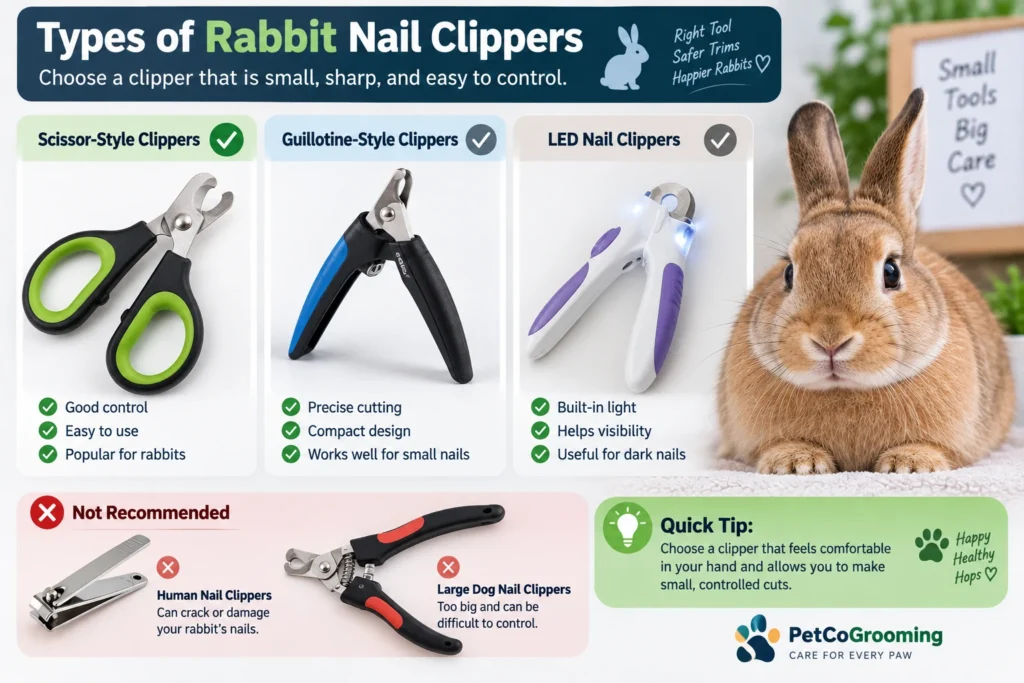
5. Scissor-Style Design
Scissor-style clippers are commonly recommended for rabbit nails because they provide a familiar grip and allow controlled cutting. The Rabbit Welfare Association & Fund specifically recommends the scissor-shaped type, while noting that some owners prefer guillotine-style designs.
For a first-time rabbit owner, the simplest tool is often the one you can hold steadily and position accurately.
Rabbit Nail Clippers vs. Human Nail Clippers
Human nail clippers are not the ideal choice for rabbit nails.
Rabbit nails have a different shape from human fingernails, and small-animal clippers are designed to work with the rounded shape of a pet’s claw. PetMD advises against using normal human nail clippers for rabbits because they can crack or damage the nail.
A useful rule is:
Rabbit or small-animal nail clipper → appropriate choice
Human fingernail clipper → avoid
The goal is a clean, controlled cut rather than crushing or splitting the nail.
How Do You Know When Your Rabbit’s Nails Need Trimming?
There is no single schedule that works perfectly for every rabbit.
Instead of relying only on a calendar, check your rabbit’s nails regularly.
You may notice that the nails:
- Extend noticeably beyond the fur
- Curve downward
- Touch the floor when your rabbit stands normally
- Catch on bedding or fabric
- Look longer than they normally do
- Are becoming difficult to see around the toes
The Rabbit Welfare Association & Fund suggests that a useful guide is keeping the nails around the level of the surrounding fur, with individual variation depending on the rabbit and coat.
Some veterinary guidance gives approximately four to six weeks as a common trimming interval for many pet rabbits, but growth varies between individuals. Regular checks are more useful than blindly following a fixed schedule.
What Is the Quick in a Rabbit’s Nail?
The quick is the living part inside the nail containing blood vessels and nerves.
Cutting into it can cause pain and bleeding, which is why identifying the quick is the most important safety skill when trimming rabbit nails.
With light-colored nails, the quick may appear as a pinkish or darker area inside the nail.
With dark nails, it can be much harder to identify.
If you cannot clearly determine where the quick ends, do not make a large cut simply because you think the nail is too long.
How to Trim Rabbit Nails Safely
Once you have the right rabbit nail clippers, the process should be slow and controlled.
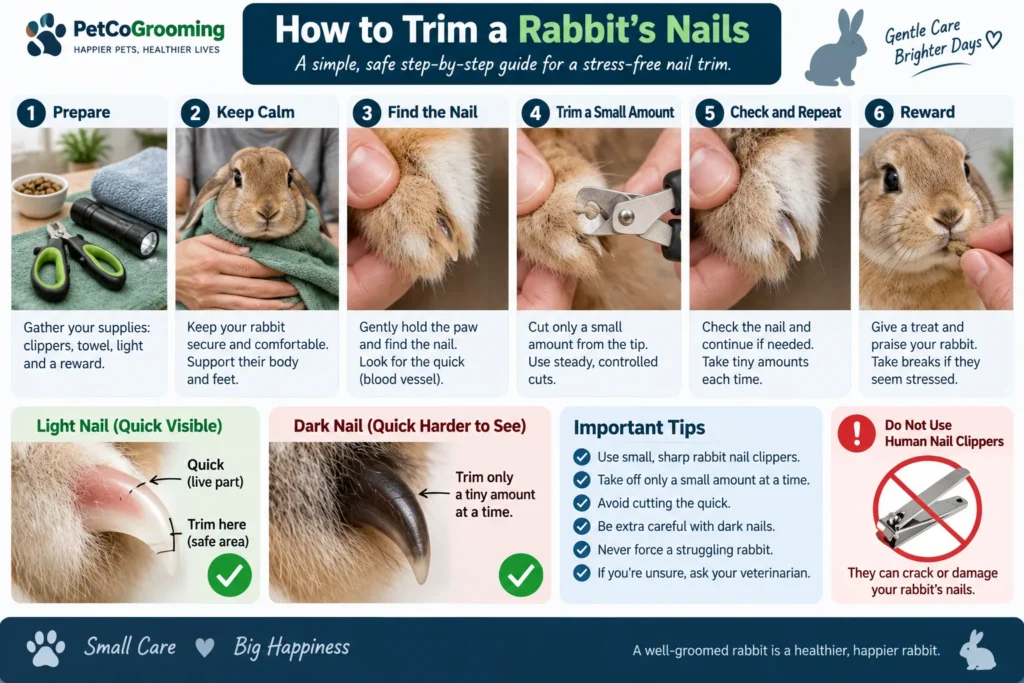
Step 1: Prepare Everything Before You Start
Have your supplies ready before bringing your rabbit into position.
You may need:
- Small-animal rabbit nail clippers
- A clean towel
- A secure, non-slip surface
- A small flashlight for dark nails
- A reward your rabbit enjoys
- A suitable way to control minor nail bleeding if an accidental quick cut occurs
Preparing first means you will not need to leave your rabbit unattended while searching for something.
Step 2: Get Your Rabbit Comfortable With Foot Handling
Do not make the first experience with nail clippers the first time your rabbit has its feet handled.
Gently touch and hold the feet during normal handling sessions.
Reward calm behavior.
This helps your rabbit become familiar with having its paws touched before you introduce the clipper.
PetMD recommends getting rabbits accustomed to having their feet handled before attempting a nail trim.
Step 3: Keep Your Rabbit Secure and Supported
Your rabbit should be properly supported throughout the process.
A towel can sometimes help provide gentle support while you work on one foot at a time. However, the rabbit should never be wrapped so tightly that breathing or normal movement is restricted.
Most importantly, do not put a rabbit on its back and deliberately induce a “trance.”
The Rabbit Welfare Association & Fund specifically warns against this practice because what appears to be calmness can actually be a fear response in a prey animal.
Step 4: Identify the Quick
Look at the nail before positioning the clipper.
For light nails, look for the visible quick inside the nail.
For dark nails, use a light if it helps you see the internal structure. If the quick remains difficult to identify, take off only a very small amount at a time or ask a veterinarian for help.
Step 5: Cut Only a Small Amount
Position the clipper near the tip and make a controlled cut.
Do not try to shorten a severely overgrown nail to the desired length in one session.
If the nails are very long, the quick may have grown farther down the nail. Taking tiny amounts off over multiple trims can allow the quick to gradually recede.
Step 6: Reward Your Rabbit
After a nail or a small group of nails, reward calm behavior.
If your rabbit becomes increasingly stressed, stop.
You do not have to finish every nail in one session.
A successful short session is better than forcing a frightened rabbit through a long one.
What If Your Rabbit Has Dark Nails?
Dark nails require extra patience because the quick may be difficult to see.
A flashlight can sometimes help illuminate the nail from behind, but visibility will vary.
A safer approach is to:
- Examine the nail carefully.
- Take only a tiny amount from the tip.
- Recheck the cut surface.
- Continue gradually if the safe margin remains clear.
- Stop if you become uncertain.
Do not assume that an LED clipper automatically makes dark nails safe to cut. Lighting is an aid, not a substitute for knowing where the quick is.
If you cannot confidently identify a safe cutting point, a rabbit-experienced veterinarian or veterinary nurse can show you how to do it safely.
What Happens If You Cut the Quick?
Accidentally cutting the quick can cause pain and bleeding.
If this happens, remain calm and apply appropriate pressure to the nail. Veterinary and pet-care guidance commonly recommends having a suitable clotting aid available when trimming nails. PetMD specifically describes styptic powder as one option, while the Rabbit Welfare Association & Fund recommends cornflour as an alternative and notes that styptic powder can sting rabbits.
If bleeding does not stop promptly, is substantial, or you are concerned about the injury, contact your veterinarian.
Do not continue trimming simply because you want to finish the remaining nails.
How Can You Make Nail Trimming Less Stressful?
The best rabbit nail trim is not necessarily the fastest one.
It is the one your rabbit can tolerate calmly.
Try these approaches:
Trim One or Two Nails at First
If your rabbit is inexperienced with nail care, you can make the first session very short.
One successful nail trim can be better than forcing all four feet into one stressful session.
Use Positive Reinforcement
Give a favorite food reward after calm behavior.
Over time, your rabbit may begin associating the clippers and foot handling with something positive.
Choose a Quiet Environment
Avoid loud noises, sudden movements, and unnecessary distractions.
Take Breaks
If your rabbit becomes agitated, stop and allow it to settle.
Never Force a Struggling Rabbit
A rabbit that is violently struggling can injure itself.
If safe positioning becomes difficult, professional help is the better option.
When Should a Veterinarian Trim Your Rabbit’s Nails?
Home nail trimming is not appropriate for every rabbit or every situation.
Ask a veterinarian or experienced rabbit professional for help if:
- Your rabbit becomes dangerously stressed or difficult to control
- The nails are severely overgrown
- Nails are curling into or toward the foot
- A nail is cracked, torn, or injured
- There is bleeding that does not stop
- The foot is swollen or painful
- Your rabbit is limping
- You cannot identify the quick
- You are simply not confident performing the trim
PetMD also notes that veterinary help may be appropriate when rabbits are too difficult to safely manage at home or when nail abnormalities are present.
Common Rabbit Nail-Trimming Mistakes
Avoid these common mistakes when using rabbit nail clippers.
Cutting Too Much at Once
Large cuts increase the chance of reaching the quick.
Better approach: remove tiny amounts.
Using Human Nail Clippers
Their design is not ideal for the rounded shape of rabbit nails.
Better approach: use a suitable small-animal clipper.
Waiting Until Nails Are Extremely Long
Long nails can be harder to manage and may allow the quick to extend farther toward the tip.
Better approach: check the nails regularly.
Holding a Rabbit Upside Down to Make It “Go Still”
A rabbit appearing motionless does not necessarily mean it is relaxed.
Better approach: keep the rabbit supported in a natural position and use gentle handling.
Trying to Finish at All Costs
A stressed rabbit may struggle more, increasing the risk of injury.
Better approach: stop and continue another time or seek professional help.
Rabbit Nail Clippers: Quick Buying Checklist
Before buying rabbit nail clippers, ask:
| Feature | What to look for |
| Size | Compact enough for small rabbit nails |
| Blade | Sharp and clean-cutting |
| Grip | Comfortable and easy to control |
| Design | Scissor-style is a practical choice for many owners |
| Visibility | Clear view of the nail while cutting |
| LED | Helpful in some situations, but not essential |
| Maintenance | Easy to clean and keep dry |
| Control | Allows small, precise cuts |
The best rabbit nail clippers are therefore not necessarily the most expensive ones. A simple, sharp, appropriately sized clipper that you can control confidently can be more useful than a feature-heavy tool that makes positioning difficult.
Frequently Asked Questions About Rabbit Nail Clippers
What are the best rabbit nail clippers?
For many pet rabbits, a small, sharp, scissor-style small-animal nail clipper is a practical choice. The most important characteristics are appropriate size, clean cutting edges, comfortable handling, and good visibility.
Can I use dog nail clippers on a rabbit?
Some small dog or cat nail clippers may physically work for rabbit nails, but bulky clippers can make precise trimming more difficult. A compact small-animal clipper is generally easier to control around tiny rabbit nails.
Can I use human nail clippers on my rabbit?
It is better to avoid them. Rabbit nails are rounded, while human nail clippers are designed for human nails. A suitable small-animal clipper is a better choice.
How often should rabbit nails be trimmed?
There is no universal schedule because nail growth varies between rabbits. Many pet rabbits need checks and trims every few weeks, with veterinary guidance commonly giving around four to six weeks as a rough interval for many rabbits. Check the nails regularly rather than relying only on the calendar.
How do I avoid cutting the quick on rabbit nails?
Identify the quick before cutting, remove only a small amount of nail at a time, and be especially cautious with dark nails. If you cannot confidently identify a safe cutting point, ask a veterinarian or rabbit-experienced professional to help.
Are LED rabbit nail clippers better?
An LED light can improve visibility in some situations, but it does not guarantee that the quick will be visible. The quality and control of the clipper still matter more than the presence of an LED.
What should I do if my rabbit won’t stay still for nail trimming?
Stop if your rabbit is struggling intensely. Build tolerance gradually through gentle foot handling and positive reinforcement, and consider having a veterinarian or experienced professional perform the trim if you cannot safely control the rabbit.
Final Takeaway
Choosing rabbit nail clippers is only the first part of safe nail care. Look for a compact, sharp, easy-to-control clipper, then focus on the skills that matter most: calmly supporting your rabbit, identifying the quick, taking small amounts off at a time, and stopping when either you or your rabbit becomes uncomfortable.
Regular nail checks can help you catch overgrowth before trimming becomes difficult. If your rabbit has very long or damaged nails, dark nails you cannot confidently assess, or becomes too stressed to handle safely, professional help is the safer choice.
A good rabbit nail-trimming routine should be controlled, gradual, and low-stress—not rushed.