Best Dog Nail Clippers: How to Choose the Right Pair for Your Dog

The best dog nail clippers are the ones that match your dog’s nail thickness, size, and your comfort level—not necessarily the most expensive pair.
For many owners, a sharp scissor/plier-style clipper with a comfortable grip and controlled cutting action is the easiest place to start.
Dogs with thick or overgrown nails may need a stronger clipper, while nervous dogs may do better with a grinder or a slower, gradual trimming routine.
Choosing nail clippers sounds simple until you actually have a dog in front of you pulling away, hiding their paws, or staring at you like you’ve betrayed them.
The good news is that you don’t need a drawer full of grooming tools. You need the right type of clipper for your dog’s nails, a little patience, and a safe trimming technique.
We looked at current veterinary guidance, professional grooming advice, and recent product evaluations to build this guide. Consumer Reports, for example, has evaluated popular dog nail clippers and grinders for ease of use, cleanup, and noise, including testing on a skittish dog.
Here’s how to choose a pair that makes nail trimming safer and less stressful.
The Best Dog Nail Clippers at a Glance
If you want the short version, use this decision guide:
| If your dog has… | Look for… | Why |
| Small, thin nails | Small scissor-style or guillotine clipper | Better control and precision |
| Medium nails | Medium scissor/plier-style clipper | Good balance of control and cutting power |
| Large, thick nails | Heavy-duty scissor/plier-style clipper | More leverage |
| Very thick or overgrown nails | Strong clipper or grinder | Allows controlled removal |
| Black nails | Clippers with good visibility and control | The quick is harder to see |
| A nervous personality | Quiet clipper or gradual grinder training | Less startling |
| Long hair around the paws | Clipper or carefully managed grinder | Reduces the chance of hair getting caught |
One current, independently evaluated option worth knowing is the Gonicc Pet Nail Trimmer. Consumer Reports describes it as basic and inexpensive, with a guard, nonslip handles, quiet manual operation, and strong performance for routine maintenance.
But don’t buy a clipper simply because somebody calls it “the best.” Your dog’s nails should determine the tool.
What Makes a Good Dog Nail Clipper?
A good clipper should let you make a clean, controlled cut without needing excessive force.
There are several things worth checking before you buy.
1. The clipper should fit your dog’s nail size
This is probably the most important factor.
A tiny clipper can be frustrating on a large dog’s thick nails. On the other hand, a large, heavy clipper may feel awkward when you’re working on a small dog’s delicate nails.
Look for a size that allows you to:
- See where you’re cutting
- Hold the paw comfortably
- Open and close the handles without straining
- Make controlled cuts
- Keep your fingers away from the cutting area
The goal isn’t maximum cutting power. It’s control.
2. Choose the right cutting style
The two common types are scissor-style and guillotine-style clippers.
VCA explains that both styles can work, but they operate differently. Scissor-style clippers use two blades that come together, while guillotine clippers place the nail through an opening and use a blade to cut it.
Dog Nail Clipper Selector
Answer 5 quick questions to find the clipper type that may suit your dog.
How big is your dog?
Choose the option closest to your dog’s size.
How thick are your dog’s nails?
Choose the description that best matches your dog’s nails.
What color are your dog’s nails?
Dark nails can make the quick harder to see.
How does your dog react to nail trimming?
Choose the description that best matches your dog.
How comfortable are you trimming dog nails?
Choose your current experience level.
Why this may fit your dog
Take small cuts and avoid cutting into the quick. If your dog becomes highly stressed or you are unsure how to trim the nails safely, stop and consider help from a professional groomer or veterinarian.
Scissor-style or plier-style clippers
These are usually the easiest choice when a dog has medium-to-large or thicker nails.
They give you a familiar squeezing motion and generally provide good leverage.
Best for: medium and large dogs, thick nails, and owners who want straightforward control.
Guillotine-style clippers
The nail goes through a small opening before the blade cuts it.
Some owners like the precision, especially on smaller dogs.
However, the nail has to be positioned correctly, and you need to be comfortable with the mechanism.
Best for: owners who already like this style and dogs with appropriately sized nails.
VCA also notes that there isn’t one universally “best” style; personal preference and the dog’s nails matter.
Best Dog Nail Clippers for Small Dogs
Small dogs generally need smaller, lighter clippers.
A common mistake is buying a heavy-duty clipper because it looks stronger. More strength isn’t automatically better when you’re working with a tiny nail.
For a small dog, prioritize:
- A narrow cutting area
- Lightweight construction
- Easy handle movement
- Sharp blades
- Good visibility
- A size appropriate for the nail
Small nails can be easy to overcut because there’s less material between the end of the nail and the quick.
Take off a little at a time rather than trying to finish the nail in one aggressive cut.
Best Dog Nail Clippers for Large Dogs and Thick Nails
Large dogs often have substantially thicker nails, so leverage becomes more important.
A sturdy scissor-style clipper is usually a practical choice because you can generate more cutting force while maintaining control.
Don’t confuse “heavy-duty” with “safe,” though. A powerful clipper can still cut into the quick if you remove too much nail.
For thick nails:
- Make sure the clipper is large enough.
- Check that the blades close cleanly.
- Support the toe firmly but gently.
- Remove small amounts when you’re unsure.
- Stop before reaching the quick.
If your dog’s nails are extremely overgrown, painful, curled, cracked, or difficult to handle, a veterinarian or professional groomer may be the better starting point.
Best Dog Nail Clippers for Black Nails
Black nails are where many owners become nervous.
The problem isn’t that black nails are inherently more dangerous. It’s that the quick isn’t as easy to see from the outside.
The quick contains blood vessels and nerves, so cutting into it can cause pain and bleeding.
When trimming dark nails, don’t try to remove a huge section at once.
Instead:
Cut a very small amount → inspect the nail → repeat if appropriate.
As you approach the quick, the appearance of the center of the nail can change. If you’re uncomfortable judging what you’re seeing, stop and ask your veterinarian or groomer to demonstrate the technique.
This is also an area where a grinder can be useful because it removes small amounts of nail gradually.
Clippers vs. a Dog Nail Grinder: Which Is Better?
Neither tool wins for every dog.
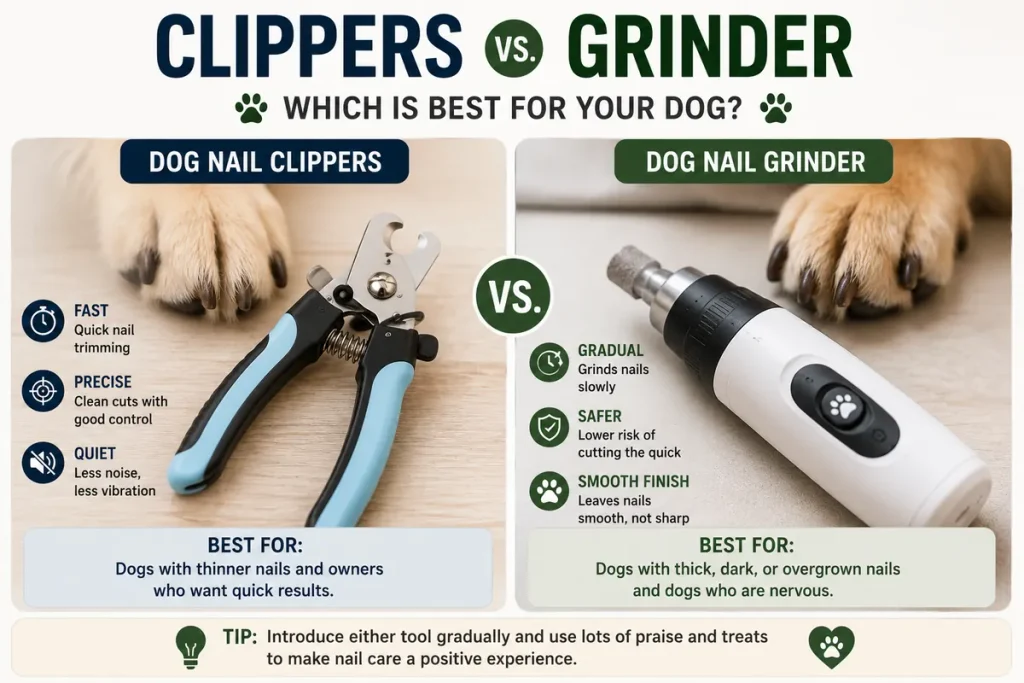
Clippers are faster.
Grinders allow you to remove nail more gradually.
Consumer Reports’ evaluations found that manual clippers can be efficient and quiet, while grinders can offer more gradual control but may introduce noise and vibration.
A grinder may be particularly useful when:
- Your dog’s nails are thick
- You want to smooth sharp edges
- You’re nervous about taking a large cut
- Your dog tolerates vibration better than the snapping action of clippers
On the other hand, some dogs strongly dislike the sound or sensation of a grinder.
AKC recommends introducing either tool gradually and using positive reinforcement rather than forcing the process.
See our guide to dog nail grinder— especially if your dog doesn’t tolerate traditional clippers well.
What About a Nail Clipper With a Safety Guard?
A safety guard can be helpful, particularly for inexperienced owners.
Some clippers include a physical guard designed to limit how much nail can enter the cutting area. Consumer Reports specifically notes this feature on the Gonicc Pet Nail Trimmer.
But a guard isn’t a substitute for knowing where the quick is.
Think of it as an extra layer of control, not permission to cut without looking.
You still need to:
- Hold the paw correctly
- Position the clipper carefully
- Take small cuts
- Watch your dog’s reaction
- Stop if you’re uncertain
Are Human Nail Clippers Safe for Dogs?
No—use nail clippers designed for dogs instead.
Dog nails are shaped differently from human fingernails, and their thickness varies considerably by dog.
Petco’s current nail-trimming guidance recommends using dog-specific clippers or a dog nail grinder and choosing a tool appropriate for the dog’s size and nail thickness.
A proper dog clipper gives you the cutting geometry and leverage needed for the job.
How to Safely Use Dog Nail Clippers
Having good clippers doesn’t automatically make nail trimming safe. Technique matters just as much.

Step 1: Get your dog comfortable
Before trimming, handle your dog’s paws regularly.
Touch the paw. Hold a toe. Let your dog see and smell the clippers.
Reward calm behavior.
If your dog pulls away, don’t turn the session into a wrestling match. Go back a step and build tolerance gradually.
AKC recommends introducing the tool in stages, rewarding the dog before progressing to actual trimming.
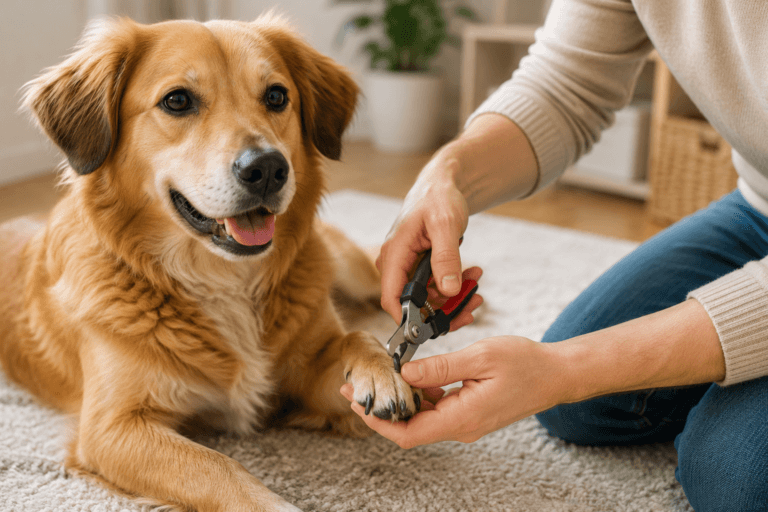
Step 2: Hold the paw gently
Support the paw without squeezing it.
Extend the nail so you can clearly see the portion you’re working on.
If fur is getting in the way, carefully move it aside before bringing the clipper toward the nail.
Step 3: Take small cuts
This is especially important with black nails.
Don’t make one giant cut because you want to “get it over with.”
A series of small, controlled cuts gives you more opportunities to stop before reaching the quick.
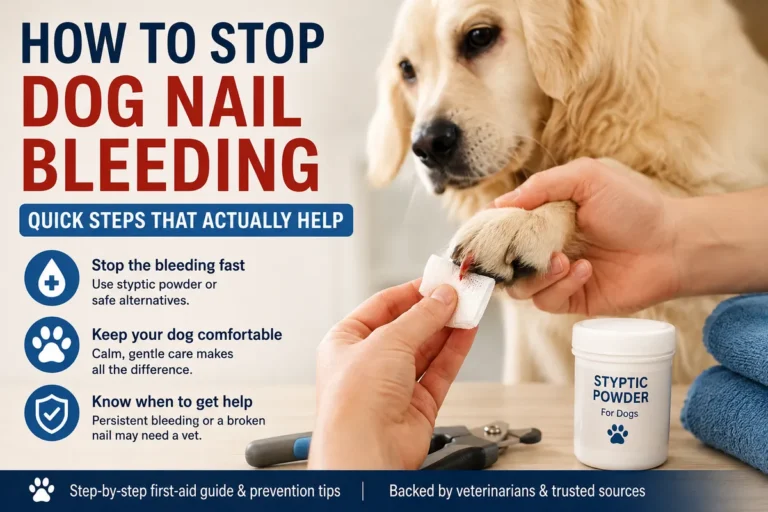
Step 4: Keep styptic powder nearby
Accidents happen.
AKC recommends having styptic or another appropriate clotting product available in case a nail is cut too short.
If you repeatedly struggle to trim your dog’s nails without causing stress or injury, professional help is a better option than forcing the process.
How Often Should You Trim Dog Nails?
There isn’t one perfect schedule for every dog.
AKC notes that many dogs need nail trims roughly every three to four weeks, but activity level and individual nail growth can change that schedule.
Dogs that spend a lot of time on hard surfaces may naturally wear their nails down more than dogs who spend most of their time indoors or on softer ground.
Instead of waiting for an exact date, watch the nails.
If you hear consistent clicking when your dog walks across a hard floor, it’s worth checking their nail length.
Our dog grooming schedule guide can help you build nail care into a broader grooming routine.
How We Chose the Clippers for This Guide
We did not claim to personally test every clipper listed online. That matters because a product review should not pretend to have hands-on experience that didn’t happen.
Instead, this guide weighs the factors that actually matter when choosing dog nail clippers:
- Dog size
- Nail thickness
- Clipper design
- Cutting control
- Handle comfort
- Visibility
- Safety features
- Suitability for black nails
- Ease of use
- Dog temperament
- Whether a grinder may be a better alternative
We also compared current veterinary and professional guidance with independent product evaluations. Consumer Reports’ published evaluation is particularly useful because its testers assessed four popular nail-clipping and grinding systems with a skittish dog and considered factors such as ease of use, cleanup, and noise.
That approach is more useful than simply picking whichever product has the highest star rating.
Common Mistakes to Avoid
Choosing a clipper that’s too small
A tiny clipper struggling against a thick nail isn’t a good combination.
Choosing the strongest clipper available
More cutting power means less margin for error if you don’t have good control.
Cutting too much at once
Small cuts are safer, especially with dark nails.
Ignoring your dog’s body language
Panting, pulling the paw away, repeatedly licking, or trying to escape can indicate that your dog needs a break. AKC recommends stopping and building positive associations rather than pushing through obvious stress.
Buying based only on price
An inexpensive clipper that fits your dog well can be more useful than an expensive model that feels awkward in your hand.
Assuming a safety guard makes mistakes impossible
It doesn’t. You still need proper technique.
Frequently Asked Questions
What are the best dog nail clippers for most dogs?
For many owners, a sharp, appropriately sized scissor/plier-style clipper is a practical choice because it offers good control and can handle a range of nail thicknesses. The best choice still depends on your dog’s size, nail thickness, and your comfort using the tool.
Are scissor or guillotine dog nail clippers better?
Neither is universally better. Scissor-style clippers are often a practical choice for medium and large dogs with thicker nails, while some owners prefer guillotine-style clippers for smaller nails. VCA notes that both styles can be effective.
What are the best dog nail clippers for black nails?
Choose a clipper that gives you good visibility and precise control. More importantly, remove only small amounts at a time because the quick is difficult to see through a dark nail.
Should I use dog nail clippers or a grinder?
Use whichever your dog tolerates and you can control safely. Clippers are generally quicker, while grinders remove nail gradually and can smooth the finished edge.
Can I cut my dog’s nails myself?
Yes, many owners can learn to trim their dog’s nails safely. If you’re inexperienced, ask your veterinarian or veterinary technician to demonstrate the technique. AKC specifically recommends getting a lesson if you’ve never trimmed a dog’s nails before.
How do I know when to stop cutting a dog’s nail?
Take small amounts and inspect the nail frequently, particularly with dark nails. Stop if you’re uncertain about where the quick is or if your dog becomes highly stressed.
What should I do if I cut the quick?
A cut quick can bleed and hurt. Keep an appropriate styptic product available and apply it according to its directions. If bleeding doesn’t stop or the injury appears significant, contact your veterinarian.
Are expensive dog nail clippers worth it?
Not necessarily. Build quality, blade sharpness, appropriate sizing, handle control, and your ability to use the clipper safely matter more than price alone.
The Bottom Line
The best dog nail clippers aren’t necessarily the ones with the longest feature list. They’re the ones that give you enough control to make clean, measured cuts on your dog’s particular nails.
For many dogs, that means a properly sized scissor/plier-style clipper. For thick nails, you may want more leverage. For nervous dogs or owners who are worried about cutting the quick, a grinder can be a useful alternative.
Start slowly, trim small amounts, keep your dog comfortable, and don’t be afraid to let a groomer or veterinary professional handle the job if either of you is struggling.
Good nail care isn’t about getting every nail perfectly trimmed in one session. It’s about creating a routine your dog can tolerate safely and consistently.