Dog Flea Shampoo: What Works, How to Use It Safely, and When It’s Not Enough
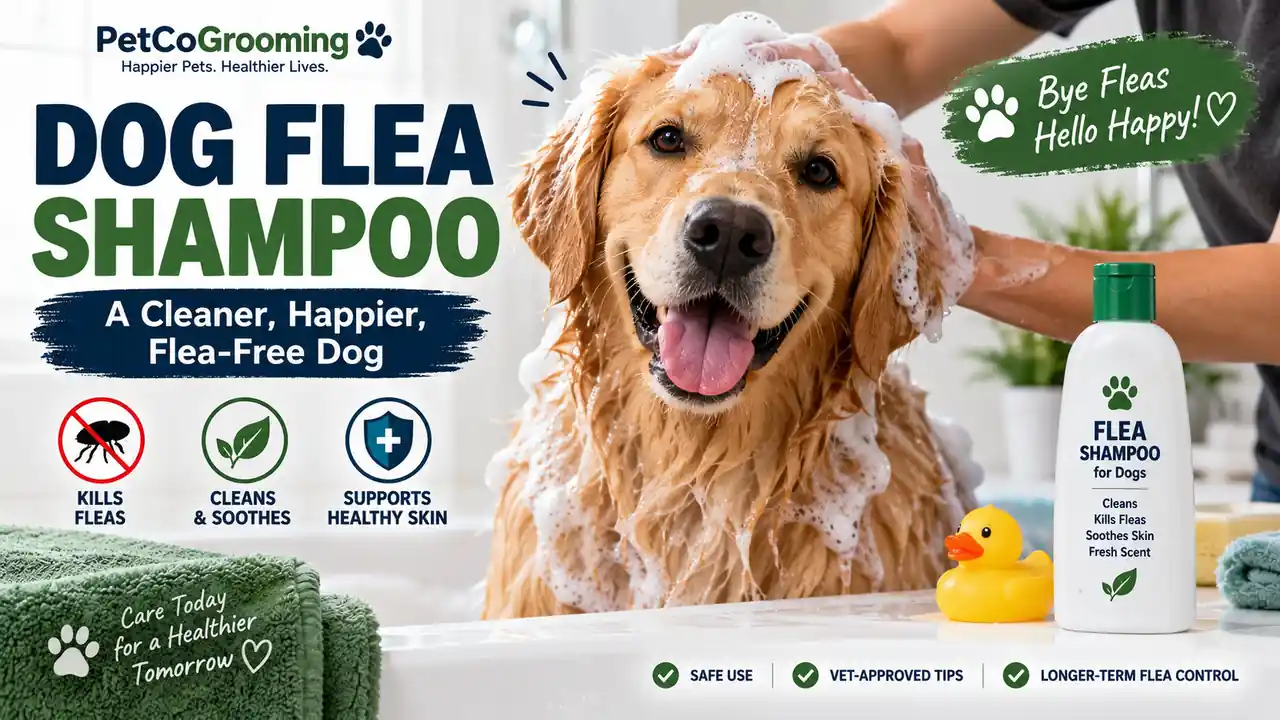
If you can see fleas on your dog, a flea shampoo can help remove or kill fleas that are on the coat during the bath—but it usually should not be treated as your dog’s entire flea-control plan. The right product depends on your dog’s age, weight, skin condition, and the exact active ingredients on the label. Long-term control also requires dealing with fleas in the home and using an appropriate preventive when recommended by your veterinarian.
Finding a flea crawling through your dog’s coat is one of those moments when you want a solution right now. A bath feels like the obvious answer, and sometimes it is a useful first step. The problem is that fleas are much harder to eliminate than the few adults you can see.
Here’s how to use dog flea shampoo intelligently—without expecting a single bath to solve an entire infestation.
What Does Dog Flea Shampoo Actually Do?
Dog flea shampoo is formulated to clean the coat while, depending on the product, killing or removing fleas and sometimes other external parasites.
The important word is depending.
Flea shampoos are not all made with the same active ingredients, and they do not all provide the same level or duration of flea control. The FDA lists shampoos alongside collars, sprays, powders, spot-on treatments, and oral products as different forms of flea and tick control. It also recommends choosing products according to the animal’s species, life stage, and weight and following the label exactly.
So don’t buy a bottle simply because the front says “flea shampoo.” Turn it around and read the label.
Look for:
- The minimum age
- The appropriate weight range
- Whether it is specifically labeled for dogs
- The active ingredients
- How long the shampoo should remain on the coat
- How frequently it can be used
- Fleas, ticks, or other parasites it is actually labeled to control
- Warnings for puppies, pregnant or nursing dogs, and dogs with health problems
That last part matters more than the marketing on the front of the bottle.
Does Flea Shampoo Kill Fleas Immediately?
Some flea shampoos are designed to kill fleas during bathing, but you should not assume that every flea shampoo instantly kills every flea or provides lasting protection after the bath.
This is one of the biggest misconceptions surrounding flea treatment.
Merck Veterinary Manual explains that flea-control products differ considerably in how quickly they kill fleas and how long they continue working. Some long-acting products may take hours to affect newly acquired fleas, while other products are designed for much faster action.
A shampoo has another limitation: the bath happens once, while your dog can continue encountering fleas afterward.
If fleas are already established in your house, new adults can emerge from environmental stages and jump back onto your dog.
That is why seeing a few fleas after treatment doesn’t automatically mean the shampoo “failed.”
Why Your Dog Can Still Have Fleas After a Bath
This is where flea biology gets frustrating.
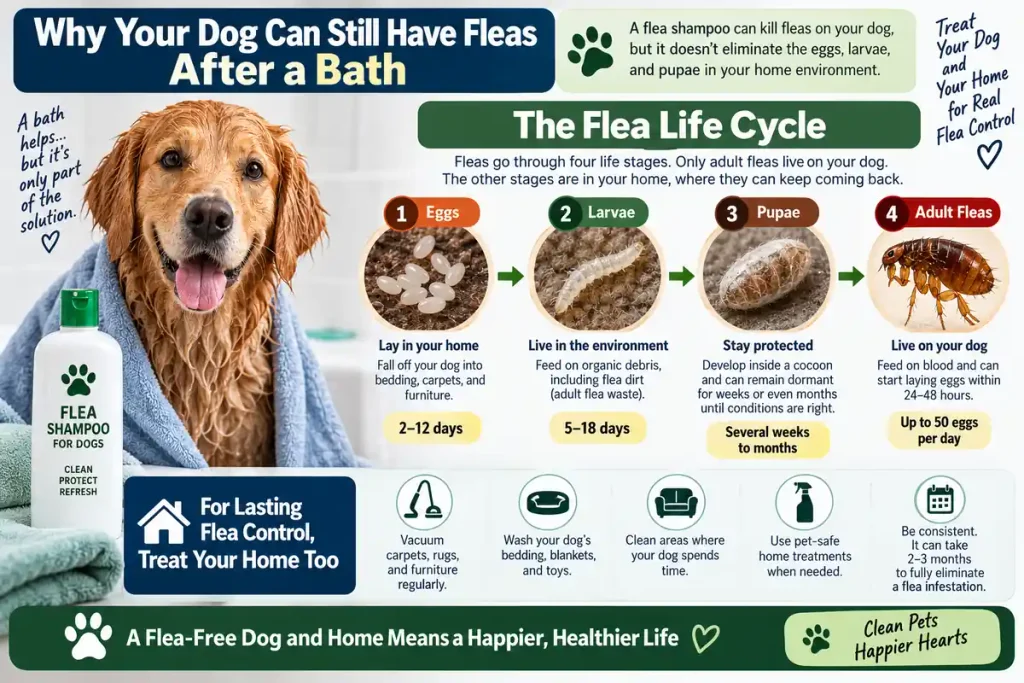
Fleas have four major life stages:
- Egg
- Larva
- Pupa
- Adult
Only the adult stage lives on your dog. The younger stages can be found in the environment.
CAPC notes that female fleas can begin producing eggs within roughly a day of their first blood meal and may produce dozens of eggs per day. Flea pupae can also remain protected inside cocoons for extended periods under unfavorable conditions.
So imagine this:
You bathe your dog Monday evening.
The adult fleas currently on the dog are reduced.
But flea eggs, larvae, and pupae are still hiding around the environment.
A few days later, another adult emerges.
Your dog picks it up.
Now it looks as though the shampoo “stopped working.”
In reality, the bath may have done exactly what it was designed to do—it just wasn’t capable of eliminating every stage of the infestation.
Merck Veterinary Manual says complete control of an established infestation commonly takes 2–3 months, largely because flea life stages already present in the environment continue to emerge.
How to Choose a Dog Flea Shampoo
Start With Your Dog, Not the Bottle
The best dog flea shampoo isn’t automatically the one with the longest ingredient list or the strongest-sounding marketing.
Start with your dog.
Consider:
- Age: Puppies have different safety requirements than adult dogs.
- Weight: Many pesticide products are labeled according to weight ranges.
- Skin condition: A dog with irritated, damaged, or allergy-prone skin may need a different approach.
- Health: Sick, elderly, pregnant, nursing, or medicated dogs may need veterinary guidance before using a flea product.
- Other pets: Especially important if cats live in the same home.
- Severity of infestation: A few fleas and a heavily infested household are very different problems.
The FDA specifically recommends consulting a veterinarian when selecting flea and tick products, particularly for weak, old, sick, medicated, pregnant, or nursing animals.
Read the Active Ingredients
Don’t judge a flea shampoo simply by words such as “natural,” “maximum strength,” or “medicated.”
The active ingredient tells you what the product is actually designed to do.
Some flea products use insecticides; others may contain insect growth regulators or different combinations of active ingredients. Merck lists several classes of flea-control compounds, including insect growth regulators and modern systemic products.
For a pesticide product, the label is the authority on how it should be used.
Never increase the amount because you think “more will work better.”
EPA specifically warns that using a flea or tick product incorrectly, using the wrong species product, or using an amount intended for a larger animal can unnecessarily expose a pet to pesticides.
Dog Flea Shampoo for Puppies: Be Extra Careful
Puppies are not simply small adult dogs.
Their age and weight can determine which flea products are appropriate.
The American Kennel Club notes that minimum ages vary substantially between flea-control products and recommends confirming the correct product based on a puppy’s current age and weight. It also reports veterinary guidance cautioning against relying on flea shampoos as a primary flea-control method.
If you have a very young puppy covered in fleas, don’t improvise with a strong pesticide shampoo.
A flea comb may be a safer temporary option for very young puppies who are too young for certain flea medications, while a veterinarian can help determine what treatment is appropriate.
How to Use Dog Flea Shampoo Safely
Once you’ve selected a product that is properly labeled for your dog, follow that product’s directions rather than copying instructions from another shampoo.
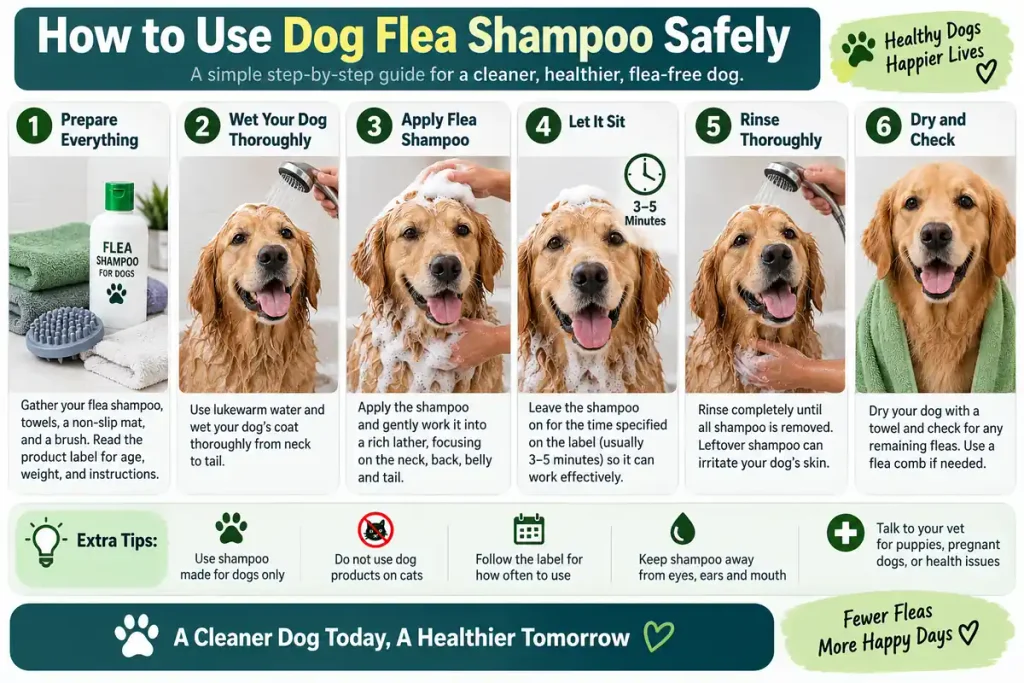
A sensible bath routine looks like this:
1. Read the Label Before the Bath
Check the age, weight, species, directions, warnings, and required contact time.
Don’t rely on memory from the last bottle you used.
The FDA specifically advises reading the label every time because directions and warnings can change.
2. Keep the Shampoo Away From the Eyes and Mouth
Work carefully around the face.
Don’t intentionally put pesticide shampoo into your dog’s eyes, nose, or mouth.
If facial treatment is necessary, follow the label directions or ask your veterinarian how to handle that area safely.
3. Follow the Required Contact Time
Some products need to remain on the coat for a specified period before rinsing.
Don’t rinse immediately if the label requires a longer contact time.
But don’t leave it on longer simply because you think extra time will kill more fleas.
4. Rinse Thoroughly
A thorough rinse is an important part of any dog bath.
The American Kennel Club’s veterinary guidance emphasizes that rinsing should not be rushed.
5. Watch Your Dog Afterward
Monitor your dog for unusual reactions, particularly when using the product for the first time.
The FDA lists possible adverse signs such as excessive salivation, vomiting, diarrhea, wobbliness, incoordination, depression, and seizures. If a dog reacts badly to a flea or tick product, the FDA recommends contacting a veterinarian promptly.
Flea Shampoo vs. Flea Preventive: What’s the Difference?
What Should I Do About My Dog’s Fleas?
Answer a few quick questions to understand what your next step may be. This guide is educational and does not replace veterinary advice.
How old is your dog?
Age can affect which flea-control products are appropriate.
How many fleas are you seeing?
Think about what you’ve noticed recently.
How does your dog’s skin look?
Choose the description that is closest to what you see.
Are there other pets in your home?
Other pets can be relevant when dealing with a household flea problem.
Have you already used flea treatment?
Tell us what you’ve already tried.
Your next step
If your dog has severe skin irritation, open or bleeding skin, unusual weakness, or a concerning reaction after using a flea product, contact your veterinarian promptly.
This distinction can save you a lot of frustration.
| Flea shampoo | Flea preventive |
| Used during bathing | Used on a recurring schedule |
| Can reduce fleas present during treatment | Designed for ongoing flea control |
| Works according to the product’s label | Duration varies by product |
| Does not automatically solve environmental infestation | Some products help prevent flea reproduction |
| Usually part of a larger strategy | Often the foundation of long-term control |
Modern flea control includes topical, oral, injectable, collar, and other formulations. Merck Veterinary Manual notes that long-acting products have significantly changed flea-control management compared with older approaches.
That doesn’t make flea shampoo useless.
It means you need to use the right tool for the right job.
A shampoo can be useful for a dog that needs a bath and immediate reduction of fleas on the coat. Long-term prevention is a separate problem.
You Also Need to Treat the Environment
If your dog has fleas, don’t focus only on the dog.
Vacuum carpets, rugs, furniture, cracks, and other areas where your dog spends time. Wash pet bedding regularly.
CAPC reports that only about 5% of an infestation consists of adult fleas on pets, with the remaining immature stages in the environment.
That’s why repeatedly bathing the dog without addressing the environment can turn into an exhausting cycle:
Fleas → bath → temporary relief → new fleas emerge → another bath.
The better approach is to interrupt the entire flea life cycle.
Cornell University’s College of Veterinary Medicine similarly recommends treating pets while addressing the indoor and outdoor environments where flea stages can persist.
Can You Use Flea Shampoo With Another Flea Product?
Don’t automatically combine flea products.
This is especially important when both products contain pesticides or overlapping active ingredients.
The FDA recommends talking with a veterinarian about flea-control products and telling them about other products your dog is already receiving.
And never assume that a product labeled for dogs is safe for cats.
EPA explicitly warns that dog flea products should never be applied to cats because some pesticides can be considerably more toxic to one species than another.
If you have both dogs and cats at home, check every product separately.
When Fleas Become a Veterinary Problem
Fleas aren’t just a cosmetic nuisance.
Some dogs develop flea allergy dermatitis, an allergic reaction to flea saliva. Merck Veterinary Manual identifies intense itching, skin lesions, hair loss, crusting, and secondary infections among possible signs.
Heavy infestations can also be particularly dangerous for puppies and other vulnerable dogs because significant blood loss can contribute to anemia.
Call your veterinarian if your dog has:
- Severe or nonstop scratching
- Significant hair loss
- Raw, bleeding, or infected skin
- Extensive scabbing
- Weakness or unusual tiredness
- Pale gums
- A very young puppy with many fleas
- A severe infestation that keeps returning
- A reaction after using a flea product
Don’t keep switching shampoos when the real problem may be flea allergy dermatitis, a secondary infection, or an infestation that requires a broader treatment plan.
Is Dog Flea Shampoo Worth Using?
Yes, but think of it as one tool—not the whole toolbox.
A properly labeled dog flea shampoo can be useful for reducing fleas during a bath, cleaning the coat, and providing immediate relief from having live parasites crawling through the fur.
But it has a major limitation: the bath only addresses what you’re treating at that moment.
For lasting control, your plan may need to include:
- An appropriate flea-control product for your dog
- Treatment of every susceptible pet in the household
- Regular vacuuming
- Washing bedding
- Environmental control when necessary
- Ongoing prevention recommended for your dog’s situation
Merck notes that eliminating an established infestation can take months, while CAPC emphasizes consistent flea control and environmental management.
That’s the part many quick “flea shampoo” articles leave out.
Frequently Asked Questions
How often can I use dog flea shampoo?
Use it only as frequently as the specific product label permits. Some flea shampoos are not intended for frequent bathing, and using a pesticide product more often than directed can increase exposure without improving control.
Does dog flea shampoo kill flea eggs?
That depends on the specific product and its active ingredients. Don’t assume that killing adult fleas means the product controls every flea life stage. Flea eggs, larvae, and pupae can remain in the environment.
Can I use human shampoo instead of flea shampoo?
Human shampoo isn’t a substitute for a properly labeled flea-control product. Dogs have different skin requirements, and the appropriate product should be selected for canine use.
Can I use dog flea shampoo on my cat?
No—not unless the product is specifically labeled for cats as well. EPA warns that dog flea products can contain pesticides that are more toxic to cats.
Why does my dog still have fleas after a flea bath?
The most common explanation is that fleas are continuing to emerge from the environment. A bath may reduce fleas on the dog without eliminating eggs, larvae, and pupae around the home.
What’s the best flea treatment for a dog?
There isn’t one universal product that is best for every dog. Age, weight, health, lifestyle, flea exposure, and other medications all matter. Your veterinarian can help choose an appropriate long-term flea-control product.
The Bottom Line
Dog flea shampoo can be useful when you need to deal with fleas on your dog’s coat, but a flea bath shouldn’t be mistaken for complete flea control. The strongest approach combines a properly labeled product with ongoing prevention and environmental control when needed.
If fleas keep coming back after bathing, don’t simply keep adding more baths. Look at the bigger picture: your dog, your other pets, your home, and the flea life cycle.
That shift—from treating the fleas you can see to controlling the infestation you can’t see—is what turns a temporary cleanup into a real flea-control plan.