Cat Groomer: What They Do, When You Need One & How to Choose

Finding a good cat groomer can make a big difference when your cat’s coat becomes difficult to manage, nails need trimming, or grooming at home turns into a stressful battle.
Unlike dogs, many cats handle much of their own basic grooming. But that doesn’t mean every cat can—or should—be groomed entirely at home. Long-haired cats can develop mats, older or overweight cats may have difficulty reaching certain areas, and some cats simply won’t cooperate with brushing, nail trimming, or bathing.
A professional cat groomer can help with routine coat care and grooming tasks while reducing the risk of accidental cuts or stressful handling. The key is knowing when professional grooming is appropriate and how to choose someone who is genuinely comfortable working with cats.
What Does a Cat Groomer Do?
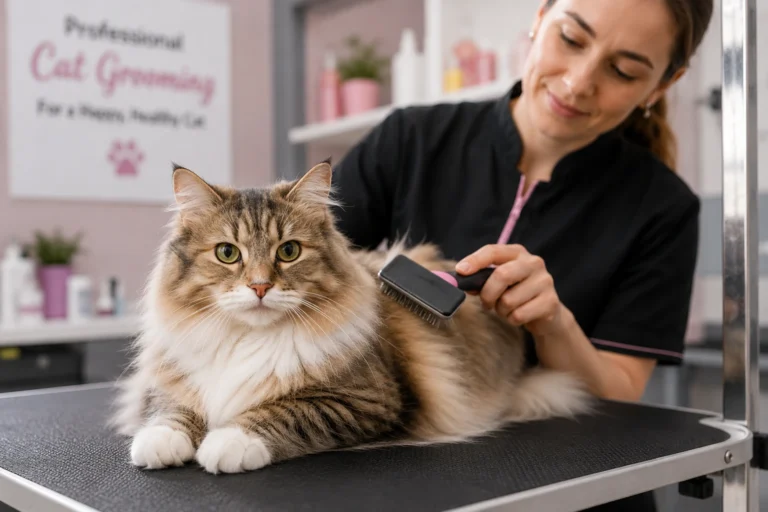
A cat groomer is a professional who provides grooming and coat-care services specifically for cats.
Depending on the groomer’s training, facilities, and services offered, a grooming appointment may include:
- Brushing and combing
- Removing loose hair
- De-shedding
- Removing minor or moderate tangles
- Mat removal
- Nail trimming
- Bathing
- Drying
- Coat trimming
- Sanitary-area grooming
- Basic coat and skin observation
The exact services vary between groomers, so it’s important to ask what is included before booking.
Professional grooming isn’t only about making a cat look neat. Regular grooming can also help owners notice changes in the skin and coat. The ASPCA notes that grooming can reveal issues such as hair loss, redness, bumps, wounds, fleas, ticks, or other abnormalities that may otherwise be hidden beneath fur.
However, a groomer is not a substitute for a veterinarian. A groomer can identify something unusual during grooming, but diagnosing or treating an underlying medical problem is a veterinary job.
Does Every Cat Need a Professional Groomer?
No. Many healthy cats can handle most routine grooming with regular care at home.
Cats are naturally effective self-groomers, and healthy adult cats often don’t need regular baths. VCA notes that bathing needs vary depending on factors such as age, lifestyle, and health, with many healthy adult cats rarely requiring a bath.
A professional groomer becomes more useful when the cat’s grooming needs exceed what the owner can safely manage.
For example, professional help may be worthwhile if your cat:
- Has a long or dense coat
- Develops recurring tangles or mats
- Strongly resists nail trimming
- Becomes extremely stressed during grooming
- Needs a bath that you cannot safely perform
- Has difficulty grooming because of age or mobility limitations
- Has a coat that has become difficult to maintain
- Requires a professional haircut or trim
The important distinction is that routine grooming and medical treatment are not the same thing.
When Should You Take Your Cat to a Groomer?
Does Your Cat Need a Professional Groomer?
Answer a few quick questions for a practical grooming recommendation.
What kind of coat does your cat have?
How often does your cat develop tangles or mats?
How does your cat react to grooming at home?
How difficult is nail trimming?
How old is your cat?
Do you notice any skin or coat warning signs?
If your cat has open wounds, significant redness, unexplained hair loss, pain, swelling, or severe skin irritation, a veterinarian may be more appropriate than a routine grooming appointment.
1. Your Cat Has Persistent Mats
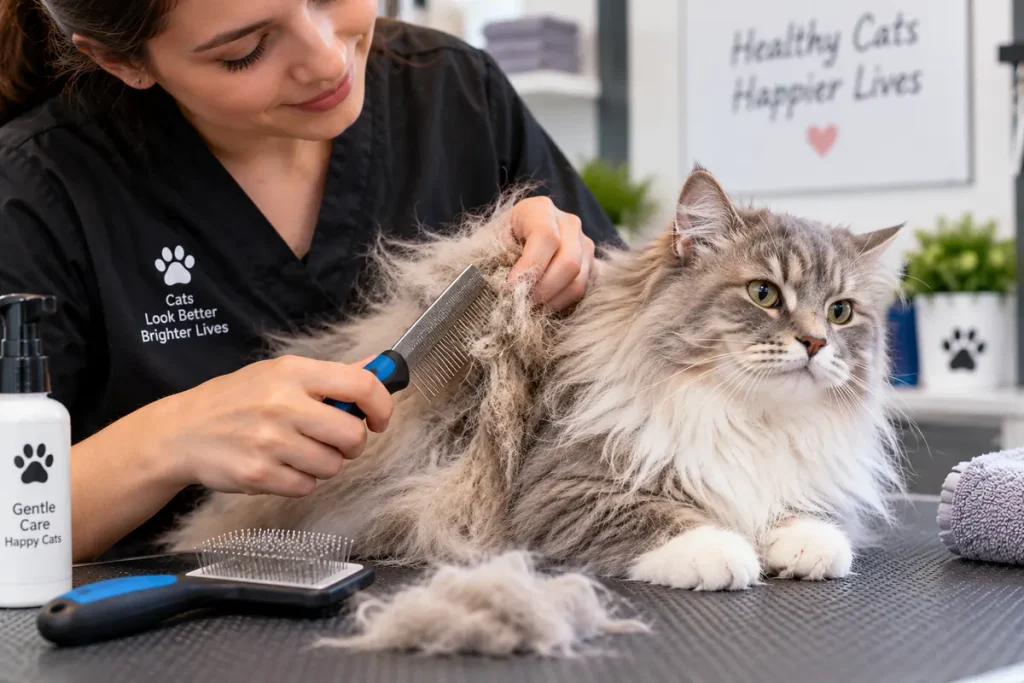
Mats are one of the clearest reasons to consider professional grooming.
A small, loose tangle may sometimes be gently worked out with an appropriate comb. But larger or tighter mats can pull on the skin and become painful.
VCA recommends professional care when tangles are severe or extensive. It also warns that removing mats requires particular care because a cat’s skin can be accidentally injured.
Never assume a tight mat is simply a ball of hair sitting safely above the skin.
Cat skin can be surprisingly close to the mat, making scissors particularly dangerous.
The ASPCA specifically advises against cutting mats out with scissors because an unexpected movement can cause a serious laceration or puncture.
If your cat has extensive matting, a professional groomer or veterinarian is the safer choice.
2. Your Cat Cannot Maintain Its Coat
Some cats gradually become less effective at grooming themselves.
Age, weight, mobility limitations, or health problems can make certain areas difficult to reach. VCA specifically notes that arthritic or overweight cats may occasionally need bathing because they have difficulty grooming themselves.
In these situations, grooming isn’t simply cosmetic.
The goal is to help keep the coat manageable and prevent problems from developing.
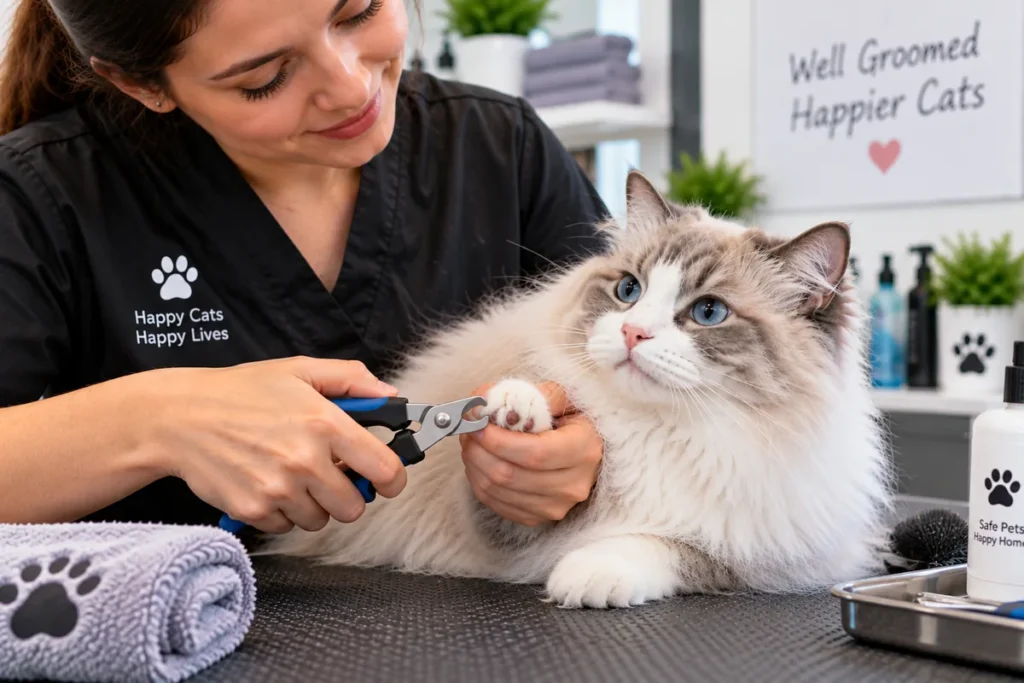
3. Nail Trimming Has Become a Battle
Some cats tolerate nail trimming surprisingly well.
Others see the nail clippers and immediately disappear.
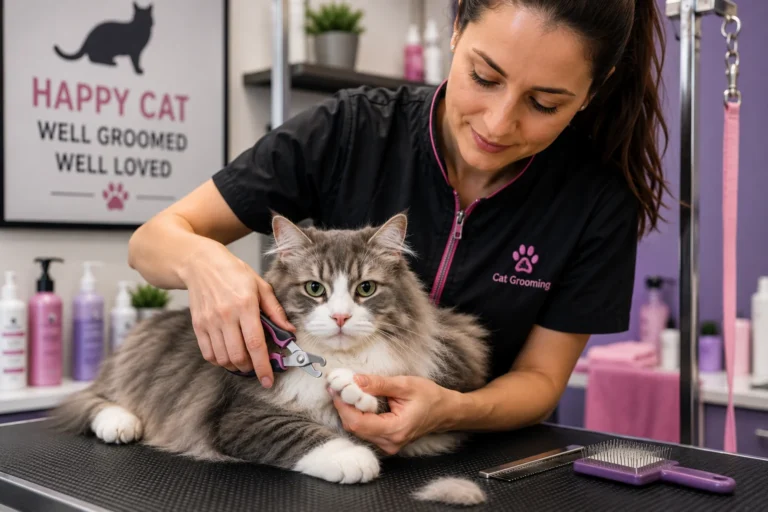
If your cat becomes highly resistant, forcing the process can increase stress and create a greater risk of accidental injury. The ASPCA recommends asking a veterinarian or groomer for help if a cat refuses to have its claws trimmed.
Professional nail trimming can therefore be useful even when the cat doesn’t need a full grooming appointment.
4. Your Cat Needs a Bath
Most cats don’t need frequent baths.
When bathing is genuinely necessary, however, it can be difficult to do safely at home—especially with a cat that strongly dislikes water.
VCA notes that many people choose a professional groomer for bathing because cats may not tolerate the experience well.
If your cat needs repeated bathing because of a skin condition, allergies, or another medical issue, talk with your veterinarian about the underlying reason and appropriate products rather than simply increasing bath frequency.
5. You Want a Professional Coat Trim
Long-haired cats sometimes need coat maintenance beyond ordinary brushing.
A professional can trim the coat while working around sensitive areas and maintaining appropriate coverage.
However, don’t assume a cat needs to be shaved simply because summer arrives. A cat’s coat provides insulation and protection, and shaving down to the skin can create unnecessary problems. The ASPCA recommends allowing a professional groomer to perform haircutting when it is appropriate and warns against shaving down to the skin or cutting the coat yourself with scissors.
Cat Groomer vs. Veterinarian: Who Should You Call?
This is an important distinction.
A cat groomer is generally appropriate for:
- Brushing
- De-shedding
- Routine coat maintenance
- Nail trims
- Routine bathing
- Coat trimming
- Mat removal when the groomer can safely manage it
A veterinarian is appropriate for:
- Open wounds
- Significant skin irritation
- Unexplained hair loss
- Bald patches
- Suspected infection
- Persistent itching
- Pain
- Significant changes in the skin or coat
- Medical conditions affecting grooming
For example, excessive hair loss isn’t necessarily a grooming problem. The ASPCA notes that allergies, infections, parasites, stress, hormonal problems, medications, and other health issues can contribute to abnormal hair loss.
So if your cat’s coat problem appears to have a medical cause, see the veterinarian first.
How to Choose a Good Cat Groomer
Not every groomer who works with dogs is equally experienced with cats.
Before booking, ask a few direct questions.
Ask: “Do you regularly groom cats?”
This is more useful than simply asking whether they accept cats.
A groomer who regularly works with cats is more likely to understand feline behavior, handling, coat types, and the differences between grooming a cat and grooming a dog.
Ask what services are included
Find out whether the appointment includes:
- Bathing
- Drying
- Brushing
- De-shedding
- Nail trimming
- Mat removal
- Hair trimming
- Sanitary trimming
Don’t assume every groomer offers every service.
Ask how they handle nervous cats
This is especially important if your cat becomes frightened during grooming.
A good conversation should give you a clear understanding of how the groomer approaches an anxious or resistant cat.
You want a professional who prioritizes safe handling rather than simply forcing the grooming session to continue.
Ask how severe mats are handled
If your cat is already matted, explain the condition of the coat before making an appointment.
A groomer may need to determine whether the mats can be safely removed during a normal grooming appointment or whether veterinary involvement is more appropriate.
Ask about veterinary referrals
A responsible groomer should recognize when a grooming issue may actually be a medical problem.
That matters because grooming can reveal abnormalities that aren’t always obvious to an owner.
The ASPCA recommends researching groomers carefully and suggests seeking referrals from veterinarians, friends, or relatives.
How Often Should a Cat See a Groomer?
There isn’t one grooming schedule that works for every cat.
The appropriate frequency depends on:
- Coat length
- Coat density
- Shedding
- Matting tendency
- Age
- Lifestyle
- Ability to self-groom
- Health
- How much grooming the owner can comfortably maintain at home
A short-haired, healthy cat that maintains its coat well may need little professional grooming.
A long-haired cat that develops tangles easily may benefit from more frequent professional maintenance.
The better approach is to establish a home-grooming routine and use professional grooming when your cat’s needs exceed what you can safely manage.
What Should You Do Between Professional Grooming Appointments?
Professional grooming works best when it is supported by simple maintenance at home.
Brush regularly
Regular brushing can reduce loose hair and help prevent tangles from becoming larger mats.
For long-haired cats, regular brushing is particularly important. ASPCA guidance recommends frequent brushing for cats that need it, while VCA emphasizes choosing a brush or comb appropriate to the coat type.
Check the coat while brushing
Don’t just move the brush through the fur.
Look at the skin and coat as you go.
Watch for:
- New mats
- Redness
- Bald areas
- Lumps or bumps
- Fleas or flea dirt
- Wounds
- Unusual irritation
If something looks abnormal, don’t automatically assume another grooming session will solve it.
Keep nail care on the radar
If your cat tolerates nail handling, routine trimming can be done at home.
If your cat consistently refuses, professional help may be easier and safer.
Don’t wait until the coat is severely matted
This is one of the biggest mistakes owners can make.
A small tangle can become a much more difficult grooming problem if it is ignored.
Should You Groom a Matted Cat at Home?
It depends on how severe the matting is—but tight or extensive mats should not be treated as a simple DIY haircut.
Never use scissors to cut a mat close to your cat’s skin.
A cat can suddenly move, and the mat may be much closer to the skin than it appears.
For extensive matting, professional grooming or veterinary care is safer. VCA specifically recommends professional care for severe or extensive tangles, while ASPCA warns against using scissors on mats.
If the skin underneath a mat is irritated, wounded, or otherwise abnormal, a veterinarian should evaluate it.
What About Cats That Hate Grooming?
This is where choosing the right professional matters most.
A cat that is frightened doesn’t necessarily need to be “toughened up.” The grooming process itself may need to be adjusted.
At home, you can gradually make grooming more familiar by:
- Starting with very short sessions.
- Letting your cat investigate the brush.
- Rewarding calm behavior.
- Handling paws gently before attempting nail trimming.
- Stopping before the cat becomes highly agitated.
- Repeating the process consistently.
The ASPCA similarly recommends introducing nail handling gradually and avoiding grooming when the cat is agitated.
A professional cat groomer should also understand that feline behavior can change the pace of an appointment.
A Simple Cat Groomer Checklist
Before booking, use this quick checklist:
☐ Does the groomer regularly work with cats?
☐ Do they offer the specific service your cat needs?
☐ Can they explain how they handle nervous cats?
☐ Do they have experience with long-haired or matted cats if applicable?
☐ Will they tell you when a veterinary evaluation is more appropriate?
☐ Can they clearly explain what is included in the appointment?
☐ Have you checked reviews or received a trusted referral?
☐ Have you explained your cat’s coat condition and temperament before booking?
If most of these answers are yes, you’re starting from a much stronger position.
Frequently Asked Questions
How much does a cat groomer cost?
Cat grooming prices vary by location, coat condition, services required, and the individual grooming business. A simple nail trim will generally be a different service from a full bath, de-shedding session, haircut, or severe mat-removal appointment.
Ask the groomer for a quote based on your cat’s actual grooming needs rather than relying on a generic online price.
Do cats need professional grooming?
Not necessarily. Many healthy cats can handle routine grooming at home. Professional grooming becomes particularly useful when a cat has persistent mats, needs a difficult bath or trim, resists nail care, or cannot adequately maintain its coat.
Can a groomer remove mats from a cat?
A professional groomer can often remove mats safely, but severe matting may require veterinary assessment. Extensive mats can be painful and can hide irritated or damaged skin.
How often should a cat be groomed?
There is no universal schedule. Coat length, density, shedding, age, health, lifestyle, and the cat’s ability to groom itself all matter. Long-haired cats generally need more regular coat maintenance than cats with short coats.
Can a cat groomer bathe my cat?
Yes, many professional groomers offer cat bathing. However, healthy adult cats often don’t need frequent baths. If your cat requires repeated bathing because of a medical or skin issue, ask your veterinarian about the appropriate routine.
Should I take a matted cat to a groomer or vet?
For mild grooming-related matting, a qualified cat groomer may be appropriate. If the matting is severe, extensive, painful, or associated with irritated or damaged skin, veterinary care may be the better starting point.
Can a groomer trim my cat’s nails?
Yes. Nail trimming is a common grooming service. If your cat strongly resists nail trimming, professional help can be safer than repeatedly forcing the process at home.
Is a cat groomer better than grooming my cat myself?
Neither is automatically better. Routine brushing and basic maintenance can often be handled at home, while professional grooming becomes valuable for difficult coats, mats, bathing, nail care, or cats that are difficult to groom safely.
Conclusion
A good cat groomer is not simply someone who makes a cat look cleaner.
The right professional can help maintain the coat, manage difficult grooming tasks, safely address certain mats, trim nails, and recognize when something may need veterinary attention.
But professional grooming doesn’t replace everyday care.
For most cats, the best approach is a combination of appropriate home grooming, regular coat checks, and professional help when the job becomes difficult or unsafe to manage yourself.
If your cat has severe matting, damaged skin, unexplained hair loss, persistent itching, or another potentially medical problem, don’t treat the issue as a simple grooming appointment. Get veterinary guidance.
The goal isn’t to groom your cat as often as possible.
The goal is to keep your cat’s coat, skin, nails, and grooming routine manageable without unnecessary stress or risk.