Siamese Cat Grooming: Complete Guide to Brushing, Bathing & Coat Care
Siamese cat grooming is relatively simple because Siamese cats have a short, fine, glossy coat that lies close to the body and generally needs only light, regular maintenance. For most Siamese cats, weekly brushing or combing is enough to remove loose hair, while routine nail, ear, eye, and dental care should be handled separately as part of their overall grooming routine.
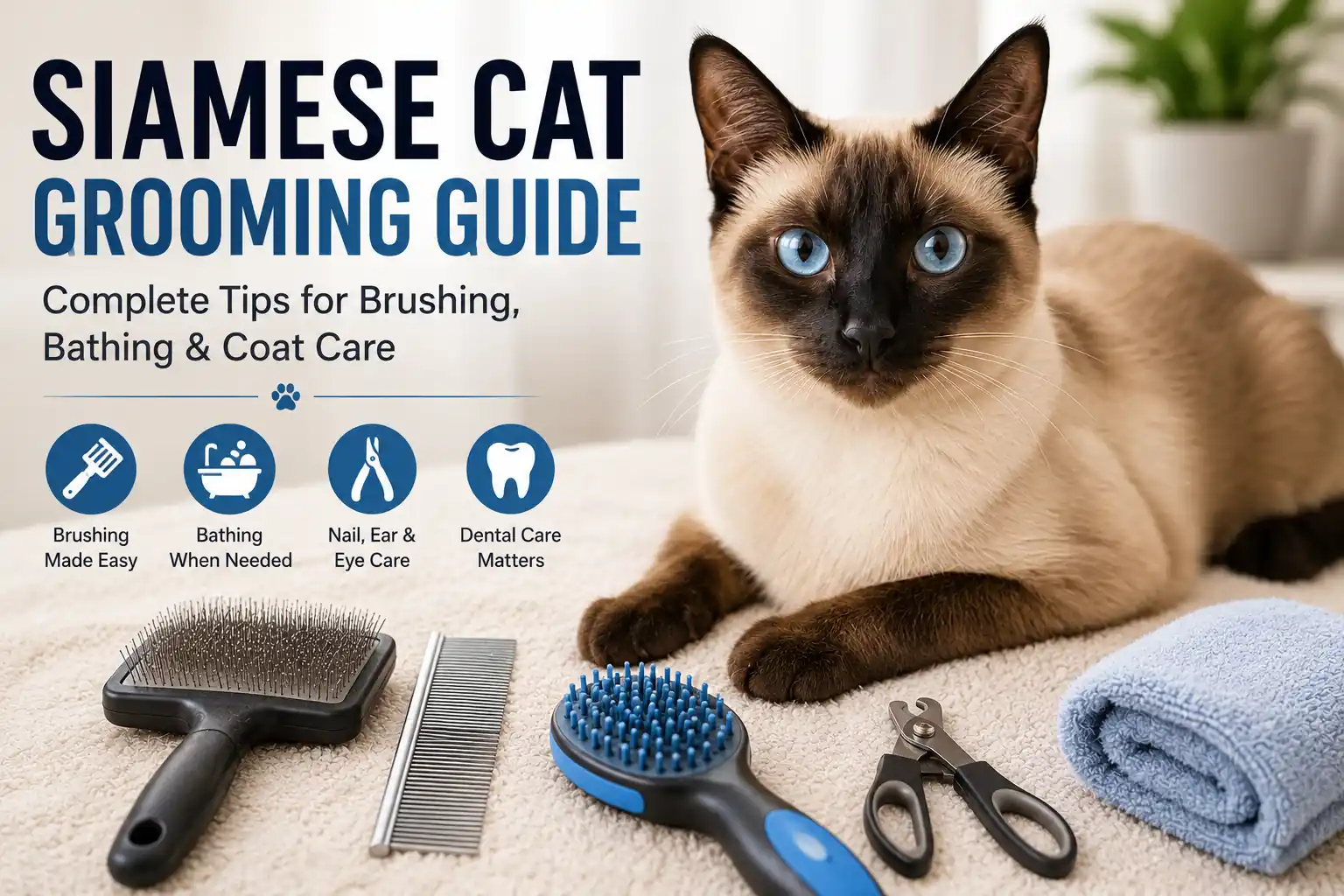
The good news for Siamese cat owners is that you don’t need an elaborate grooming routine to keep this breed looking sleek and healthy. Siamese cats are naturally attentive to their own cleanliness, and their short coat is considerably easier to maintain than the long, dense coat of breeds such as Ragdolls or Persians.
Still, Siamese cat grooming shouldn’t mean doing nothing. A few minutes of regular coat care gives you an opportunity to remove dead hair, check the skin, inspect sensitive areas, and make grooming a normal part of your cat’s routine.
Do Siamese Cats Need Grooming?
Yes, but they generally need less grooming than long-haired cats.
The Siamese has a short, fine-textured coat that lies close to the body. TICA describes the coat as very short, glossy, sleek, and fine, while the Cat Fanciers’ Association classifies the Siamese as a shorthair breed.
That means most healthy Siamese cats don’t need complicated haircuts, frequent professional grooming, or daily full-body brushing.
Instead, focus on:
- Removing loose or dead hair
- Checking the skin and coat
- Keeping nails trimmed
- Monitoring ears and eyes
- Maintaining dental hygiene
- Bathing only when genuinely necessary
- Watching for changes in normal grooming behavior
For a healthy adult Siamese, consistency matters more than an elaborate grooming setup.
How Often Should You Groom a Siamese Cat?
For coat care, once a week is a practical starting point for most Siamese cats.
TICA says Siamese cats can enjoy being combed weekly with a stainless-steel comb. VCA similarly notes that a quick weekly comb is generally sufficient for the Siamese coat.
Some cats may benefit from more frequent brushing during periods of increased shedding, while others may need only brief weekly sessions.
A simple routine could look like this:
Weekly:
Brush or comb the coat and inspect the skin.
Every few weeks:
Check nail length and trim as needed.
Regularly:
Inspect ears, eyes, teeth, and gums.
As needed:
Bathe the cat if the coat becomes unusually dirty or your veterinarian recommends it.
The goal isn’t to groom your Siamese for a specific number of minutes. The goal is to keep the cat comfortable and the coat in good condition.
What Is the Best Brush for a Siamese Cat?
Because Siamese cats have short, fine coats, you don’t need a heavy-duty long-hair grooming tool.
A soft rubber grooming brush, gentle brush, or stainless-steel comb can work well.
TICA specifically says Siamese cats can be combed weekly with a stainless-steel comb, while CFA notes that even your hands can be used to remove dead hair; a rubber brush is another option.
Best options
Stainless-steel comb:
Useful for gently removing loose hair and checking the coat.
Soft rubber brush:
A comfortable option for collecting loose hair.
Soft-bristle brush:
Can provide a gentle finishing pass.
Your hands:
CFA specifically notes that wet hands can be used to stroke the coat and remove dead hair.
You don’t need to buy the most aggressive deshedding tool available.
For a Siamese, gentle and consistent is usually better than aggressive hair removal.
How to Brush a Siamese Cat
Brushing a Siamese should be quick, gentle, and positive.
Step 1: Choose a calm time
Don’t start grooming when your cat is excited, hiding, or trying to play.
Pick a relaxed moment when your Siamese is comfortable.
Step 2: Let your cat inspect the brush
If your cat isn’t accustomed to grooming, allow it to sniff the tool first.
This can make the process feel less unfamiliar.
Step 3: Start along the back
Use gentle strokes in the direction of the coat.
Avoid pressing hard.
Step 4: Move toward the sides
Continue slowly around the body, watching your cat’s reaction.
Step 5: Check sensitive areas
Pay attention around the:
- Neck
- Chest
- Behind the front legs
- Abdomen
- Base of the tail
Step 6: Finish positively
Give your cat praise, affection, or a reward if appropriate.
The objective is to create a grooming routine your Siamese doesn’t dread.
Do Siamese Cats Shed?
Yes. Siamese cats do shed, even though their short coat can make shedding less noticeable than it is with long-haired breeds.
CFA specifically notes that Siamese cats shed and that regular grooming helps control the amount of shedding.
You may notice loose hair:
- On furniture
- On bedding
- On clothing
- During brushing
- During seasonal changes
Regular grooming helps collect some of that loose hair before it ends up around your home or gets swallowed during self-grooming.
However, a sudden major increase in shedding shouldn’t automatically be treated as normal grooming behavior. If you notice significant coat changes, bald areas, skin irritation, or other symptoms, speak with your veterinarian.

How to Reduce Siamese Cat Shedding
You can’t completely stop a healthy cat from shedding.
Instead, focus on managing it.
Brush regularly
A short weekly grooming session can remove loose hair before it falls around your home.
Avoid aggressive brushing
More brushing doesn’t necessarily mean less shedding.
Overly forceful brushing can irritate the skin.
Maintain overall health
Coat quality is influenced by overall health, nutrition, and skin condition.
Monitor changes
If shedding suddenly becomes much heavier or occurs alongside itching, licking, bald patches, redness, or skin changes, veterinary evaluation may be appropriate.
For a broader grooming routine, you can also connect this article naturally with our cat grooming tools content as part of your regular home-care setup.
Do Siamese Cats Need Baths?
Usually, no—not as a routine requirement.
Siamese cats are generally excellent self-groomers, and their short coat is easy to keep clean.
VCA says Siamese cats rarely need bathing, while CFA says a Siamese generally should not require bathing unless the cat is being shown.
A bath may become appropriate when:
- The cat gets unusually dirty
- Something sticky gets onto the coat
- The cat cannot clean a particular area
- A veterinarian recommends bathing for a skin condition
- A professional groomer recommends it for a specific reason
Don’t bathe your Siamese simply because you think every cat needs a regular bath.
How to Bathe a Siamese Cat Safely
If your Siamese genuinely needs a bath, preparation makes a huge difference.
Before the bath
Have everything ready:
- Cat-specific shampoo
- Towels
- A secure bathing area
- Lukewarm water
- A non-slip surface
- A calm environment
Never improvise with human shampoo. Cats have different skin needs, so use a product specifically intended for cats unless your veterinarian recommends something else.
During the bath
Keep the water comfortably lukewarm.
Avoid spraying water directly into the face.
Keep the session as calm and efficient as possible.
After the bath
Rinse thoroughly so no shampoo residue remains.
Towel dry gently and keep your cat somewhere warm and comfortable while the coat dries.
If your Siamese becomes extremely distressed during bathing, don’t turn grooming into a struggle. A professional cat groomer or veterinarian may be a better option for difficult situations.
Should You Shave a Siamese Cat?
Generally, there is no routine reason to shave a healthy Siamese cat.
The Siamese already has a naturally short coat, so shaving normally provides little grooming benefit.
If the coat has an unusual problem, severe contamination, or a medical reason requiring clipping, let a veterinarian or experienced cat groomer determine what should be done.
Never shave your cat simply because it seems hot.
A cat’s coat is part of its normal skin covering, and unnecessary clipping can create additional stress without solving an actual grooming problem.
Siamese Cat Nail Care
Coat grooming is only one part of the picture.
Nail care should also be part of your Siamese’s routine.
TICA recommends regular nail trimming and notes that the sharp tip can be clipped carefully while avoiding the quick—the sensitive area containing blood vessels and nerves.
If you’re new to trimming cat nails:
- Choose a calm time.
- Handle the paws gently.
- Press the paw pad lightly to extend the claw.
- Identify the quick.
- Remove only the sharp tip.
- Reward calm behavior.
Don’t try to cut deeply into the nail.
If your cat strongly resists nail trimming, ask a veterinarian or professional groomer to demonstrate the correct technique.
Siamese Cat Ear Care
Siamese cats have large, prominent ears, so they’re easy to inspect.
You don’t need to constantly clean healthy ears.
Instead, regularly look for changes such as:
- Excessive wax
- Unusual discharge
- Redness
- Swelling
- Bad odor
- Persistent scratching
- Frequent head shaking
If you notice these signs, don’t assume the problem is simply dirty ears.
Ear problems can have different causes and may require veterinary treatment.
Avoid putting household liquids or cotton swabs deep into the ear canal.
Siamese Cat Eye Care
The Siamese is known for its striking blue eyes, so eye changes can be noticeable.
During routine grooming, check for:
- Excessive tearing
- Crusting
- Redness
- Swelling
- Cloudiness
- Squinting
- A sudden change in appearance
A tiny amount of normal eye discharge can happen, but persistent or unusual discharge deserves attention.
If your cat is squinting or appears painful, contact a veterinarian rather than trying to solve the issue through grooming.
Dental Care Is Part of Grooming Too
A clean coat doesn’t tell you everything about a cat’s health.
Dental care should be included in your overall routine.
TICA’s current cat-grooming guidance recommends regular dental care, including brushing with a cat-specific toothbrush and pet-safe toothpaste.
If your Siamese isn’t used to tooth brushing, don’t expect to start with a full brushing session immediately.
Introduce it gradually:
- Let your cat smell the toothbrush.
- Introduce a tiny amount of cat-safe toothpaste.
- Touch the teeth gently.
- Gradually increase the duration.
- Keep sessions positive.
Never use human toothpaste unless your veterinarian specifically tells you otherwise.
Can Siamese Cats Groom Themselves?
Yes.
Siamese cats are generally very attentive to their own grooming.
Their short coat is also relatively easy for them to maintain.
But self-grooming doesn’t eliminate the need for human assistance.
Regular brushing can remove loose hair before your cat swallows it, and grooming sessions allow you to inspect the skin and coat for changes.
TICA’s general grooming guidance explains that cats naturally groom themselves but can still benefit from human assistance with coat maintenance.
Think of human grooming as supporting your cat’s natural routine, not replacing it.
Is Excessive Grooming Normal for a Siamese Cat?
This is an important distinction.
Normal grooming is expected.
Excessive grooming is different.
If your Siamese suddenly starts licking or chewing one area repeatedly, creates bald patches, develops irritated skin, or spends dramatically more time grooming than usual, don’t simply brush the cat more often.
VCA notes that Siamese cats can show anxiety-related overgrooming, potentially leading to psychogenic alopecia.
Overgrooming can have multiple possible causes, including behavioral and medical issues.
If the behavior is persistent or accompanied by hair loss or skin changes, talk with your veterinarian.
Siamese Cat Grooming for Kittens
The best time to establish a grooming routine is early.
A Siamese kitten doesn’t need long grooming sessions.
Instead, teach the kitten that:
- Hands touching paws are normal.
- A brush isn’t threatening.
- Ears can be gently inspected.
- Nail handling is part of life.
- Short grooming sessions end positively.
Start with very brief sessions and increase them gradually.
This can make future nail trimming, brushing, and veterinary handling considerably easier.
The goal isn’t to produce a perfectly groomed kitten.
The goal is to create a cat that is comfortable being handled.
What About Siamese Cats That Hate Brushing?
Some cats simply don’t enjoy being brushed.
Don’t assume that resisting the brush means you need a stronger brush.
Try changing the experience first.
Use shorter sessions
Two calm minutes may be better than fifteen stressful minutes.
Change the tool
A soft rubber brush may be more comfortable than a metal tool for some cats.
Change the location
Try grooming in a quiet area where your cat already feels safe.
Reward cooperation
Praise or reward your cat after calm behavior.
Don’t force it
If your Siamese becomes highly distressed, stop and try again later.
The long-term goal is cooperation, not winning a wrestling match.
Simple Siamese Cat Grooming Routine
Here’s a practical routine most owners can follow.
| Grooming task | Practical frequency |
|---|---|
| Coat brushing/combing | About weekly |
| Skin and coat check | During grooming and periodically |
| Nail inspection | Regularly; trim as needed |
| Ear inspection | Regularly |
| Eye check | During routine handling |
| Dental care | Regularly |
| Bath | Only when needed |
| Professional grooming | Usually unnecessary for routine coat care |
The exact schedule should be adjusted to your individual cat.
A Siamese with an unusually oily coat, skin condition, mobility problem, or another health issue may need a different grooming plan.
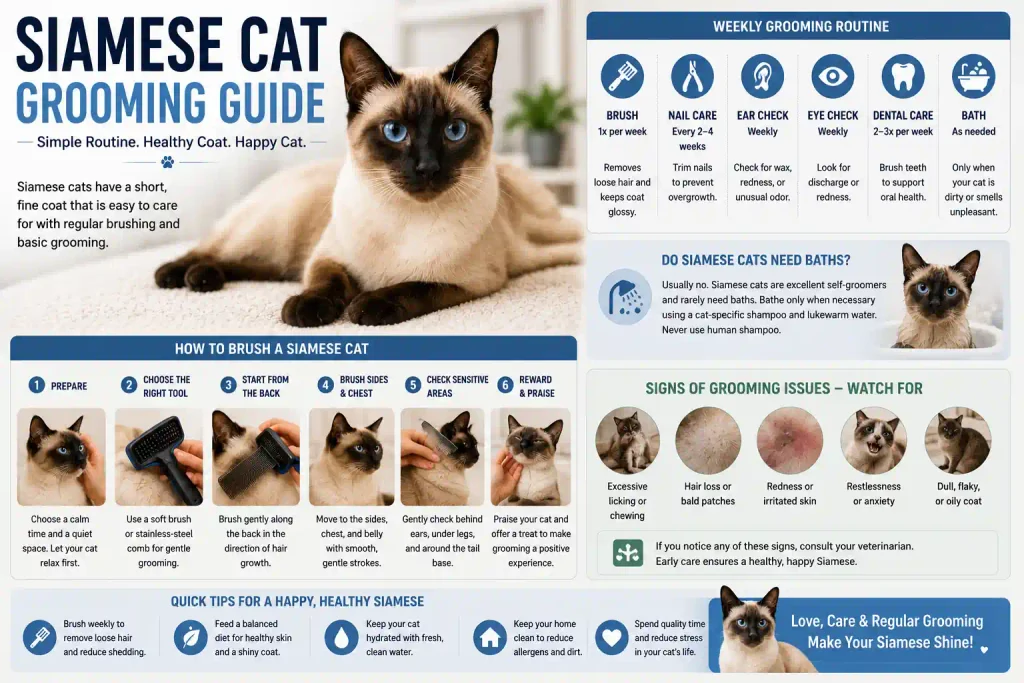
Siamese Cat Grooming: What You Actually Need
You don’t need a huge grooming cabinet.
A basic home kit can include:
1. Soft grooming brush
Useful for removing loose hair.
2. Stainless-steel comb
Useful for checking and grooming the short coat.
3. Cat nail clippers
For controlled nail-tip trimming.
4. Cat toothbrush
For gradual dental care.
5. Cat-safe toothpaste
Use a formulation intended for cats.
6. Cat-specific shampoo
Keep it available for situations when bathing is actually necessary.
That’s enough for most healthy Siamese households.
If you’re building a broader grooming setup, our best brush for Ragdoll cat article provides a useful comparison of grooming tools for a very different coat type. That comparison also highlights why Siamese cats don’t generally need the same heavy-duty grooming equipment as long-haired breeds.
Common Siamese Grooming Mistakes
Mistake 1: Brushing too aggressively
A short coat doesn’t need force.
Mistake 2: Bathing too often
Siamese cats generally don’t require routine baths.
Mistake 3: Using human grooming products
Cats need products designed for feline skin and coat care.
Mistake 4: Ignoring the nails
Coat grooming isn’t the entire grooming routine.
Mistake 5: Assuming every behavior is normal
Sudden excessive grooming can be a sign that something needs attention.
Mistake 6: Turning grooming into a struggle
Positive, short sessions are usually more productive than forcing a resistant cat.
Frequently Asked Questions
How often should you groom a Siamese cat?
For most healthy Siamese cats, weekly brushing or combing is a practical routine. TICA recommends weekly combing, while VCA says a quick weekly comb is generally sufficient for the breed.
Do Siamese cats need to be brushed?
Yes. Even though their short coat is low-maintenance, brushing helps remove dead and loose hair and gives owners an opportunity to check the coat and skin.
What is the best brush for a Siamese cat?
A stainless-steel comb or soft rubber brush is a good choice. CFA notes that Siamese cats can even be groomed effectively with wet hands, while TICA recommends a stainless-steel comb.
Do Siamese cats need baths?
Usually not. Siamese cats are naturally clean and their short coats are easy to maintain. Baths are generally reserved for situations where the cat becomes unusually dirty or a veterinarian recommends bathing.
Do Siamese cats shed a lot?
Siamese cats do shed, but their short coat makes shedding less noticeable than it is with many long-haired breeds. Regular grooming can help manage loose hair.
How can I reduce my Siamese cat’s shedding?
Regular gentle brushing, a balanced diet, and appropriate overall health care can help manage normal shedding. A sudden or extreme change in shedding should be discussed with a veterinarian.
Should I shave my Siamese cat in summer?
Routine shaving isn’t generally necessary for a healthy Siamese because the breed already has a naturally short coat.
How often should I trim my Siamese cat’s nails?
Inspect the nails regularly and trim the sharp tips when needed. TICA recommends regular nail trimming and emphasizes avoiding the quick.
Why is my Siamese cat grooming itself so much?
Some self-grooming is completely normal. But persistent excessive grooming, licking, chewing, bald patches, or irritated skin can warrant veterinary evaluation. VCA specifically notes that Siamese cats can develop anxiety-related overgrooming.
Can I groom my Siamese cat at home?
Yes. For most healthy Siamese cats, basic coat grooming, nail care, and routine inspection can be performed at home. Professional help may be useful when a cat is extremely resistant, has difficult mats, or has a medical grooming need.
Final Takeaway
Siamese cat grooming doesn’t need to be complicated.
Because Siamese cats have a short, fine, close-lying coat, most healthy cats can maintain a neat appearance with a simple weekly brushing or combing routine, plus regular nail, dental, ear, and eye care. TICA and CFA both describe the Siamese as a low-maintenance breed from a coat-care perspective, while VCA recommends a quick weekly comb and notes that routine bathing is rarely necessary.
The best approach is to keep grooming gentle, consistent, and stress-free.
You don’t need to chase every loose hair or bathe your cat on a fixed schedule. Instead, use grooming time to maintain the coat, support your cat’s comfort, and notice changes early.
And remember: if your Siamese suddenly starts overgrooming, develops bald spots, has irritated skin, or shows other unusual changes, treat that as a potential health or behavioral concern rather than simply a grooming problem.