Dog Nail Grinder: How to Choose, Use, and Maintain One Safely
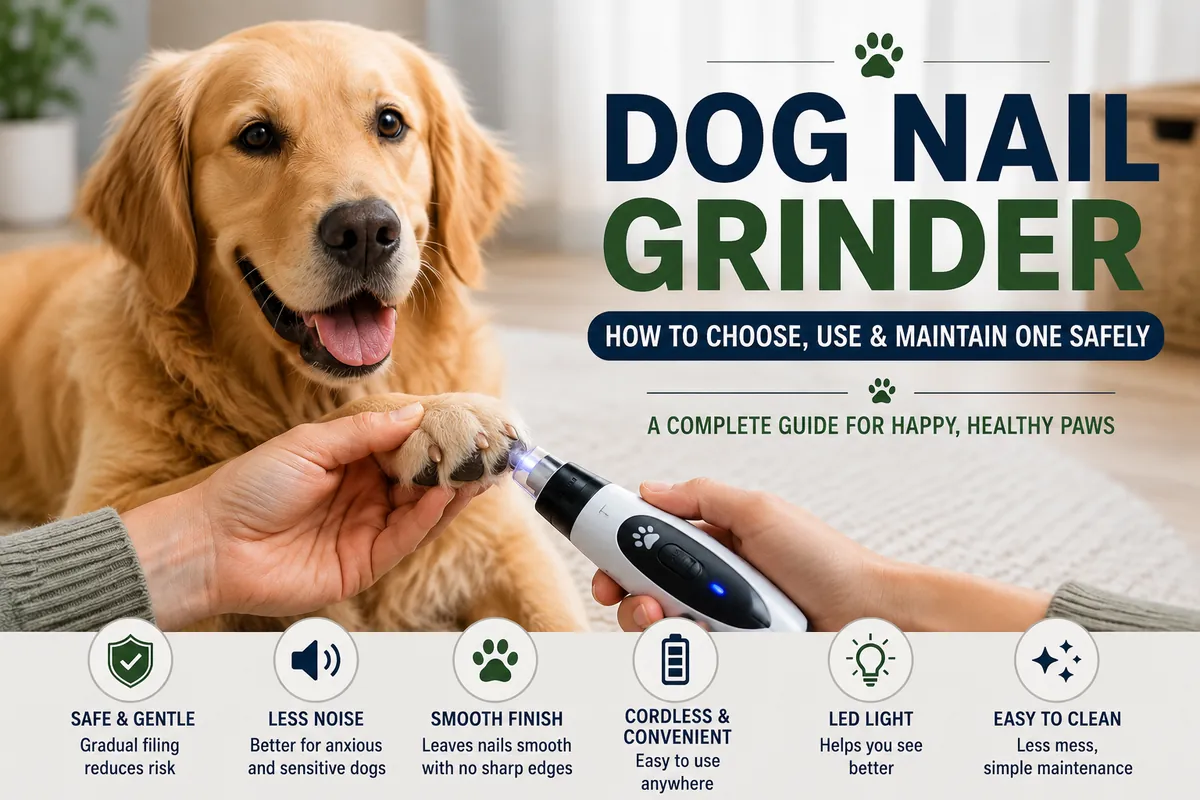
A dog nail grinder is a powered grooming tool that gradually files down a dog’s nails instead of cutting through them in one motion. When used carefully, it can create smoother nail edges and give you more control over how much nail you remove at a time.
The key is not speed—it is patience. Short passes, regular inspection, and gradual training can make nail grinding safer and less stressful for many dogs.
For plenty of dog owners, nail care is one of the most intimidating parts of home grooming. A dog may pull away, dislike having their paws handled, or become nervous when they hear a grinder turn on. Dark nails can make the quick difficult to see, while long-haired dogs create another challenge because fur must be kept away from the rotating attachment.
A grinder is not automatically the best choice for every dog, but it can be a useful alternative to traditional clippers. The American Kennel Club and VCA Animal Hospitals both recognize grinding as an option for dog nail care, noting advantages such as smoother nail edges and gradual removal of nail material.
What Is a Dog Nail Grinder?
A dog nail grinder is an electric grooming tool with a rotating abrasive surface. Instead of clipping off part of the nail, the grinder gradually wears away the tip.
Most models are cordless and may include features such as:
- Multiple speed settings
- Different grinding ports
- Rechargeable batteries
- Protective guards
- Replaceable sanding bands or grinding heads
- LED lights
- Dust-catching attachments
The best feature for your dog depends less on marketing claims and more on your dog’s size, nail thickness, coat type, and tolerance for sound and vibration.
A tiny dog with soft nails may not need a powerful motor. A large dog with thick nails may need a tool capable of removing material efficiently without requiring excessive pressure.
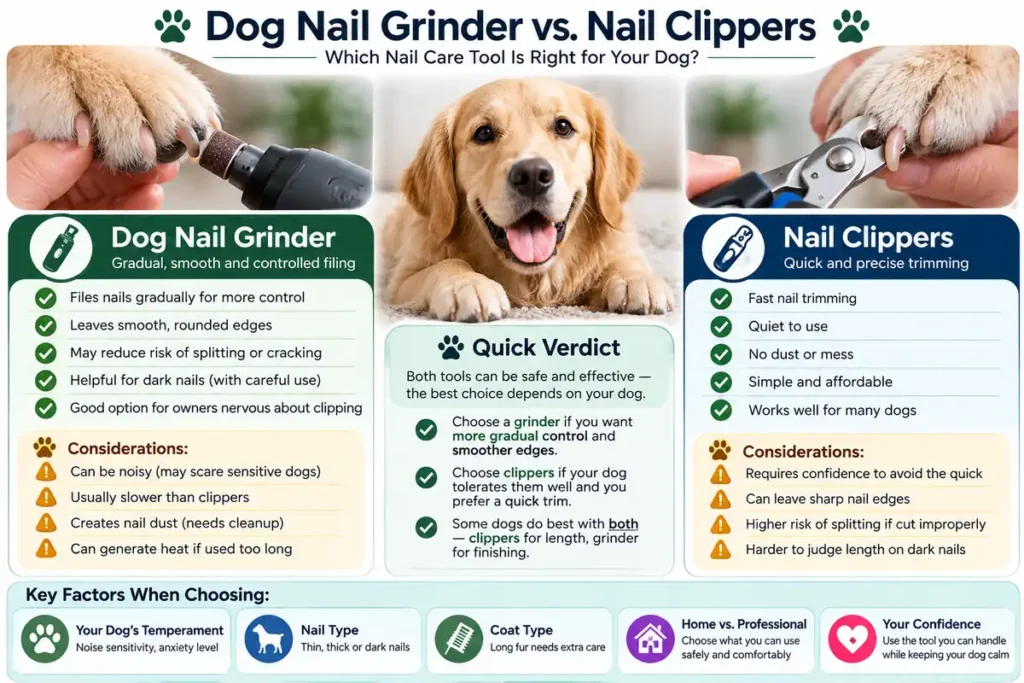
Dog Nail Grinder vs. Clippers
Both tools can be useful. The better choice often depends on the dog and the person handling the grooming.
A grinder is only one option for dog nail trimming, and some dogs may still be more comfortable with traditional clippers.
| Situation | Nail Grinder | Nail Clippers |
| Gradual nail shortening | Excellent | Less gradual |
| Smooth nail edges | Excellent | May leave sharp edges |
| Fast trimming | Usually slower | Usually faster |
| Noise-sensitive dogs | May be difficult | Often quieter |
| Owners nervous about clipping | Can provide more gradual control | Requires confidence around the quick |
| Thick nails | Depends on motor and abrasive | Can work well with the right clipper |
VCA notes that grinding can leave nails smooth and may reduce the risk of damaging the quick because material is removed gradually. However, grinders are not stress-free for every dog. Noise, vibration, heat, and unfamiliar sensations can all cause discomfort.
Veterinary guidance from VCA notes that grinding can leave smoother nail edges and may reduce the likelihood of damaging the quick, but the rotating tool can also catch hair or cause injury if it contacts the skin.
The right question is not:
“Are grinders better than clippers?”
Instead, ask:
“Which method can I safely use while keeping my dog comfortable?”
Some dogs strongly prefer a grinder. Others will tolerate clippers much better.
How to Choose the Right Dog Nail Grinder
A nail grinder is just one part of a practical home grooming setup, alongside other essential dog grooming tools.
Consider your dog’s nail size
Small dogs generally need less power than large dogs with thick nails.
Look for a grinder that gives you control rather than simply choosing the most powerful option available. A fresh abrasive attachment and appropriate technique matter as much as motor strength.
Think about noise and vibration
Some grinders are quieter than others, but “quiet” does not mean silent.
Consumer Reports’ testing has specifically considered noise alongside ease of use and cleanup because sound can affect how comfortably a dog tolerates grooming.
If your dog is anxious, gradual training may matter more than buying a grinder advertised as quiet.
Look at speed control
Multiple speeds can be useful because you may want more control when first learning.
A lower practical setting can help you work carefully, while a suitable higher setting may be useful for thicker nails when the manufacturer recommends it.
Check the grinding attachment
The abrasive surface eventually wears down.
Before buying a grinder, check whether replacement bands or heads are readily available. A worn attachment may work less efficiently and tempt you to apply unnecessary pressure.
Consider long-haired dogs
Dogs with feathering around their paws require extra care.
The AKC specifically advises keeping long fur away from the grinding tool so it does not become caught.
This is especially important for breeds with long hair around their feet.
How to Use a Dog Nail Grinder Safely
The biggest mistake is trying to finish every nail as quickly as possible.
A safer approach is gradual and controlled.

If you accidentally grind too close to the quick and bleeding occurs, see our guide on how to stop dog nail bleeding.
Prepare the area
Choose:
- Good lighting
- A stable, nonslip surface
- A calm environment
- Treats your dog enjoys
- A clean grinder with the correct attachment
It is also sensible to have a pet-appropriate styptic product available in case a nail accidentally bleeds during grooming. VCA recommends having a styptic product available as part of nail-care preparation.
The American Kennel Club recommends using a dog-specific grinder, working on small amounts at a time, and keeping long fur away from the rotating tool.
Get your dog comfortable with paw handling
Do not introduce the grinder for the first time and immediately expect a complete pedicure.
Start by gently touching the paws and individual toes.
If your dog pulls away, becomes tense, or appears worried, pause.
VCA’s handling guidance uses gradual desensitization and positive associations, encouraging short sessions and rewarding the dog for accepting each step.
Introduce the grinder before using it
Let your dog see and sniff the tool while it is turned off.
Reward calm behavior.
Later, briefly turn it on at a comfortable distance and reward your dog again.
The goal is to prevent the sound from becoming a signal that something unpleasant is about to happen.
Support one toe at a time
Hold the toe gently enough to stabilize it without twisting the paw or squeezing the joint.
Keeping the nail stable gives you better control and reduces the chance of the rotating attachment touching surrounding skin or fur.
Use short, controlled passes
Do not hold the grinder against one spot for a prolonged period.
Grinding creates friction, and friction can generate heat.
Work gradually, pause, inspect the nail, and allow time for the dog to remain comfortable. AKC guidance similarly recommends grinding only a small part of the nail at a time and checking your progress.
Stop when you’re unsure
You do not have to finish all four paws in one session.
One successful nail may be enough for a nervous dog during early training.
Ending a session before your dog becomes overwhelmed can make future grooming easier.
How to Grind Black Dog Nails
Black nails are challenging because the quick is not visible through the nail in the same way it may be in light-colored nails.
The safest approach is gradual removal and frequent inspection.
Work on a small amount of nail, remove dust, and look at the nail before continuing.
Avoid trying to achieve a dramatic length reduction in one session.
If nails are severely overgrown, the living tissue may extend farther toward the tip. Gradual maintenance may be necessary rather than aggressive shortening.
If you cannot confidently judge where to stop, a professional groomer or veterinary professional can help.
How to Help an Anxious Dog Accept a Nail Grinder
An anxious dog does not necessarily need a stronger restraint system.
Often, the better solution is slower training.
Dogs with broader grooming fears may also benefit from the techniques in our guide to dog grooming for anxious dogs.
Break the process into tiny steps
For example:
- Touch the paw → reward.
- Hold one toe → reward.
- Show the grinder → reward.
- Turn it on briefly at a distance → reward.
- Bring the powered-off grinder near the nail → reward.
- Make one brief contact → reward.
VCA describes this gradual process as desensitization and counterconditioning—breaking a potentially stressful activity into manageable steps while building a positive emotional association.
VCA recommends breaking nail-care training into small steps and pairing the process with positive experiences such as food rewards.
Keep sessions short
Do not wait until your dog becomes overwhelmed.
A short, successful session is better than forcing a complete trim.
Pay attention to your dog
Warning signs may include:
- Pulling the paw away
- Freezing
- Heavy tension
- Repeated attempts to escape
- Escalating fear or aggression
If stress continues to increase, stop.
For dogs with significant grooming anxiety, professional guidance may be the safest option.
Common Dog Nail Grinder Problems
The grinder gets warm
Friction can generate heat.
Avoid pressing hard or keeping the rotating surface against one area for too long.
Pause regularly and inspect the nail and the dog’s comfort.
Some dogs prefer grinders while others dislike the sound or vibration, and AKC also notes that grinders can generate heat and become entangled in a dog’s coat if used carelessly.
The dog hates the sound
Start farther away.
Pair the sound with something positive, such as a high-value treat.
Do not expect immediate acceptance.
Thick nails are taking too long
Check whether:
- The abrasive attachment is worn
- The tool is suitable for the nail size
- You are using the grinder according to its instructions
Do not compensate by forcing heavy pressure against the nail.
Nail dust is messy
Grinding naturally creates dust.
Some tools include collection attachments, but you should still clean the grinder according to the manufacturer’s instructions.
Consumer Reports’ evaluations have also identified cleanup as a practical factor when comparing nail-care tools.
Paw hair is getting close to the grinder
Stop immediately and move the fur away from the rotating attachment.
Long-haired dogs may need the surrounding fur carefully secured or managed before grinding.
How Often Should You Grind Your Dog’s Nails?
Nail care works best as part of a consistent dog grooming schedule based on your dog’s individual needs.
Dog Nail Grinding Routine Planner
Get a personalized estimate for how often to check and maintain your dog's nails.
Your Dog's Nail Care Routine
Based on the information you provided, here is a practical maintenance estimate.
This tool provides a general grooming estimate only. Nail growth and natural wear vary between individual dogs. Check your dog's nails regularly and contact a veterinarian or qualified groomer if you are unsure about safe nail care.
There is no single schedule that fits every dog.
Nail growth depends on factors such as:
- Activity level
- Walking surfaces
- Age
- Individual nail growth
The AKC notes that many dogs need regular nail trimming approximately every three to four weeks, although individual needs vary.
Instead of following a calendar blindly, inspect your dog's nails regularly.
If you hear nails clicking frequently on hard flooring or notice that they are becoming long, it may be time to assess whether grooming is needed.
Dog Nail Grinder Maintenance
A grinder works best when maintained properly.
Clean away nail dust
Follow the manufacturer's cleaning instructions.
Dust buildup can affect attachments and make the tool unpleasant to handle.
Replace worn abrasive parts
Grinding bands and heads do not last forever.
Replace compatible parts when they become worn or less effective.
Check the battery
Rechargeable grinders should be charged according to the manufacturer's instructions.
Avoid discovering that the battery is dead halfway through a grooming session with an already nervous dog.
When You Should Use a Professional Groomer or Veterinarian
Home grooming is not always the right answer.
Seek professional help if:
- A nail is bleeding and bleeding does not stop
- A nail is broken or split
- The paw is swollen or painful
- Your dog reacts aggressively from fear or pain
- Nails are severely overgrown
- You are unable to confidently identify a safe stopping point
Nail care should never become a situation where you feel forced to continue despite uncertainty.
For more practical home-care advice, explore our complete collection of dog grooming tips.
Frequently Asked Questions
A grinder can offer more gradual control because it removes nail material slowly, but both grinders and clippers can be safe when used correctly. The best choice depends on the dog and the handler.
Grinding should not hurt when performed correctly and kept away from the quick. However, excessive friction can create heat, and a dog may dislike the sound or vibration.
Yes, but introduce grooming gradually. Early positive experiences with paw handling can help puppies become more comfortable with routine nail care later.
Some anxious dogs prefer the gradual action of a grinder, while others are frightened by its sound or vibration. Gradual training is usually more important than assuming one tool will work for every anxious dog.
A grinder can still damage the quick if too much nail is removed. Gradual work and frequent inspection are essential.
There is no required time limit. For a nervous dog, a session may involve only one nail or a few seconds of training. Building tolerance safely is more important than finishing all four paws.
Final Thoughts
A dog nail grinder can be an excellent home grooming tool, but the tool itself is only part of the equation.
The real difference comes from:
- Choosing a grinder appropriate for your dog
- Introducing it gradually
- Working in short passes
- Watching for heat
- Keeping long fur away
- Inspecting each nail frequently
- Stopping when you are uncertain
For many dogs, nail grinding becomes easier once it is treated as a routine skill rather than a stressful task that has to be completed all at once.
The best dog nail grinder routine is not the fastest one. It is the one that keeps your dog safe, comfortable, and willing to cooperate again next time.