Your Puppy’s First Grooming Appointment: A Practical Prep Checklist
Puppy care · A thoughtful first visit
Your puppy’s first professional grooming appointment is easier to plan when you treat it as an introduction, not a test the puppy has to pass. The goal is to help your dog begin learning what a salon visit involves, give the groomer useful information, and agree on a realistic first service.
Some puppies are curious about new people and places; others need more time to become comfortable with handling, sounds, and unfamiliar surfaces. Even a puppy who accepts brushing at home may respond differently in a salon. A first visit does not have to deliver a perfect haircut, and no plan can guarantee that a puppy will feel comfortable with every part of grooming.
Quick Answer: How Should I Prepare for My Puppy’s First Grooming Appointment?
Ask your veterinarian whether the timing is appropriate for your puppy’s health and current preventive-care needs. Contact the salon to confirm its current age, vaccination or documentation, parasite-control, drop-off, and service policies. Choose a groomer who welcomes questions, explain your puppy’s temperament and handling experience, and agree on what the first appointment will include.
At home, practice only brief, gentle handling your puppy already tolerates, pair it with rewards, and stop before discomfort. On appointment day, bring requested records and clear instructions, keep the handoff calm, and agree how the groomer should contact you if your puppy struggles or the service needs to change. The first visit may be an introduction or partial service rather than a full haircut.
1. Check Timing With Your Veterinarian and the Salon
Is my puppy old enough for a professional groom?
There is no single age that fits every puppy, health situation, and salon. Timing can depend on your puppy’s health, vaccination status, coat needs, and the provider’s current policies. Ask your veterinarian about your individual puppy’s readiness and any health or preventive-care considerations before booking.
Then ask the salon what it currently requires. Providers can have different rules for minimum age, vaccination records, parasite concerns, first-time appointments, and services offered. For example, the requirements in PetSmart’s grooming FAQ describe that provider’s policies; they are not universal rules for every US salon.
Confirm details directly instead of relying on an old online post or another salon’s policy. If your veterinarian recommends waiting or has concerns, discuss that advice with the salon before booking.
What should I ask before reserving a time?
A short call or message can prevent surprises. Ask:
What documentation do you need, and how should I provide it?
Do you accept puppies for an introductory visit, and what does it involve?
Which services are appropriate for a first appointment?
What are the estimated cost and duration for the specific service?
Should I stay nearby, remain reachable by phone, or return at a set time?
What happens if my puppy is frightened or cannot complete the planned service?
Are there drop-off, pick-up, cancellation, or health-related requirements?
Policies and prices can vary by provider, location, coat condition, and service. Confirm the details for your booking, including what might change the quoted cost.
2. Choose a Groomer Who Can Work at Your Puppy’s Pace
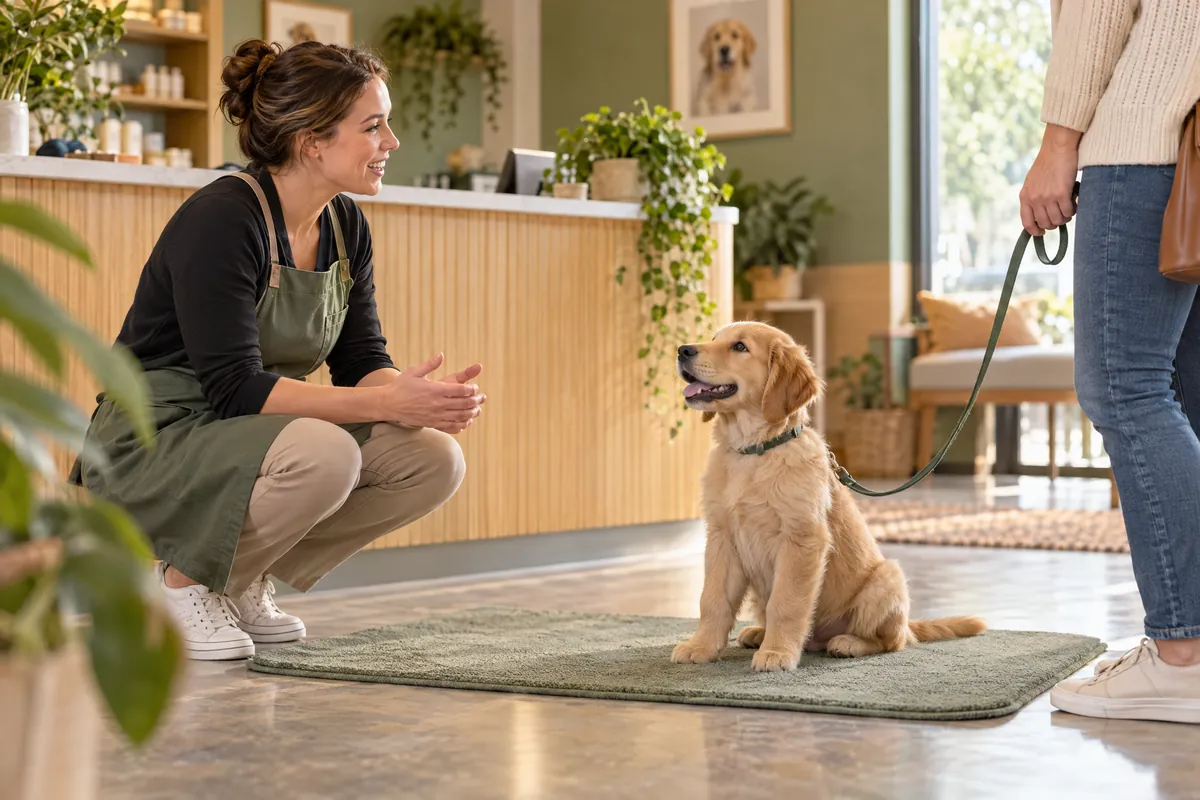
Convenience matters, but it should not be your only selection criterion. Look for a groomer who answers questions clearly, explains the proposed service, and takes your puppy’s comfort seriously. You should be able to discuss handling concerns without pressure to promise that your puppy will cooperate.
Ask who will handle the puppy, how the groomer approaches a first visit, and what happens if the puppy shows distress. Ask whether an introductory visit can focus on a few manageable experiences rather than completing every service. The best plan depends on the puppy and the salon; a partial appointment may be more appropriate than a full package.
Discuss coat needs and future maintenance, but do not assume the first visit must establish the final haircut. The immediate priority is a realistic introduction and clear communication. Our overview of professional dog grooming services can help you understand services to discuss, but confirm exactly what your chosen salon offers.
If your puppy is already very worried around unfamiliar people or handling, tell the salon before booking. Discuss a slower plan with your veterinarian and review these ideas for making grooming less stressful for anxious dogs. Do not wait until drop-off to disclose a concern that could affect the appointment.
3. Prepare a Useful Puppy Profile
The groomer cannot know what your puppy has experienced unless you explain it. A concise profile is more useful than saying only, “He’s friendly” or “She’s a little nervous.”
Share the puppy’s age, relevant health or skin concerns, coat-care history, and any veterinary instructions that matter to grooming. Explain what the puppy has experienced: brushing, paw handling, a dryer, unfamiliar people, or new places. Be honest if these things are new.
Describe the puppy’s current comfort rather than making promises. For example: “She accepts a few gentle strokes along her back but pulls away when her feet are handled.” That gives the groomer a clearer starting point than “She should be fine.”
Before the appointment, agree on three points:
Priorities: What matters most today—an introduction, a gentle bath if appropriate, coat tidying, or another service the salon recommends?
Boundaries: Are there areas or services you want discussed with you before proceeding?
Contact plan: Confirm your phone number and what the groomer should do if the puppy becomes distressed, the plan changes, or additional work affects cost or timing.
If the coat is tangled, the puppy is uncomfortable, or a concern changes the plan, ask the groomer to pause and contact you rather than press ahead with an unagreed service.
4. Practice Gentle Handling at Home—Without Forcing It
Home preparation is about familiarity, not rehearsing a complete salon appointment. Keep practice brief and finish while your puppy is comfortable. The American Kennel Club’s guidance on setting puppies up for success with handling and grooming supports short, positive experiences rather than pushing through a long session. Use the practical lesson for your own puppy; do not copy breeder newborn-handling procedures.
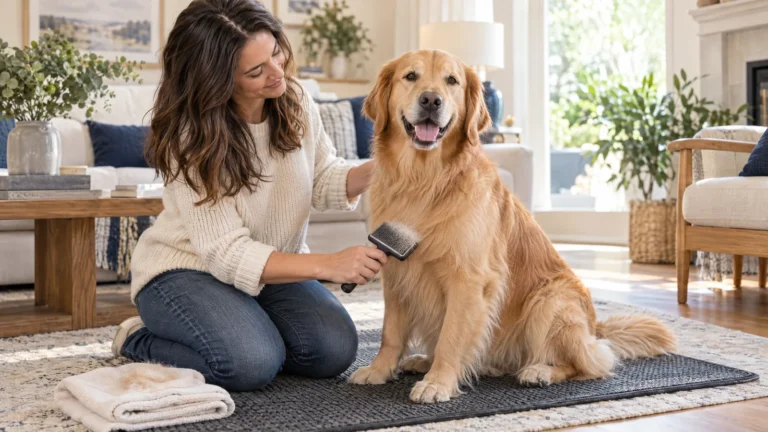
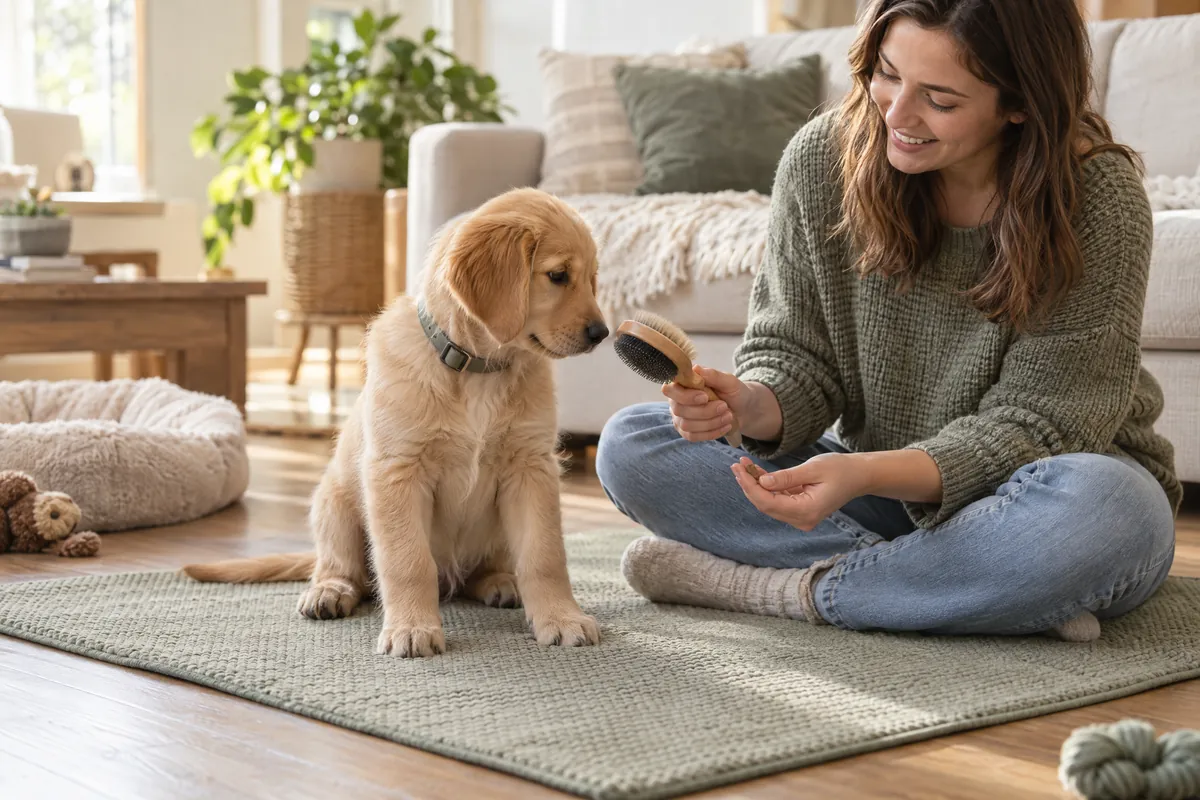
Start with ordinary touch your puppy already accepts, such as a gentle stroke along the shoulder or back. Pair calm contact with a small suitable reward, praise, or another positive experience. If the puppy stays relaxed, briefly touch an area that may need routine care, then reward and stop. Do not reach straight for paws, tail, ears, or belly if your puppy is not comfortable with that contact.
If your puppy accepts a brush, try a few gentle strokes with an appropriate tool, then pause. You do not need to brush every area or make the puppy tolerate a dryer, nail tool, or other unfamiliar equipment in one sitting. Introduce new experiences separately and only at a level the puppy can handle.
Stop if your puppy pulls away, repeatedly tries to escape, freezes, tenses, or otherwise seems uncomfortable. Do not hold the puppy still, punish resistance, or continue to “get them used to it.” PetMD’s grooming tips for a new puppy also discusses gentle, reward-based handling and sharing nervousness or preferences with the groomer. If handling seems painful or the response is sudden or unusual, ask your veterinarian rather than treating it as a training problem.
5. Use This Arrival-Day Checklist
Before leaving home, check the salon’s instructions:
Confirm the appointment time, location, and drop-off instructions.
Bring or submit the required documentation in the format the salon accepts.
Make sure your contact number is correct and you can respond during the appointment.
Review the planned service, estimated cost, duration, and contact plan.
Tell the groomer about new health concerns, skin changes, sensitivity, or behavior changes since booking.
Bring only items the salon has requested or agreed to accept.
Allow time for a calm handoff instead of explaining everything in a rush.
Ask whether the salon has specific instructions about meals, toileting, or exercise. Follow advice appropriate to your puppy rather than applying a universal rule. If an instruction seems unsuitable, check with your veterinarian.
At drop-off, give a concise summary of priorities and concerns. Be calm and clear, but do not conceal important information to make the appointment seem easier.
6. Keep Expectations Realistic for the First Visit
A first appointment does not have to include a full haircut, bath, nail service, ear care, and every other task. Depending on your puppy’s readiness and the salon’s policies, the visit may focus on meeting the groomer, becoming familiar with the setting, brief handling, or a limited service the puppy can tolerate.
Ask what the groomer thinks is achievable and what the fallback plan will be. If your puppy becomes overwhelmed, stopping or changing the service may be responsible. That is not automatically a failed appointment; it provides information for next time.
Do not expect your puppy to remain comfortable just because home handling went well. A salon includes unfamiliar people, sounds, smells, surfaces, and procedures. A puppy who struggles on the first visit is not necessarily destined to dislike grooming. Progress can be uneven, and the pace should reflect the puppy’s response.
Agree in advance that the groomer will contact you if the plan needs to change. Clarify whether work will stop, whether a partial service can be completed safely, and whether a cost change requires your approval. Do not ask the groomer to finish at all costs or continue through visible distress.
7. At Pickup: Debrief and Plan the Next Practice
When you collect your puppy, ask what went well and what was difficult:
Which parts did my puppy accept most comfortably?
Were there signs of fear, sensitivity, or discomfort?
What was completed, and what was left for another time?
Is there a coat or skin concern to discuss with my veterinarian?
What simple handling experience would be useful to practice before the next visit?
When should we discuss booking again, based on my puppy’s needs and response?
Ask for practical observations, not guarantees. If the groomer reports pain, skin changes, or another health concern, follow up with your veterinarian. If the puppy was frightened by one part of the process, make the next home practice easier instead of repeating the difficult experience until the puppy gives in.
Keep the next practice small: perhaps letting the puppy see the brush, accepting a brief touch on a comfortable area, or standing calmly for a moment. Reward voluntary cooperation and stop before stress builds. The aim is to make care more familiar over time, not to force rapid progress.
Frequently Asked Questions
Should my puppy get a full haircut at the first appointment?
Not necessarily. The appropriate service depends on the puppy’s needs, comfort, coat, and salon policies. A short introduction or partial service may be a better starting point.
Should I practice brushing every day before the appointment?
There is no universal practice schedule. Offer brief, positive handling experiences when your puppy is comfortable, and stop if they show discomfort. Keep the experience manageable and voluntary.
What if my puppy cries or struggles at the salon?
Tell the groomer beforehand about known sensitivities and agree on a contact plan. If the puppy becomes distressed, the service may need to pause, change, or end. Do not insist that the groomer finish through distress.
What if my puppy has mats or seems sore?
Tell the groomer and consult your veterinarian if there is pain, skin irritation, or a sudden change in handling tolerance. Do not attempt risky at-home clipping or expect the groomer to complete a service without discussing what is safe and appropriate.
Sources
American Kennel Club, Setting Puppies Up for Success With Handling and Grooming.
PetMD, Grooming Tips for a New Puppy.
PetSmart, Grooming FAQ (provider-specific policies; requirements vary by salon).
General grooming education, not veterinary advice or a salon booking service. Confirm health and timing questions with your veterinarian and current requirements with your chosen groomer. G2 is an original AI-generated editorial illustration, not photographs of an actual appointment.