Dog Grooming Cuts & Styles: 15 Popular Looks and How to Choose the Right One
The best dog grooming cuts and styles depend on your dog’s coat type, breed, lifestyle, and how much daily maintenance you can realistically manage. Popular options include puppy cuts, teddy bear cuts, kennel cuts, breed-specific trims, and longer styles, but the right choice should always prioritize your dog’s comfort, coat health, and practical needs.
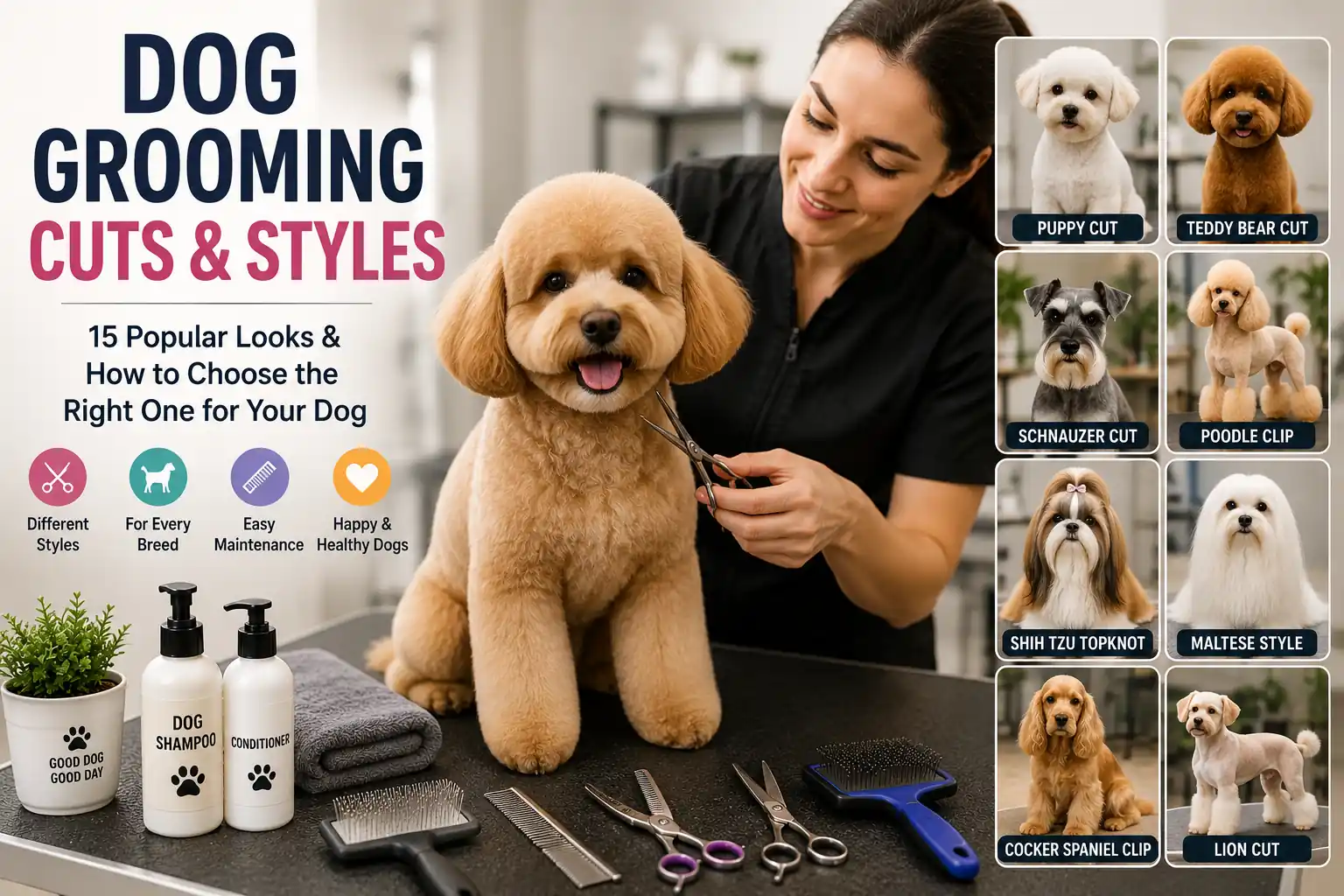
Choosing a haircut for your dog can be surprisingly difficult. A photo may show exactly what you want, but the same style can look completely different on another dog because coat texture, density, face shape, and growth pattern all matter. Before you tell your groomer, “I want this cut,” it helps to understand what the major styles actually mean and which ones fit your dog’s coat and lifestyle.
How to Choose the Right Dog Grooming Cut
The best haircut isn’t necessarily the shortest, fluffiest, or trendiest one. Start with four questions:
- What type of coat does your dog have?
- How much brushing can you do between appointments?
- How active is your dog?
- Do you want a practical trim or a specific breed/style look?
For example, a long-haired Shih Tzu may be comfortable with a shorter maintenance cut, while a Poodle can be styled in several different ways. A Golden Retriever has a different grooming strategy altogether because its natural coat should not simply be treated like a continuously growing hair coat.
Your groomer should also consider the condition of the coat before recommending a style.
15 Popular Dog Grooming Cuts and Styles
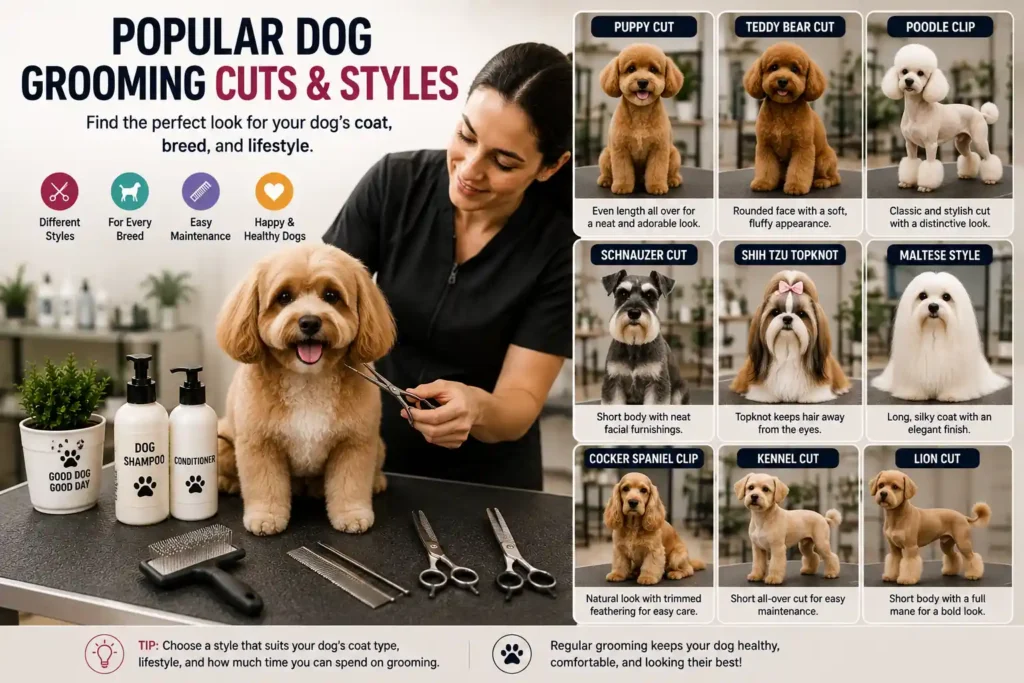
1. Puppy Cut
The puppy cut is one of the most commonly requested pet grooming styles.
Despite the name, it isn’t reserved for puppies. It generally means keeping the coat at a relatively even, manageable length throughout the body, although the exact length can be customized.
It’s popular because it gives dogs a neat, youthful appearance while making daily maintenance easier.
Best for:
- Shih Tzus
- Maltese
- Yorkies
- Poodles
- Many Poodle mixes
- Other continuously growing coats
The exact length isn’t universal, so tell your groomer how short or fluffy you want the finished coat.
2. Teddy Bear Cut
The teddy bear cut is designed to create a soft, rounded appearance, particularly around the face.
The body is generally kept at a manageable length while the face, head, and sometimes legs are shaped to create a fuller, rounded look.
It’s especially popular among owners of:
- Shih Tzus
- Poodles
- Goldendoodles
- Cavapoos
- Bichon Frises
- Other fluffy or curly-coated dogs
The biggest advantage is appearance, but there’s a maintenance trade-off: keeping the coat fluffy means regular brushing is still important.
3. Kennel Cut
A kennel cut is a practical, relatively short trim designed to keep the coat easier to maintain.
It’s a good option for owners who want less daily brushing or dogs whose coats become tangled easily.
The exact length varies by groomer and owner preference, so don’t assume “kennel cut” means the same thing everywhere.
Before the appointment, ask:
“What length will you leave on the body, face, legs, and tail?”
That simple question can prevent a major misunderstanding.
4. Summer Cut
A summer cut generally means taking a dog’s coat shorter for easier maintenance during warm weather.
However, shorter does not automatically mean better or cooler for every dog.
Dogs with double coats, in particular, require more careful consideration. Their natural coat serves important functions, so owners shouldn’t assume that shaving is the appropriate solution for summer.
For dogs with long or continuously growing hair, a groomer may recommend a shorter maintenance trim instead.
If you’re unsure whether your dog’s coat should be shortened, ask a professional groomer before making the decision.
5. Lamb Cut
The lamb cut creates contrast between the body and legs.
The body is kept relatively short while the legs remain fuller, producing a softer, more sculpted appearance.
This style is particularly associated with Poodles and can also work on some Poodle mixes and other suitable coats.
It requires more styling than a simple all-over trim, so maintenance is usually moderate.
6. Lion Cut
The lion cut is a dramatic style in which the body is trimmed short while more hair is retained around areas such as the head, neck, and sometimes the tail.
It creates a distinctive mane-like appearance.
This isn’t an everyday choice for every dog, but it can be used on certain long-haired dogs when the coat and owner’s preferences make it appropriate.
Because the style involves significant changes to coat length, discuss the desired result with your groomer before clipping begins.
7. Topknot Style
A topknot is technically a hairstyle rather than a haircut.
Long hair on the top of the head is gathered and secured so it stays away from the dog’s eyes and creates a distinctive appearance.
Topknots are common with breeds such as:
- Shih Tzus
- Maltese
- Yorkies
If you use a topknot, it should never be pulled so tightly that it causes discomfort or irritates the skin.
8. Breed-Specific Grooming Cuts
Some dogs have traditional grooming styles associated with their breed.
These cuts can emphasize the breed’s characteristic outline rather than simply making the coat shorter.
Examples include:
- Poodle clips
- Schnauzer trims
- Westie-style trims
- Scottish Terrier trims
- Cocker Spaniel clips
Breed-specific grooming can be especially useful when you want a recognizable appearance while maintaining the coat’s intended shape.
If your dog has a breed-specific coat, bring a clear reference photo to the groomer.
9. Poodle Cuts
Poodles have some of the widest variety of grooming styles.
Popular Poodle options include:
- Continental
- Modern
- Puppy
- Sporting
- Scandinavian
- Modified clips
The classic Continental style has closely clipped areas combined with longer sections and distinctive pom-poms.
Petco notes that Poodles can be customized extensively, which means the best style often depends on whether the owner wants a traditional, practical, or more modern appearance.
For everyday pet owners, a simpler Poodle cut can often be much easier to maintain than a show-oriented style.
10. Shih Tzu Grooming Styles
Shih Tzus are especially versatile when it comes to grooming.
Popular choices include:
- Puppy cut
- Teddy bear cut
- Longer pet trim
- Topknot
- Short summer-style trim
- Breed-inspired longer styles
A puppy cut is often chosen by owners who want easier maintenance, while a longer coat requires considerably more brushing.
Current grooming guides continue to identify puppy and teddy bear styles as popular Shih Tzu options.
If you’re interested in breed-specific grooming, the how to groom your dog at home guide can also help you understand what maintenance is realistic between professional appointments.
11. Maltese Grooming Styles
Maltese dogs naturally grow long, silky hair, giving owners several grooming choices.
Common styles include:
- Maltese puppy cut
- Teddy bear style
- Kennel cut
- Full coat
- Short maintenance trim
- Topknot
A full coat can look beautiful, but it demands considerably more brushing and coat management.
A shorter trim can be much more practical for active families or owners who don’t have time for daily coat maintenance.
12. Schnauzer Cut
Schnauzers have a recognizable grooming profile.
A typical Schnauzer style keeps the body shorter while leaving longer hair on areas such as the legs and face. The beard and eyebrows contribute heavily to the breed’s distinctive appearance.
This is a good example of why breed-specific grooming isn’t simply about taking a pair of clippers over the whole dog.
The shape matters.
13. Cocker Spaniel Clip
Cocker Spaniels have naturally distinctive feathering around areas such as the ears, chest, legs, and body.
A traditional Cocker-style trim typically preserves some of that feathering while keeping the overall coat neat and manageable.
If your dog spends a lot of time outdoors, your groomer may recommend a more practical version that reduces the amount of coat collecting dirt and debris.
14. Puppy-Style Short Trim for Yorkies
Yorkies can grow long, flowing coats, but many pet owners choose a much shorter, easier-to-maintain style.
A short, even trim can reduce brushing demands while keeping the dog neat and comfortable.
The puppy cut is particularly popular because it creates a consistent, manageable length rather than requiring the owner to maintain a long show-style coat.
15. Asian Fusion and Creative Styles
Asian fusion grooming has become increasingly visible in modern grooming culture.
These styles often use creative shaping, rounded faces, sculpted legs, and carefully blended transitions.
They’re more artistic than a simple maintenance trim and generally require a groomer with advanced styling skills.
If you’re considering one, bring multiple reference photos and ask the groomer whether your dog’s coat can realistically achieve the look.
Best Dog Grooming Style by Coat Type
Your dog’s coat is one of the most important factors when selecting a grooming style.
| Coat type | Common grooming options | Maintenance |
|---|---|---|
| Long, silky | Puppy, teddy bear, topknot, longer trim | High |
| Curly/wavy | Puppy, teddy bear, lamb, Poodle styles | Moderate–high |
| Short coat | Light trim, tidy-up grooming | Low |
| Double coat | Brushing, de-shedding, light tidying | Moderate |
| Thick/matted coat | Professional assessment first | High |
This isn’t a rigid rulebook. Two dogs of the same breed can have different coat textures and maintenance needs.
That’s why a groomer should evaluate the actual dog rather than choosing a style based solely on breed.
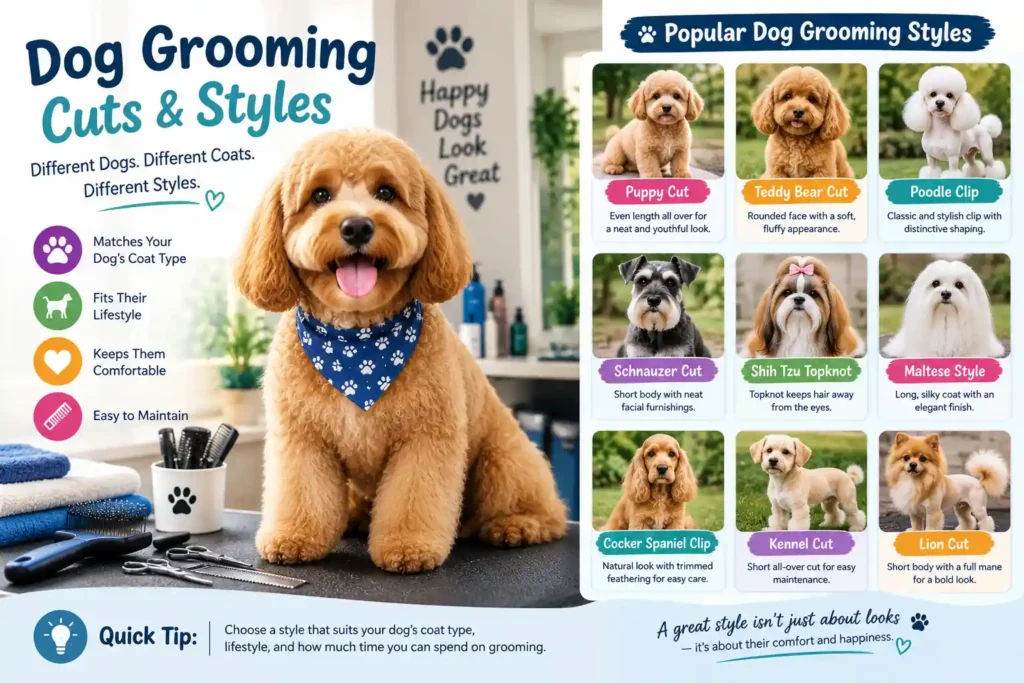
How Often Should Different Grooming Styles Be Maintained?
The shorter or more sculpted the style, the more noticeable regrowth may become.
Dogs with continuously growing coats often need professional grooming every several weeks, depending on the desired length and how quickly the coat grows.
Longer styles may require more frequent brushing between appointments even if the dog doesn’t visit the groomer as often.
Your grooming schedule should therefore consider both professional appointments and home maintenance.
For a broader maintenance routine, see our guide to dog grooming tips.
How to Tell Your Groomer What You Want
One of the easiest ways to get a better grooming result is to stop relying on style names alone.
Instead, explain:
- How short you want the body
- How full you want the face
- How much hair you want around the ears
- Whether you want the legs fluffy or short
- How you want the tail finished
- How much daily brushing you can manage
Then show a photo.
A reference photo plus a clear explanation is usually much more useful than simply saying, “Give my dog a teddy bear cut.”
Modern grooming guides also emphasize that shared terminology and clear expectations can reduce misunderstandings between owners and groomers.
Which Dog Grooming Cut Is Easiest to Maintain?
For many owners, a short, even maintenance trim is easier than a long or heavily sculpted style.
But “easy” depends on the coat.
A short haircut does not eliminate brushing requirements for every dog, and a longer haircut can be perfectly manageable if the owner is willing to maintain it consistently.
Think about your real routine:
Busy schedule + little brushing time → simpler style
Daily brushing + love of a fluffy look → longer style
Show or breed presentation → specialized grooming
The best style is the one you can realistically maintain.
Should You Shave Your Dog’s Coat?
Don’t automatically choose shaving just because summer is approaching or the coat seems difficult.
Coat type matters.
For dogs with double coats, removing the coat completely can be inappropriate and may affect how the coat functions and regrows. For dogs with continuously growing hair, a shorter trim may be a reasonable option when performed appropriately.
If you’re unsure, ask a professional groomer familiar with your dog’s coat before choosing a very short cut.
What If Your Dog Is Severely Matted?
Severe matting changes the grooming conversation.
Trying to force a brush through tightly packed mats can be painful, and using household scissors near the skin can be dangerous.
If the coat is severely matted, let a professional groomer assess it.
The safest style may not be the style you originally wanted—it may be the style that allows the coat and skin to be safely managed.
Dog Grooming Cuts vs. Dog Grooming Styles: What’s the Difference?
The terms are often used interchangeably, but there’s a useful distinction.
A cut usually describes how the coat is trimmed or clipped.
A style can include the complete finished appearance, including:
- Face shape
- Body length
- Leg shape
- Ear length
- Tail finish
- Topknot
- Breed-specific details
So when discussing your dog’s next appointment, think about the whole finished look, not just the body length.
Frequently Asked Questions
What is the most popular dog grooming cut?
Puppy cuts and teddy bear styles are among the most commonly requested everyday pet-grooming looks, especially for dogs with continuously growing coats.
What haircut is easiest for a dog to maintain?
A relatively short, even maintenance trim is generally easier to manage than a long, heavily styled coat, although the best option depends on the dog’s coat type.
What is the difference between a puppy cut and a teddy bear cut?
A puppy cut generally emphasizes a relatively even coat length, while a teddy bear style focuses more on a rounded, fuller facial appearance. The exact lengths are not standardized across all groomers.
What is the best haircut for a Shih Tzu?
A puppy cut, teddy bear style, or longer traditional trim can all work. The best choice depends on how much brushing you can provide and the look you want.
What is the best haircut for a Poodle?
Poodles can wear many styles, from simple puppy and sporting trims to highly specialized traditional clips. For most pet homes, the best choice balances appearance with maintenance.
Should I bring a picture to my groomer?
Absolutely. A clear reference photo can make it much easier to communicate the desired face, body, leg, ear, and tail shape.
How often should my dog get a haircut?
That depends on coat growth, desired length, grooming style, and home maintenance. Dogs with continuously growing coats generally require more frequent professional grooming than short-coated dogs.
Can I choose any grooming style for my dog?
Not necessarily. Your dog’s coat type, condition, health, and structure can limit which styles are practical or safe.
Final Takeaway
The best dog grooming cuts and styles aren’t simply the ones that look great in a photo. The right choice should match your dog’s coat, lifestyle, comfort, and your ability to maintain the look between appointments.
If you want a low-maintenance routine, choose a practical trim. If you love a fluffy appearance and can commit to regular brushing, a teddy bear or longer style may work beautifully. For breed-specific or highly sculpted looks, an experienced professional groomer can help you achieve the shape safely.
Before your next appointment, save a reference photo, explain how much maintenance you’re comfortable with, and ask your groomer what will work best for your dog’s actual coat.