Cat Shampoo: How to Choose the Right One for Your Cat
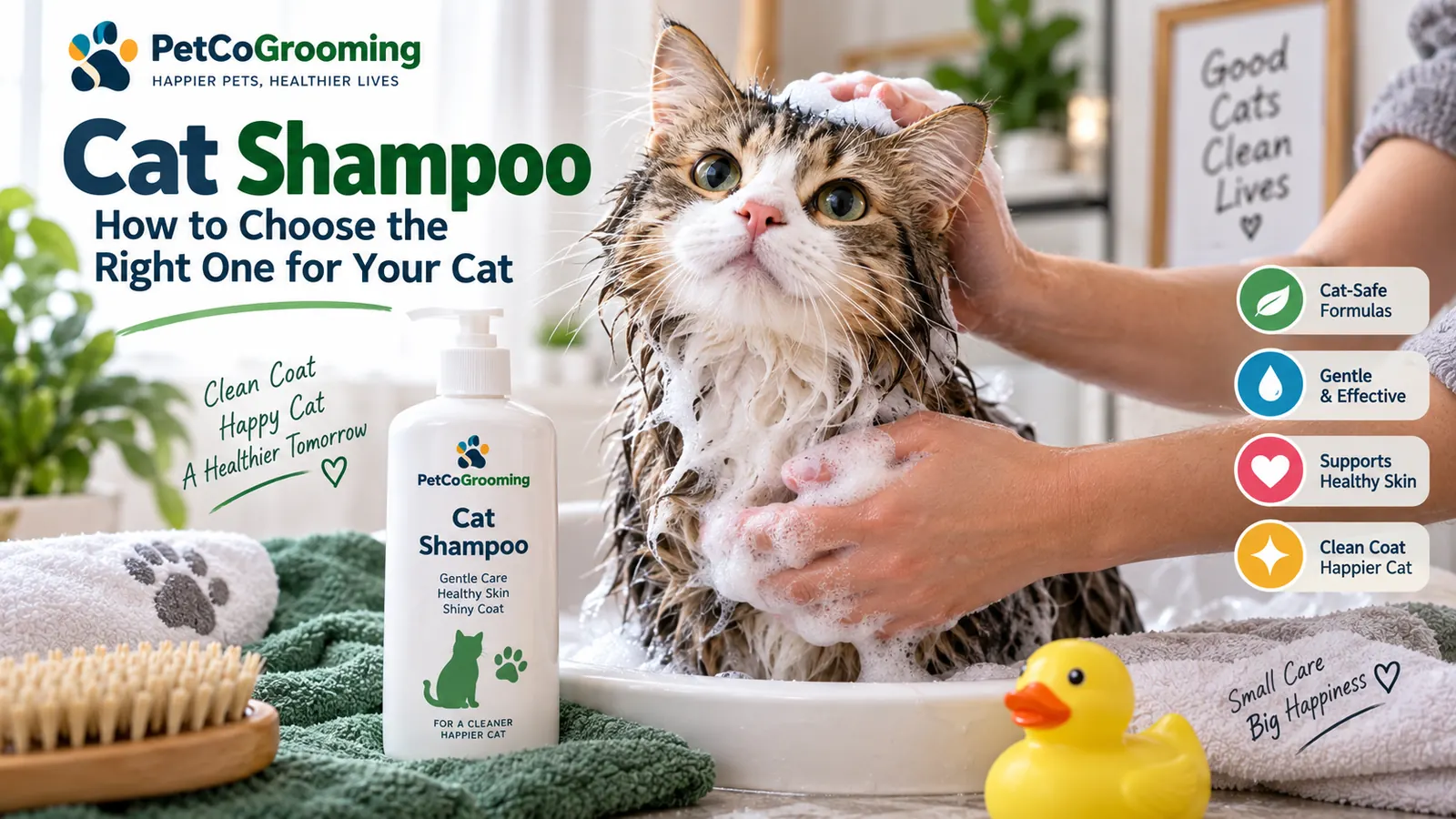
If your cat actually needs a bath, use a shampoo made specifically for cats rather than human shampoo or a random household cleanser. Most healthy cats do not need frequent baths, but a cat-safe shampoo can be useful when a cat gets unusually dirty, has a coat-care problem, or needs a veterinary-directed bathing routine.
Do Cats Really Need Cat Shampoo?
Usually, not very often.
Cats are naturally good at grooming themselves, so routine shampooing isn’t necessary for most healthy cats. A bath may become appropriate when your cat gets into something messy, has difficulty grooming because of age or mobility, or has a skin condition for which your veterinarian recommends bathing.
That means the goal isn’t to find a shampoo you can use constantly.
The goal is to have the right shampoo for the situation when your cat actually needs one.
What Makes a Good Cat Shampoo?
The safest starting point is simple: look for a product clearly formulated for cats.
When comparing cat shampoos, pay attention to these factors.
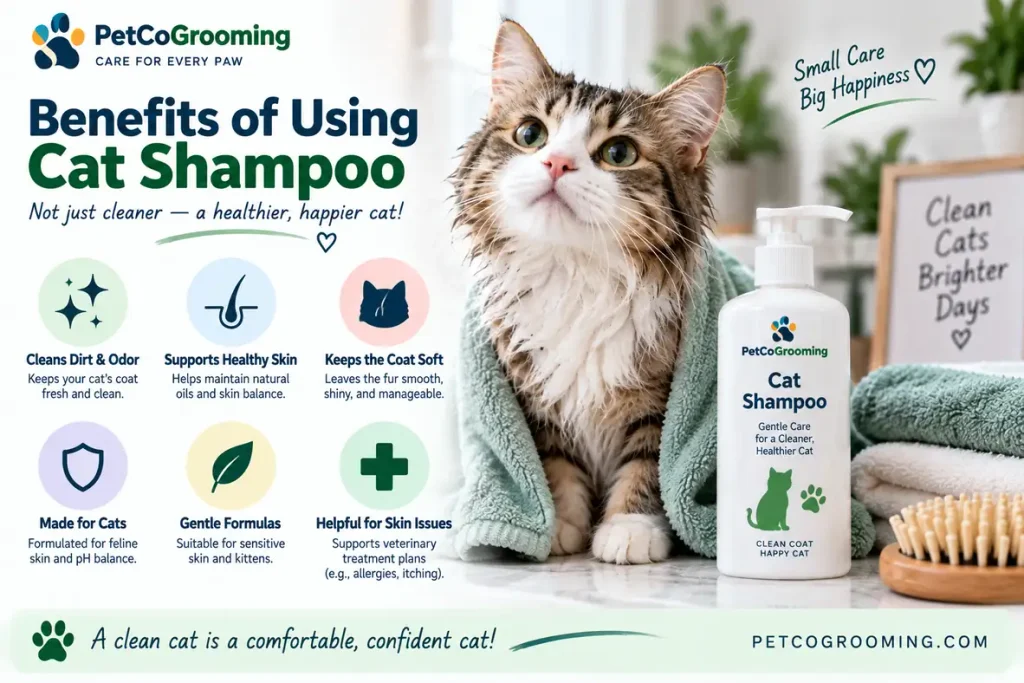
1. It Should Be Made for Cats
Cats aren’t small dogs, and human shampoo isn’t designed for feline skin.
The ASPCA specifically recommends cat shampoo for bathing and warns that human shampoo can dry a cat’s skin.
Look for labeling that clearly identifies the product as suitable for cats.
If the bottle only says it’s for dogs, don’t assume it’s automatically appropriate for your cat.
2. Match the Shampoo to Your Cat’s Need
A basic cleansing shampoo and a medicated shampoo serve different purposes.
For example:
- Routine cleaning: choose a gentle cat-formulated cleanser.
- Sensitive or easily irritated skin: look for a product specifically intended for that need.
- A diagnosed skin condition: use the shampoo recommended by your veterinarian.
- Fleas or parasites: don’t assume an ordinary shampoo will solve the problem. Follow an appropriate flea-control plan instead.
Veterinary hospitals note that medicated shampoos can be used for specific problems such as bacterial or yeast infections and certain allergic skin conditions, but the appropriate product depends on the condition being treated.
3. Consider How Easily It Rinses Out
A shampoo that is difficult to rinse completely can leave residue behind.
That’s especially important with cats because they groom themselves after bathing.
The ASPCA recommends thoroughly rinsing shampoo from a cat’s coat because leftover residue can irritate the skin.
So don’t judge a shampoo only by how much it lathers.
Easy rinsing matters more than impressive bubbles.
4. Be Careful With Strong Fragrances
A heavily scented shampoo isn’t automatically a better shampoo.
If your cat has sensitive skin or reacts poorly to scented products, a simpler, cat-specific formula may be a better choice. If your cat already has a skin problem, ask your veterinarian what type of shampoo is appropriate rather than choosing based only on marketing claims.
5. Check the Age Label
Kittens may require products specifically formulated for their age.
Don’t assume an adult cat shampoo is automatically appropriate for a very young kitten. If you’re bathing a kitten for the first time, check the product’s age directions and ask your veterinarian if you’re unsure.
Can You Use Human Shampoo on a Cat?
It’s best not to.
Human shampoo is formulated for human skin, not feline skin. The ASPCA specifically advises against using human shampoo when bathing cats because it can dry the skin.
This includes the tempting “just this once” situation.
If your cat urgently needs cleaning and you don’t have cat shampoo available, the safest approach depends on what got on the cat. For an ordinary small mess, plain lukewarm water and careful cleaning may be enough. If the substance could be toxic, don’t experiment with household products—get veterinary or poison-control guidance. The ASPCA recently emphasized that different substances require different decontamination approaches.
Can You Use Dog Shampoo on a Cat?
Don’t assume that a dog shampoo is safe for cats.
Some products are specifically labeled for multiple species, while others are not. Read the label rather than relying on the word “pet.”
This is particularly important with flea and parasite products. Some ingredients or concentrations intended for one species can be dangerous for another.
If a shampoo isn’t clearly labeled for cats, choose a cat-specific product or ask your veterinarian before using it.
What About Medicated Cat Shampoo?
Medicated shampoo is different from ordinary grooming shampoo.
If your cat has persistent itching, redness, scaling, hair loss, sores, or another skin problem, don’t simply choose a medicated shampoo because it sounds stronger.
The underlying problem matters.
Veterinary guidance notes that medicated shampoos may be selected for bacterial infections, yeast infections, allergies, and other specific conditions. The appropriate product should match the condition rather than being chosen at random.
If your cat has an ongoing skin problem, let your veterinarian determine whether medicated bathing is appropriate.
How to Use Cat Shampoo Safely
Once you’ve chosen an appropriate product, the bathing technique matters just as much.
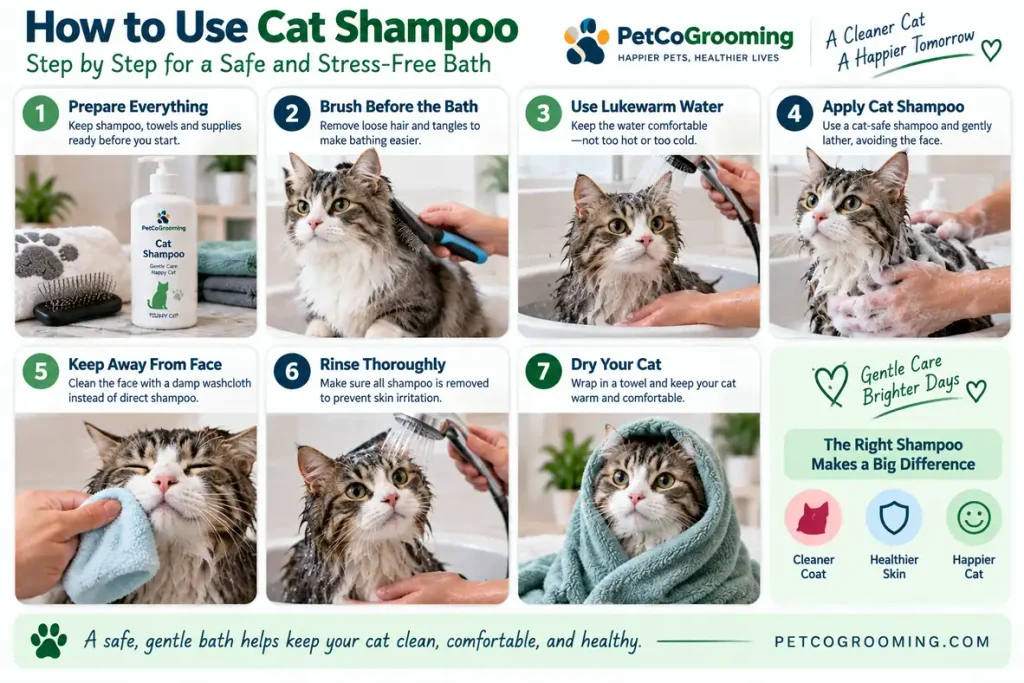
Step 1: Prepare Everything First
Have your shampoo, towels, a non-slip surface, and whatever you need within reach.
You don’t want to leave a wet cat unattended while searching for supplies.
Step 2: Brush Before the Bath
Brush out loose hair and deal with manageable tangles before adding water.
The ASPCA recommends brushing the cat before bathing and taking care of mats beforehand.
This is only appropriate if the paragraph discusses brushing before a bath, loose hair, mats, or long coats.
Step 3: Use Lukewarm Water
Avoid hot water.
A calm, controlled setup can make the experience easier for both you and your cat. The ASPCA recommends lukewarm water and a non-slip surface during bathing.
Step 4: Keep Shampoo Away From the Face
Wet the body carefully and avoid directly spraying the eyes, ears, and nose.
For the face, a damp washcloth is often a better approach than pouring shampoo over the head.
Step 5: Follow the Product Directions
Don’t guess how much shampoo to use or how long it should remain on the coat.
Some products are designed simply to cleanse, while medicated products may have specific instructions.
Step 6: Rinse Extremely Well
This is one of the easiest steps to underestimate.
Rinse until the shampoo is completely removed. Residue can irritate the skin, and anything left on the coat may later be encountered during grooming.
Step 7: Dry Your Cat
Wrap your cat in a towel and keep them somewhere warm and away from drafts.
If your cat tolerates a dryer, use the lowest comfortable setting rather than blasting them with hot air.
Cat Shampoo vs. Waterless Cat Shampoo
A traditional shampoo requires a wet bath and thorough rinsing.
A waterless product can be useful for situations where a full bath isn’t practical, but it shouldn’t automatically be treated as equivalent to a traditional bath.
Think of it this way:
| Situation | Better starting point |
| Light surface dirt | Spot cleaning or cat-safe wipes |
| Normal bath when needed | Cat shampoo + water |
| Cat strongly dislikes water | Consider an appropriate waterless product |
| Heavy or greasy contamination | Thorough washing/rinsing |
| Diagnosed skin condition | Veterinarian-directed shampoo |
| Possible toxic substance | Veterinary/poison-control guidance |
The right choice depends on why the cat needs cleaning, not simply which product sounds easiest.
Cat Shampoo Mistakes to Avoid
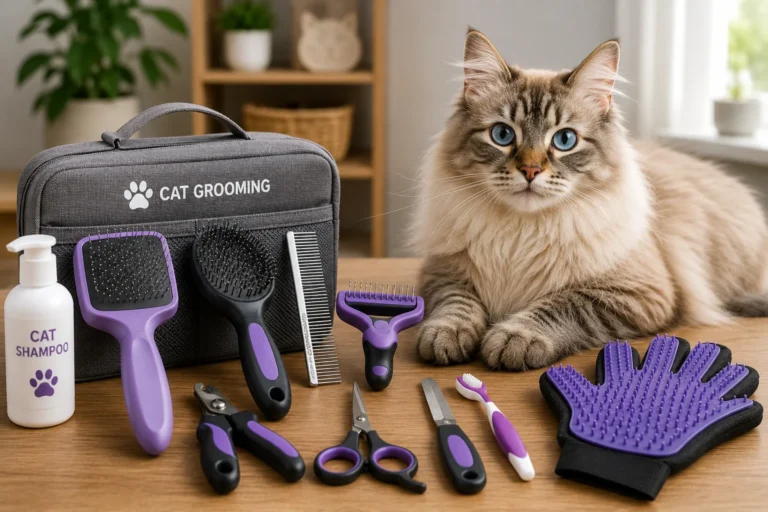
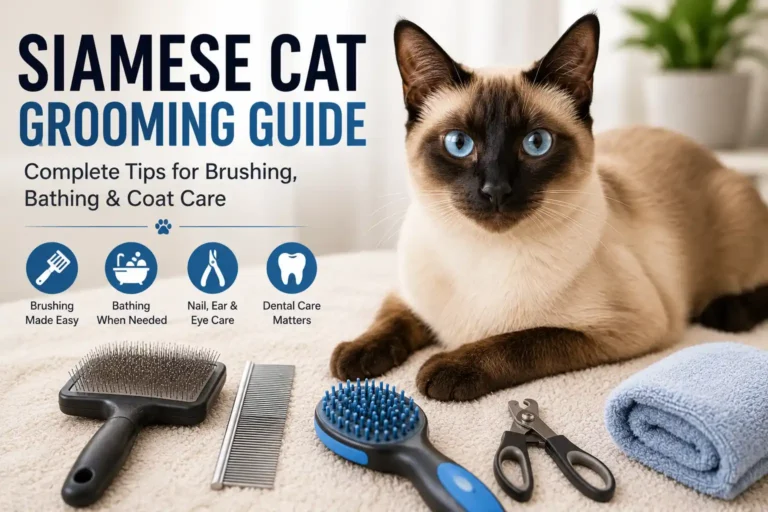
A proper set of cat grooming tools can make bathing and coat maintenance easier before and after a bath.
Using your own shampoo
Human shampoo isn’t formulated for cats and can dry or irritate their skin.
Bathing just because the coat smells slightly different
A change in odor can have many causes. More shampoo isn’t necessarily the answer.
Scrubbing aggressively
A cat’s bath should be gentle. Rough scrubbing can make an already stressful experience worse.
Leaving shampoo residue
Incomplete rinsing can irritate the skin.
Using medicated shampoo without knowing why
“Medicated” doesn’t mean “better for every cat.” Different skin conditions require different approaches.
Turning every bath into a battle
If your cat becomes extremely distressed, stop and reassess the situation. Some cats need a different grooming approach, while others may need professional or veterinary assistance.
When Should You Ask a Veterinarian About Cat Shampoo?
Talk with your veterinarian if your cat has:
- Persistent itching
- Red or inflamed skin
- Significant dandruff or scaling
- Hair loss or bald patches
- Recurrent odor
- Sores or lesions
- A diagnosed skin condition
- A suspected toxic substance on the coat
- A grooming problem that keeps returning
A shampoo may clean the coat, but it doesn’t necessarily address why the skin or coat problem is happening.
Quick Cat Shampoo Checklist
Before buying, ask:
☑ Is it specifically made for cats?
☑ Is it appropriate for my cat’s age?
☑ Does it match my cat’s actual grooming need?
☑ Can it be rinsed thoroughly?
☑ Does the label provide clear directions?
☑ If my cat has a skin condition, has a veterinarian recommended this type of product?
If you can answer those questions confidently, you’re already much closer to making a sensible choice.
FAQs About Cat Shampoo
What is the best shampoo for cats?
There isn’t one shampoo that’s best for every cat. The right choice depends on whether your cat simply needs occasional cleaning or has a specific skin, coat, age, or veterinary need.
Can I use human shampoo on my cat?
It’s best to avoid it. Human shampoo isn’t formulated for cats and can dry their skin.
Can I use dog shampoo on my cat?
Only if the product is explicitly labeled as safe for cats. Don’t assume a dog-only product is suitable for feline use.
How often should I shampoo my cat?
There isn’t a single schedule that fits every cat. Most healthy cats don’t need frequent baths because they groom themselves. Some cats need occasional or more specialized bathing because of their coat, health, or circumstances.
Can I use medicated cat shampoo without a vet?
If your cat has a suspected or ongoing skin condition, it’s better to get veterinary guidance first. Medicated shampoos are intended for specific problems, not as a general upgrade over ordinary shampoo.
What if my cat hates baths?
Don’t assume you need to force a full bath every time. For minor messes, a suitable wipe or spot-cleaning approach may be enough. If bathing is necessary but consistently becomes unsafe or extremely stressful, consider professional grooming or veterinary guidance.
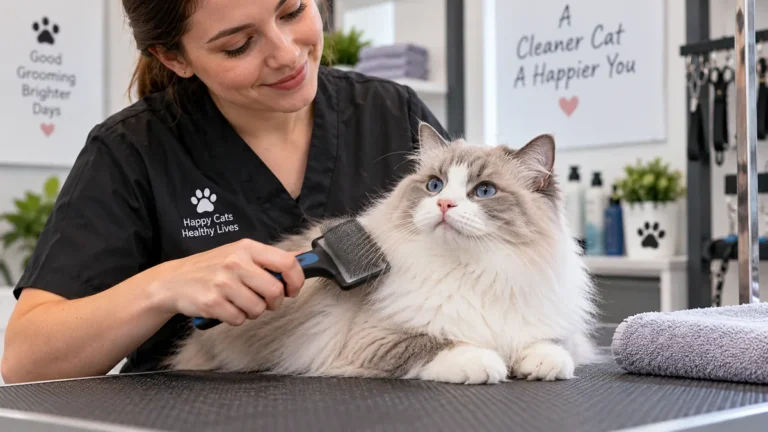
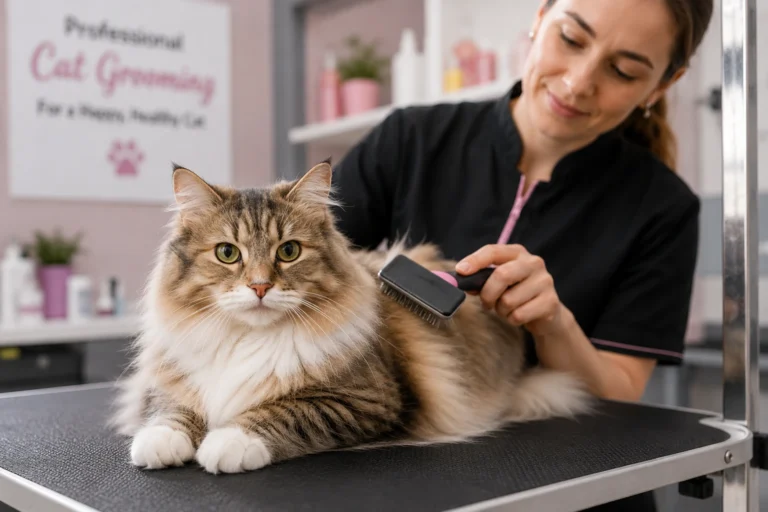
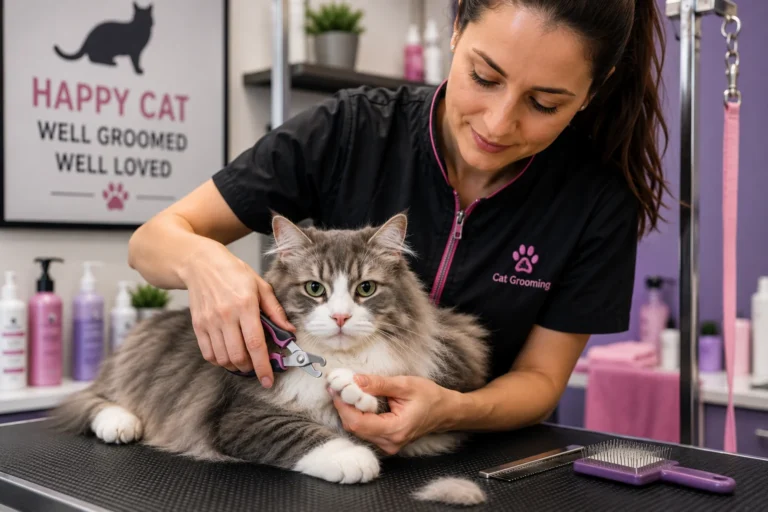
If bathing becomes too stressful or difficult to do safely, a professional cat groomer may be a better option
Bottom Line
The best cat shampoo is not necessarily the one with the strongest scent, biggest lather, or longest list of promises. It’s the one that’s appropriate for cats, fits your cat’s actual need, can be rinsed thoroughly, and is used correctly.
For most healthy cats, shampoo should be an occasional grooming tool—not a routine requirement. When a bath is necessary, choose feline-specific products and keep the process gentle, controlled, and thorough.
For cats with recurring skin problems or unusual contamination, shampoo selection should be part of a broader veterinary plan rather than a guessing game.