
Dog Ear Hematoma: What It Looks Like, Why It Happens, and What to Do
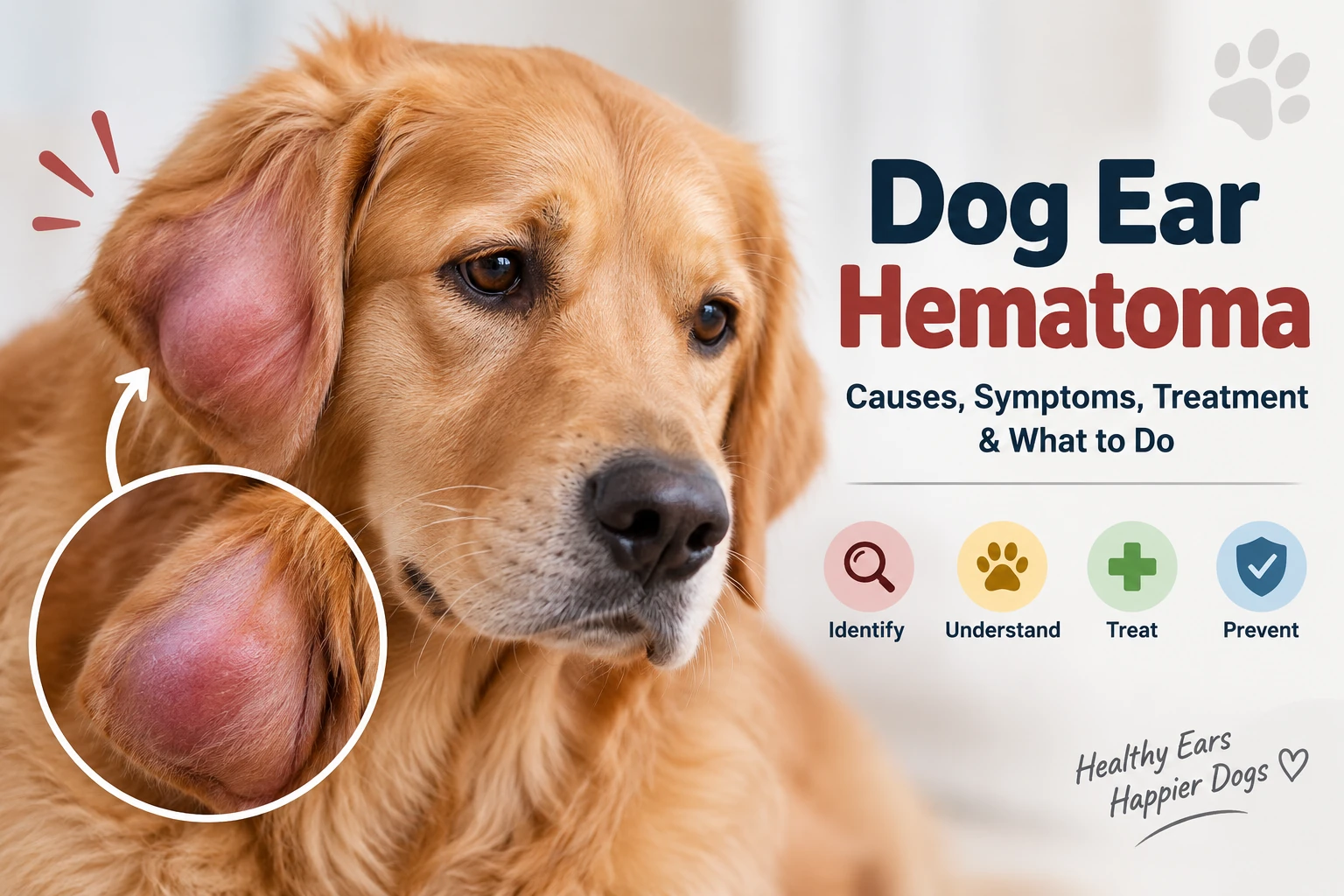
A dog ear hematoma is a pocket of blood that forms inside the ear flap, usually after small blood vessels break. It can make part or all of the ear flap look swollen, thick, soft, or spongy. The problem often develops after a dog repeatedly shakes its head or scratches an irritated ear.
A dog ear hematoma is not simply a grooming issue. The swelling itself needs veterinary assessment, and the reason the dog was scratching or shaking its head should also be investigated. Ear infections, allergies, parasites, foreign material, and other inflammatory conditions can contribute to the problem.
If you notice a new, fluid-filled swelling on your dog’s ear flap, contact your veterinarian rather than trying to drain it at home.
What Is a Dog Ear Hematoma?
A dog ear hematoma, also called an aural or auricular hematoma, is a collection of blood between the skin and cartilage of the ear flap, known as the pinna.
The swelling commonly appears on the inner or concave side of the ear. It can involve a small section of the ear or extend across much of the pinna. Early in the process, the swelling may feel soft, warm, and fluid-filled.
Some owners describe it as feeling like a small water balloon under the skin.
The important point is that the swelling is not usually the original problem. Something may have caused the ear to become itchy, painful, or irritated, leading the dog to scratch or shake its head forcefully enough to damage small blood vessels.
What Does a Dog Ear Hematoma Look Like?
A hematoma can look different depending on its size and how long it has been present.
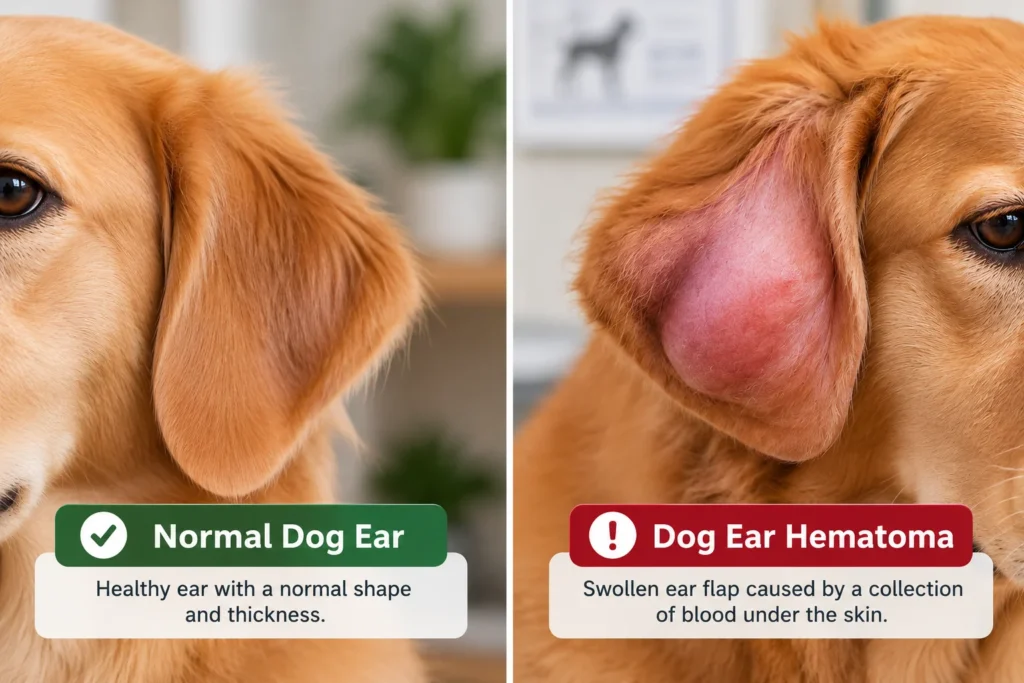
Common signs include:
- A sudden swelling of the ear flap
- A thickened or puffy section of the pinna
- A soft or spongy feeling
- Warmth around the swollen area
- Sensitivity when the ear is touched
- Head shaking
- Scratching at the ear
- Holding the ear differently than usual
The swelling may affect only one part of the ear or much of the ear flap.
As the hematoma becomes older, scar tissue can develop. This can leave the ear permanently thickened, wrinkled, or distorted, sometimes producing the appearance commonly called “cauliflower ear.”
What Causes a Dog Ear Hematoma?
The immediate cause is usually damage to small blood vessels within the ear flap.
But the bigger question is: why did those vessels break?
In many dogs, the chain looks something like this:
Ear irritation → itching or discomfort → scratching/head shaking → blood vessel damage → hematoma
Veterinary sources commonly associate ear hematomas with underlying ear irritation or inflammation.

Ear Infections
An outer-ear infection, known as otitis externa, can cause significant itching and discomfort.
A dog may shake its head repeatedly or scratch at the affected ear. That trauma can contribute to formation of a hematoma.
The infection itself therefore needs attention—not just the swollen ear flap.
Allergies
Allergic skin disease can cause inflammation and itching around the ears.
Merck Veterinary Manual notes that aural hematomas in dogs can occur in association with atopic dermatitis and food allergy when the ear canals are sites of allergic inflammation, itching, and secondary infection.
Parasites
Parasites can also irritate the ear.
For example, ear mites can cause ear irritation, scratching, and head shaking, and severe self-trauma can contribute to an aural hematoma.
Foreign Material
Grass, plant material, or another foreign object can sometimes irritate the ear canal.
The dog may respond by scratching or shaking its head, potentially contributing to vessel damage.
Trauma
A hematoma can also follow direct trauma to the ear, such as an injury or bite. The American College of Veterinary Surgeons lists external trauma among the possible causes.
In some dogs, bleeding or clotting problems may also contribute, particularly when a hematoma develops without an obvious history of scratching or trauma.
Is a Dog Ear Hematoma Painful?
It can be.
Dogs with an aural hematoma may show sensitivity when the ear is touched, and the underlying ear problem can itself be painful or intensely itchy. VCA describes aural hematomas as very painful and recommends prompt treatment.
Watch for behavior such as:
- Pulling away when you touch the ear
- Whining or becoming unusually quiet
- Repeated head shaking
- Scratching
- Rubbing the ear against furniture or the floor
- Holding the ear differently
- Becoming reluctant to have the head handled
Don’t repeatedly manipulate a swollen ear to see whether it is getting larger. If a new swelling is present, arrange a veterinary examination.
What Should You Do If Your Dog Has an Ear Hematoma?
The safest first step is simple:
Contact your veterinarian for an examination.
Your veterinarian needs to assess both the hematoma and the underlying reason for the ear irritation.
Depending on the situation, the veterinary examination may include looking into the ear canal and performing tests such as an ear swab or other diagnostic testing. The American College of Veterinary Surgeons notes that additional testing may be used to investigate infections, allergies, parasites, or other underlying causes.
Do Not Try to Drain It Yourself
A tempting response is to puncture the swelling with a needle or attempt to squeeze the fluid out.
Don’t do this at home.
A hematoma is a medical problem involving the ear’s tissues, and simply removing the fluid does not necessarily solve the underlying cause. The space can refill, and an improperly performed procedure can introduce infection or cause additional injury.
Veterinary treatment is designed not only to remove accumulated blood when necessary but also to reduce the space where fluid can collect again.
How Do Veterinarians Treat Dog Ear Hematomas?
Treatment depends on the individual dog, the size and age of the hematoma, the condition of the ear, and the underlying cause.
Veterinarians may use different approaches, including drainage techniques, medication in selected cases, or surgery.
Drainage and Stabilization
One goal is to remove accumulated blood or fluid and prevent the space from simply filling again.
Some veterinary techniques use drains, while others use sutures or other methods to bring the tissues together and reduce the dead space. A bandage or other support may also be used to protect the ear during healing.
Surgery
Surgery is one established treatment option, particularly when the hematoma requires a more definitive approach.
The exact procedure varies, but veterinary surgery commonly involves draining the hematoma and placing sutures to keep the tissues compressed while they heal.
Medical Management
Some hematomas may be managed medically in selected circumstances.
Veterinary sources describe approaches involving drainage and corticosteroid treatment or, in some cases, oral medication. The appropriate treatment depends on the individual case and should be determined by a veterinarian.
There is no single treatment that is appropriate for every dog.
Why Treating the Underlying Ear Problem Matters
This is one of the most important parts of managing a dog ear hematoma.
If the dog continues to have an untreated infection, allergy, parasite problem, foreign body, or other source of irritation, it may continue scratching and shaking its head.
That can increase the chance of recurrence.
The American College of Veterinary Surgeons specifically notes that recurrence is common when the underlying condition is not resolved.
For this reason, successful management isn’t simply:
“Drain the swelling.”
It is closer to:
Identify the irritation → treat the underlying problem → manage the hematoma → protect the ear while it heals.
What Happens If a Dog Ear Hematoma Is Left Untreated?
Some hematomas can eventually be reabsorbed by the body, but that does not mean leaving one alone is always a good option.
Untreated inflammation can lead to scar tissue and permanent thickening or wrinkling of the ear flap. In more advanced cases, the ear can develop the characteristic cauliflower-like appearance.
The altered ear can also become more difficult to examine or may partially obstruct the ear canal.
Because the underlying cause may still be present, waiting for the swelling to disappear doesn’t necessarily address the original problem.
How Can You Help Your Dog While Waiting for the Vet?
Until your dog can be examined:
- Keep the dog as calm as reasonably possible.
- Try to prevent vigorous scratching if you can do so safely.
- Don’t puncture, squeeze, or massage the swelling.
- Don’t put random medications or household products into the ear.
- Avoid repeatedly cleaning an obviously painful ear.
- Follow your veterinarian’s instructions if treatment has already started.
If your dog is scratching intensely, ask your veterinarian how to safely limit further self-trauma.
The goal is to avoid making the ear more irritated while arranging appropriate veterinary care.
When Is a Dog Ear Hematoma an Emergency?
A new ear-flap swelling generally warrants veterinary attention, but some accompanying signs make the situation more urgent.
Seek prompt veterinary care if your dog has:
- Severe pain
- Rapidly increasing swelling
- Significant bleeding
- Marked weakness or collapse
- Pale or white gums
- Trouble breathing
- Severe trauma
- A very painful or severely inflamed ear
- Neurological signs such as significant loss of balance
The urgency can also depend on the underlying cause and your dog’s overall condition.
If there is substantial external bleeding or signs of shock, veterinary emergency care is appropriate.
Can Dog Ear Hematomas Be Prevented?
You cannot prevent every hematoma, but you can reduce some of the problems that lead to one.
Regularly check your dog’s ears for:
- Unusual odor
- Redness
- Discharge
- Excessive wax
- Swelling
- Scratching
- Head shaking
- Sensitivity
If your dog repeatedly scratches its ears or shakes its head, don’t treat that behavior as normal grooming.
Early evaluation of the underlying ear problem may help prevent repeated self-trauma.
Good grooming also helps you notice changes sooner, but routine ear cleaning should not replace veterinary examination when an ear looks abnormal.
Dog Ear Hematoma vs. a Normal Ear Swelling
A normal dog’s ear flap should not suddenly develop a soft, fluid-filled pocket.
A useful distinction is:
| Normal ear | Possible hematoma |
| Normal shape | Sudden thick or swollen area |
| Normal temperature | May feel warm |
| No unusual sensitivity | May be painful or sensitive |
| No repeated head shaking | Head shaking may be present |
| No unusual scratching | Scratching may be frequent |
| No fluid-filled pocket | Soft, spongy swelling |
This table cannot diagnose a hematoma. Several ear conditions can cause swelling, so a veterinarian should confirm what is happening.
Frequently Asked Questions
What is a dog ear hematoma?
A dog ear hematoma is a collection of blood within the ear flap, usually caused by damage to small blood vessels. It commonly occurs after repeated scratching or vigorous head shaking associated with an irritated ear.
Can a dog ear hematoma heal on its own?
Some hematomas can gradually be reabsorbed, but spontaneous healing can leave the ear thickened, wrinkled, or permanently deformed. Veterinary assessment is recommended so the underlying cause and appropriate treatment can be determined.
Should I pop my dog’s ear hematoma?
No. Do not puncture or drain a suspected hematoma yourself. Veterinary treatment may involve controlled drainage and measures to prevent the space from refilling.
Why does my dog keep getting ear hematomas?
Recurrence can happen when the underlying cause of ear irritation has not been resolved. Ear infections, allergies, parasites, foreign material, and other conditions can cause scratching or head shaking that contributes to hematoma formation.
Is a dog ear hematoma dangerous?
An aural hematoma is not usually life-threatening by itself, but it can be painful and may cause permanent ear deformity if it is not appropriately managed. More importantly, the underlying ear condition may require treatment.
How long does a dog ear hematoma take to heal?
Healing time varies according to the size of the hematoma, treatment method, underlying ear condition, and how well the dog avoids further trauma. Veterinary aftercare is important because recurrence can occur if the ear continues to be irritated.
The Bottom Line
A dog ear hematoma is a blood-filled swelling in the ear flap that commonly develops after scratching or vigorous head shaking. The visible swelling is only part of the problem—the underlying cause of the ear irritation also needs attention.
If you notice a new swollen, soft, or spongy area on your dog’s ear, don’t puncture it or try to drain it yourself. Arrange a veterinary examination, especially if your dog is painful, repeatedly shaking its head, scratching, or showing signs of an ear infection.
The earlier the underlying problem is identified, the better the chance of protecting your dog’s comfort and reducing the risk of recurring hematomas or permanent ear deformity.