How to Remove Mats From a Dog: A Safe, Gentle Step-by-Step Guide
To remove mats from a dog safely, first determine how tight and close to the skin the mat is, then work gently from the outer edges with appropriate grooming tools. Small, loose mats may sometimes be loosened at home, but tight, extensive, painful, or skin-level mats are safer to have removed by an experienced professional groomer or veterinarian.
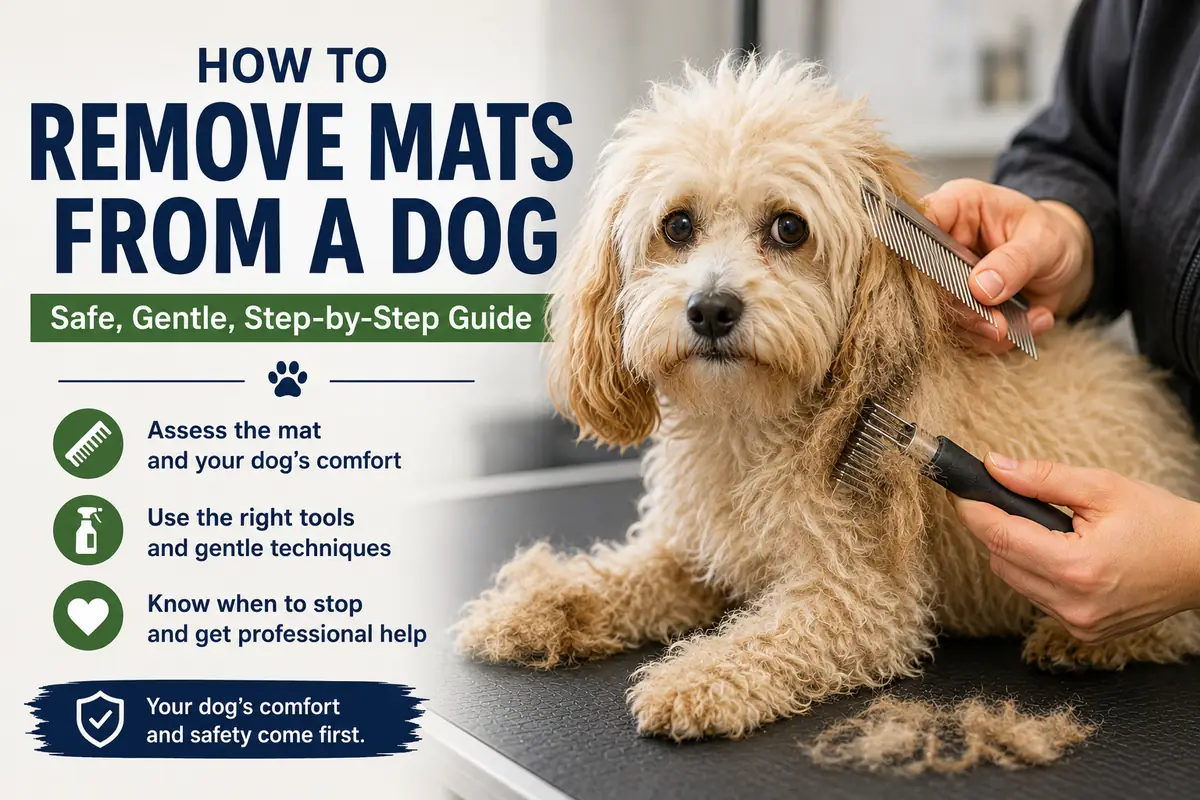
If you’ve just found a knot in your dog’s coat, don’t panic—and don’t immediately reach for scissors. A small tangle and a dense mat are two very different grooming problems. The safest approach depends on the size of the mat, where it is located, how tightly it has compressed, your dog’s tolerance for grooming, and what the skin underneath looks like.
Matting isn’t simply a cosmetic problem. Tight mats can pull on the skin, trap moisture and debris, and contribute to irritation and other skin problems. The New Zealand government’s dog-welfare guidance specifically recommends regular grooming to prevent matting and notes that mats can harbor external parasites and contribute to dermatitis.
What Is a Mat in a Dog’s Fur?
A mat is a tightly tangled mass of hair that has become compressed instead of separating normally.
Loose hair can become caught in the surrounding coat. Movement, moisture, dirt, friction, collars, harnesses, and repeated rubbing can gradually turn a simple tangle into a dense knot.
Mats commonly develop:
- Behind the ears
- Under the collar
- Under a harness
- Around the armpits
- On the chest
- Between the legs
- Around the belly
- Near the tail
- On feathered legs
- Around the paws
Professional groomer guidance notes that mats can become so close to the skin that they are difficult to see from the outside. A comb may appear to pass over the coat while a dense layer of tangled hair remains underneath.
Can You Remove a Mat From a Dog at Home?
Sometimes—but only if the mat is small, loose, accessible, and your dog remains comfortable.
A loose surface tangle is very different from a hard mat pressed tightly against the skin.
If you can gently separate the outer hair with your fingers and a comb begins moving through the tangle without significant pulling, you may be able to work it apart gradually.
If the mat feels hard, wide, tight, painful, wet, or attached closely to the skin, stop trying to remove it yourself.
Veterinary-reviewed guidance similarly recommends that large mats close to the skin be handled by a professional rather than repeatedly pulled or brushed at home.
First: Check How Severe the Mat Is
Before touching the brush, look at the mat carefully.
A small, loose tangle
You may be able to gently loosen this yourself.
A medium, compacted mat
Proceed cautiously. If your dog becomes uncomfortable or the mat doesn’t begin loosening, stop.
A large, dense mat
Professional removal is usually the safer choice.
A mat stuck against the skin
Don’t try to cut it out with household scissors.
A painful or irritated area
Don’t keep brushing it. Have the skin assessed.
A useful rule is simple:
If removing the mat requires force, it is no longer a good DIY grooming job.

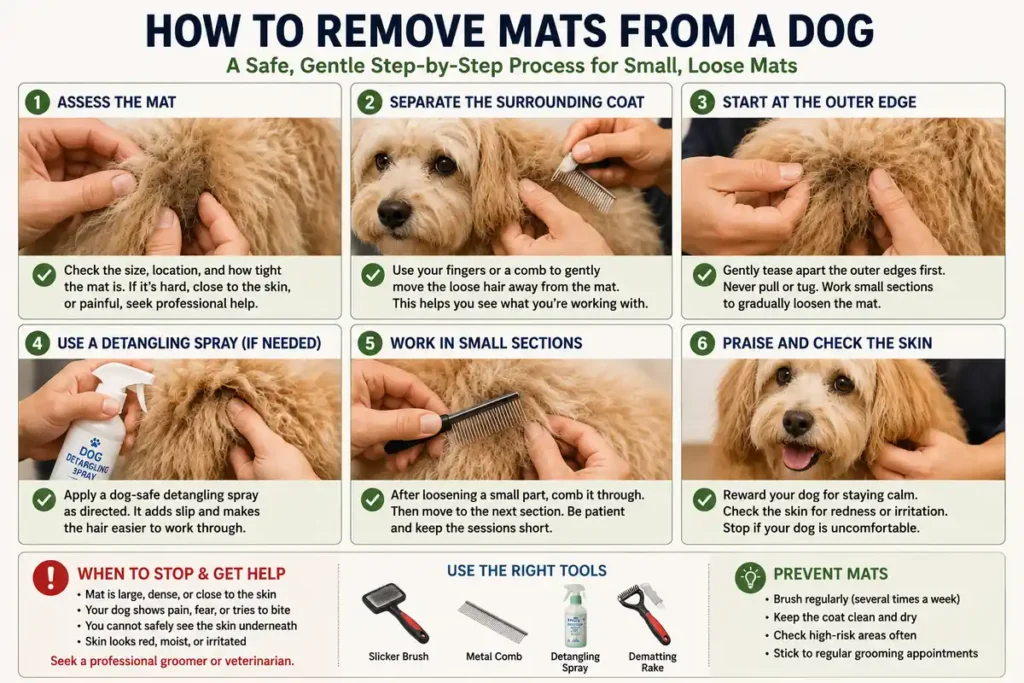
How to Remove a Small Dog Mat Safely
If the mat is genuinely small and loose, use a slow approach.
1. Choose a calm moment
Don’t start after your dog has already become frustrated with grooming.
Give yourself enough time to work without rushing.
Your dog should be relaxed and standing or lying comfortably.
2. Separate the surrounding coat
Use your fingers or a comb to move the unaffected hair away from the mat.
This lets you see what you’re actually dealing with.
It also prevents you from repeatedly brushing through healthy coat unnecessarily.
3. Start at the outer edge
Don’t attack the center of the knot.
Use your fingers to gently tease apart the outermost portion.
The goal is to make the mat smaller little by little.
If the hair doesn’t give easily, don’t pull harder.
4. Use a suitable grooming product if appropriate
A dog-safe detangling product can make working through a small tangle easier.
Use a product specifically intended for dogs and follow its directions.
Avoid improvising with household hair products or human cosmetics.
5. Work in tiny sections
Once a small section loosens, comb that section.
Then move to the next.
You’re essentially turning:
one large tangle → several smaller tangles → loose hair.
This is much gentler than trying to pull the entire mat apart in one pass.
6. Keep the skin supported
When working around a small tangle, keep your hand close to the base of the hair and avoid pulling the entire coat against the skin.
This reduces unnecessary movement of the skin.
If your dog starts reacting strongly, stop.
Never Use Scissors to Cut a Mat Close to the Skin
This deserves its own warning.
Don’t slide scissors underneath a tight mat and cut toward the skin.
It’s surprisingly easy to mistake skin for tangled hair, particularly when the mat is dense.
The Atlantic Professional Groomer’s Association warns that owners can accidentally cut dogs while attempting to remove mats with scissors and says severe matting is often better handled by clipping the coat rather than painfully dematting it.
The risk is especially concerning:
- Behind the ears
- Around the armpits
- On the belly
- Around the groin
- Between the legs
- Near the tail
- Around facial areas
If a mat is tight enough that you cannot clearly see where the skin ends and the hair begins, don’t cut it yourself.
Should You Bathe a Dog Before Removing Mats?
No. Remove the mats or have them professionally addressed before bathing.
Water can cause an existing tangle to tighten and become more difficult to separate.
Current professional grooming guidance specifically advises dealing with matting before bathing because wetting an already matted coat can make the problem worse.
A better sequence is:
Assess → detangle or professionally clip → brush/comb → bathe if needed → dry thoroughly.
Don’t put a heavily matted dog straight into the bathtub hoping shampoo will somehow loosen everything.
What Tools Do You Need?
For a small, manageable tangle, you don’t need a huge grooming kit.
Fine or medium-tooth comb
Useful for checking whether the coat is actually free of tangles.
Slicker brush
Useful for separating loose coat and working through light tangles.
Dog-safe detangling spray
Can help with manageable knots when used according to the product instructions.
Your fingers
Often the best starting point for a small mat because you can feel how much resistance you’re creating.
Clippers
These are generally more appropriate for significant matting when the coat needs to be clipped rather than painfully brushed apart.
The exact tool should depend on the coat and severity of the mat—not on how quickly you want the grooming session finished.
What If the Mat Is Very Tight?
Stop trying to brush it out.
A tight mat can pull directly on the skin with every stroke.
Repeatedly attacking it with a dematting tool can turn grooming into a painful experience and may damage the coat or irritate the skin.
Professional groomers may determine that clipping the matted section is the most humane option.
The Atlantic Professional Groomer’s Association describes severe dematting as potentially painful and identifies clipping the coat as the most humane and often necessary solution for severe matting.
It may feel disappointing to lose some coat length, but a shorter, comfortable coat is better than keeping a painful mat simply to preserve the hairstyle.
When Should You Take a Matted Dog to a Groomer?
A professional groomer is the better choice when:
- Mats cover a large part of the body
- Mats are close to the skin
- The coat feels like a solid sheet
- Your dog becomes distressed when you touch the mat
- You cannot determine where the skin is
- Several areas are heavily matted
- Your dog has a history of snapping during grooming
- The matting has been present for a long time
A professional can assess whether the coat can be safely detangled or whether clipping is the better option.
For severe matting, especially when the skin underneath looks abnormal, veterinary input may also be appropriate.
When Does Matted Fur Become a Health Problem?
A mat can create more than a grooming inconvenience.
Tight hair can continuously pull on the skin. Mats can also trap moisture, dirt, and debris against the body.
The New Zealand government’s dog-welfare guidance specifically warns that mats can harbor external parasites and that dermatitis can develop underneath them.
Look underneath and around the mat for:
- Redness
- Moisture
- Swelling
- Bad odor
- Broken skin
- Discharge
- Bleeding
- Tenderness
- Persistent licking
- Scratching
If you see these signs, don’t treat the problem as a simple knot.
Your dog may need veterinary assessment.
What About Mats Behind a Dog’s Ears?
Mats behind the ears deserve extra caution.
The hair is often fine, the area moves constantly, and the skin is difficult to see through dense tangles.
If it’s only a small loose tangle, you can carefully work from the outer edge.
But if the mat is:
tight + close to the skin + painful
leave it alone and contact a professional.
Current guidance specifically warns against cutting painful ear-area mats with scissors because of the risk of cutting the thin skin underneath.
What About Mats Under a Collar or Harness?
These are common trouble spots because of friction and moisture.
Check the coat regularly around:
- Collar lines
- Harness straps
- Chest straps
- Behind the front legs
When safe to do so, remove the collar or harness before examining the coat.
A recent 2026 grooming guide specifically identifies behind the ears and harness lines as areas where movement, pressure, friction, and moisture can encourage mat formation.
Don’t wait until you can visibly see a huge knot.
Run your fingers through these areas regularly.
Should You Brush a Matted Dog Every Day?
Not necessarily.
Brushing frequency should prevent mats from forming rather than become a punishment for an existing severe mat.
For a coat that mats easily, frequent short grooming sessions may be more practical than one long weekly session.
A current professional grooming guide recommends consistent brushing for high-risk coats and emphasizes identifying the areas where individual dogs mat fastest.
Your dog’s coat type matters.
A short-coated dog may need much less grooming than a Poodle, Doodle, Shih Tzu, Maltese, or another coat that continuously grows and tangles.
How to Prevent Mats From Coming Back
Removing the mat is only half the job.
The next step is figuring out why it formed.
Brush to the skin
Don’t simply brush the surface of a fluffy coat.
Use an appropriate comb to check that you’re reaching through the coat.
Check high-risk areas
Pay special attention to:
- Behind ears
- Armpits
- Collar area
- Harness area
- Belly
- Tail
- Legs
- Paws
Keep the coat dry
Moisture can contribute to tangling, particularly in already knot-prone coats.
Don’t skip grooming appointments
If your dog needs regular professional trimming, stretching appointments too far apart can allow small tangles to become serious mats.
Check after swimming
Wet coats can tangle more easily.
Give the coat an appropriate brush and comb once it’s ready to be groomed.
Build a realistic routine
A five-minute grooming check several times a week may be more effective than remembering to do a massive grooming session once a month.
What If Your Dog Hates Mat Removal?
This is where grooming and behavior overlap.
If your dog already associates brushing with pulling and pain, forcing the process can make future grooming harder.
Keep sessions short.
Reward calm behavior.
Work on an easy area first.
Don’t begin with the most painful mat.
If your dog is growling, snapping, trembling, or repeatedly trying to escape, stop and seek professional help.
This is especially important because our previous article on dog grooming for anxious dogs covers gradual handling and positive grooming experiences in more detail.
That makes a natural internal link between the two PetCoGrooming articles rather than forcing an unrelated link into the page.
Can You Remove Mats Without Cutting the Hair?
Sometimes, yes—but only when the mat is small and loose enough to separate safely.
Not every mat should be brushed out.
If the hair has compressed into a dense layer against the skin, removing it without clipping may cause unnecessary pain.
The goal isn’t:
“Save every strand of hair.”
The goal is:
“Remove the mat without hurting the dog.”
That distinction is important.
A professional groomer may decide that clipping is the safest solution, particularly for severe or extensive matting.
The Safest Decision Tree for Dog Mats
Use this simple check:
Small + loose + dog comfortable?
Try gentle home detangling.
Medium + resistant?
Stop if there’s pulling or discomfort and consider a groomer.
Large + dense + close to skin?
Professional removal.
Pain, redness, odor, bleeding, or discharge?
Veterinary assessment.
Dog is trying to bite because of fear or pain?
Stop and get professional help.
This decision tree is much safer than applying the same brush-and-pull technique to every type of mat.
Frequently Asked Questions
A severely compacted mat should generally be assessed by an experienced groomer or veterinarian rather than aggressively brushed at home. If the mat is tight against the skin, painful, extensive, or impossible to separate without force, clipping may be the safer and more humane option.
It’s better not to rely on household oils as a universal detangling solution. Use a product specifically formulated for dogs if you need additional slip, and follow its directions. The bigger issue is whether the mat is actually safe to detangle.
Usually, you should not bathe a heavily matted dog first. Water can tighten existing tangles and make them harder to remove. Deal with the mat before bathing whenever possible.
Avoid cutting a tight mat with household scissors, especially when it is close to the skin. The risk of accidentally cutting the dog is significant. Professional groomers have safer methods for removing difficult mats.
Yes. Tight mats can pull on the skin and cause discomfort. Severe matting can also be associated with irritation and skin problems.
Common contributors include loose shedding hair, long or curly coats, friction, moisture, inadequate brushing, collars or harnesses, and areas that are difficult to reach during routine grooming.
Common locations include behind the ears, under the collar or harness, armpits, belly, legs, tail, and paws.
Severe matting may require clipping, but the decision should be made based on the condition of the coat and skin. If the mats are extensive or close to the skin, having a professional handle the clipping is safer than attempting it yourself.
Severe matting can trap moisture, dirt, and debris against the skin and is associated with skin irritation and dermatitis. If you notice redness, odor, discharge, sores, or pain underneath a mat, seek veterinary advice.
Regular brushing and combing, keeping the coat appropriately maintained, checking friction areas, and keeping up with professional grooming when needed are the most practical prevention steps.
Final Answer: How to Remove Mats From a Dog Safely
Small, loose mats can sometimes be worked apart gently at home, but dense mats should never be attacked with force or household scissors.
Start by checking the mat and the skin around it. If it is loose, work from the outside inward with your fingers and an appropriate comb, taking small sections and stopping whenever your dog becomes uncomfortable.
If the mat is tight, extensive, painful, wet, or close to the skin, don’t turn the grooming session into a struggle. A professional groomer can determine whether it can be safely detangled or whether clipping is the more humane option.
And if the skin underneath is red, swollen, moist, bleeding, foul-smelling, or painful, move beyond grooming advice and involve a veterinarian.
The easiest mat to remove is the one that never becomes a mat in the first place. Regular coat checks, consistent brushing, and attention to high-friction areas can prevent a small tangle from becoming a painful grooming problem.