Comfort-First Grooming for Senior Dogs: Practical Ways to Adapt Each Session
Senior dog grooming · Comfort before the checklist
The best way to groom a senior dog is to focus on what they comfortably manage today. Prepare a stable, nonslip space, keep supplies close, and adapt each task to your dog’s preferred position and tolerance. You do not need to complete every grooming task in one session.
Pause when your dog seems tired or uncomfortable, and talk with your veterinarian about new or persistent difficulty standing, walking, or getting up. A dog’s age alone does not determine what grooming should look like. Some older dogs remain comfortable with their familiar routine; others need changes to the setup, the order of tasks, or the amount handled at once.
What can make grooming harder for an older dog?
Grooming often asks a dog to stand, shift position, lift a paw, or tolerate handling in areas they cannot easily see. These demands may become tiring or uncomfortable for some senior pets. VCA Yorba Regional notes that the movement and standing involved in a full grooming session can leave senior pets tired, sore, or stiff (VCA Yorba Regional’s grooming information). This is a reminder to discuss your own dog’s needs with the people caring for them—not a rule that every older dog will have the same limits.
Pay attention to changes in your dog’s usual movements. The American Animal Hospital Association (AAHA) recommends watching a pet’s posture and movement. Notice how easily your dog rises, stands, and walks. Discuss new or persistent difficulty with your veterinarian (AAHA’s guide to assessing a senior pet’s quality of life). Do not assume a new reluctance to stand or be handled is simply an inevitable part of getting older. If your dog seems uncomfortable, stop the task that is causing difficulty. When the change is new, persistent, or concerning, ask your veterinarian for guidance.
Prepare a comfortable grooming space
A good setup reduces unnecessary movement and makes it easier to stop when your dog needs a break. Prepare the area before inviting your dog over, so you are not reaching across them or leaving them waiting while you look for tools.
Choose a stable, nonslip surface
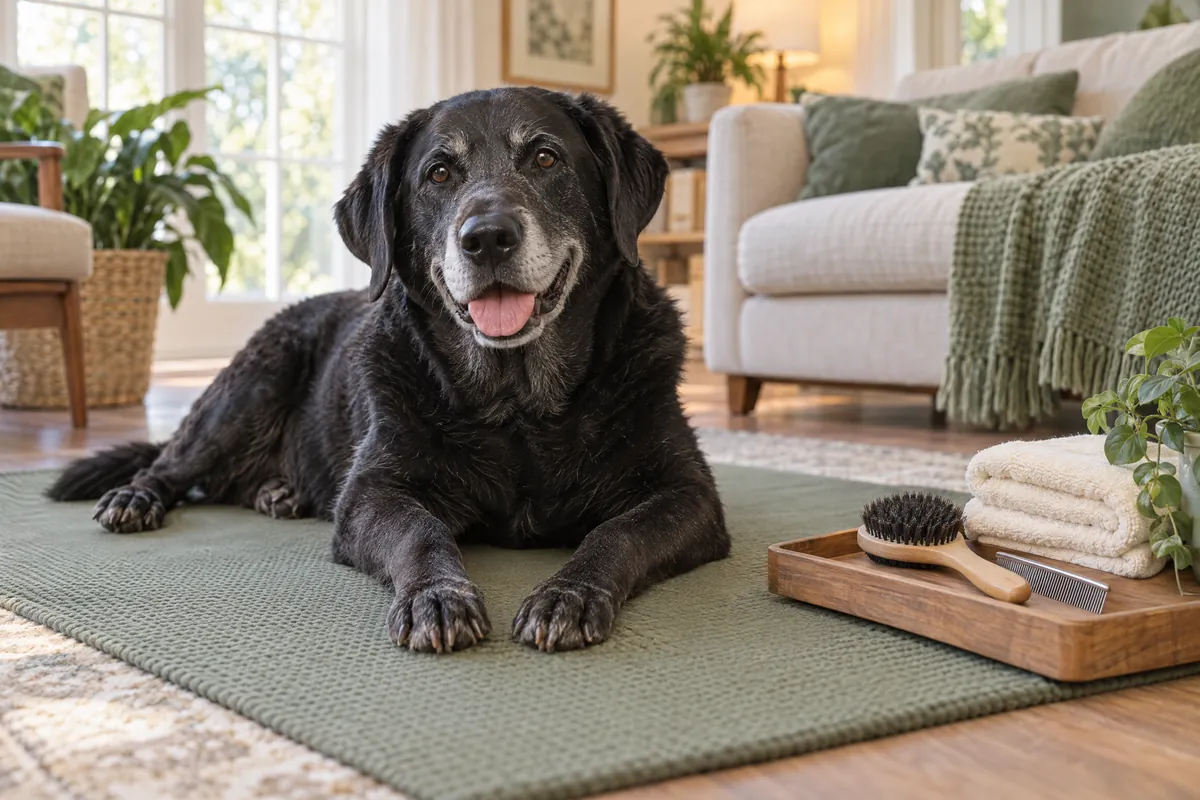
Use a level place where your dog can stand or lie down comfortably. A nonslip mat or rug that stays in place can be a useful home accommodation; AAHA includes nonslip rugs among options to consider for senior pets (AAHA’s senior-pet guidance). Make sure the surface does not bunch up or slide underfoot.
A floor-level setup may be easier if your dog is comfortable approaching and using it. Do not improvise an elevated grooming station or place your dog on a high surface if getting on or off it is difficult. Choose a location your dog can access naturally, and ask your veterinarian or groomer if you are unsure what arrangement suits your dog.
Keep tools within reach
Gather towels and a suitable brush or comb before starting. Include nail-care tools only if your dog is comfortable with paw handling. Keep supplies close enough that you do not need to leave your dog unattended or lean awkwardly over them.
Good lighting helps you see the coat and the area you are working on without repeatedly moving your dog. Keep the room at a comfortable temperature, particularly if the routine includes washing. A simple setup is often enough; adding equipment is not useful if it makes the space harder for your dog to enter or use.
Let your dog choose a comfortable position
Some dogs prefer to stand briefly, some settle into a sit, and others are more comfortable lying down for certain tasks. Let your dog use a natural position that they can maintain comfortably. Do not force a position, stretch a limb, lift the dog manually into place, or restrain them to reach an area.
A position that works for one task may not work for another. You might be able to brush the top of your dog’s back while they stand, but find that reaching underneath a leg requires an awkward shift. Leave that area for another time or ask a groomer how it can be handled comfortably. Finishing every patch of fur is less important than avoiding a struggle.
Plan each session around your dog’s tolerance
Instead of treating grooming as one long checklist, divide it into small, useful tasks. Choose priorities based on what needs attention and what your dog is comfortable doing that day.
Start with the most useful task
Choose one useful task that suits your dog’s coat and routine. You could gently brush an accessible area or check for visible tangles and debris. Another option is a gentle spot cleanup. Consider nail care separately, and only if your dog accepts it comfortably. Cosmetic styling can wait when your dog is tiring or finding handling difficult.
The best starting point depends on the dog and the task. Your dog may accept a brief coat check but dislike paw handling. In that case, do the coat check. Leave the feet for a different session or a professional.
Keep sessions flexible rather than following a timer
There is no single session length that fits every senior dog. Watch your dog’s response instead of aiming for a fixed number of minutes. If they start shifting away, repeatedly trying to sit or lie down, or no longer seem comfortable in the position, pause.
If they settle and appear comfortable, you can decide whether another small task makes sense. A break is not a failure. You can leave a task unfinished even after starting it. Avoid pushing through resistance in the hope that your dog will simply get used to it.
Make the stopping point clear
Before starting, decide what “enough for today” could look like. For example, check and gently brush the back and sides. You can stop there instead of attempting every leg and paw. Another day, you may only manage a quick look at the coat and a gentle cleanup of one accessible area.
Keep a simple note of what went comfortably and what did not. This can help you avoid repeating an awkward approach and gives a groomer useful information. It is not a diagnosis or a formal assessment; it is a record of your dog’s observed preferences and limits.
Adapt coat care without pulling or forcing
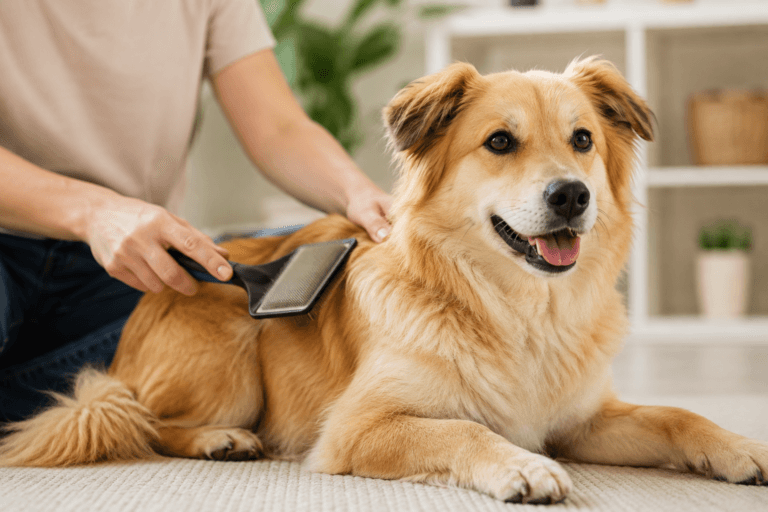
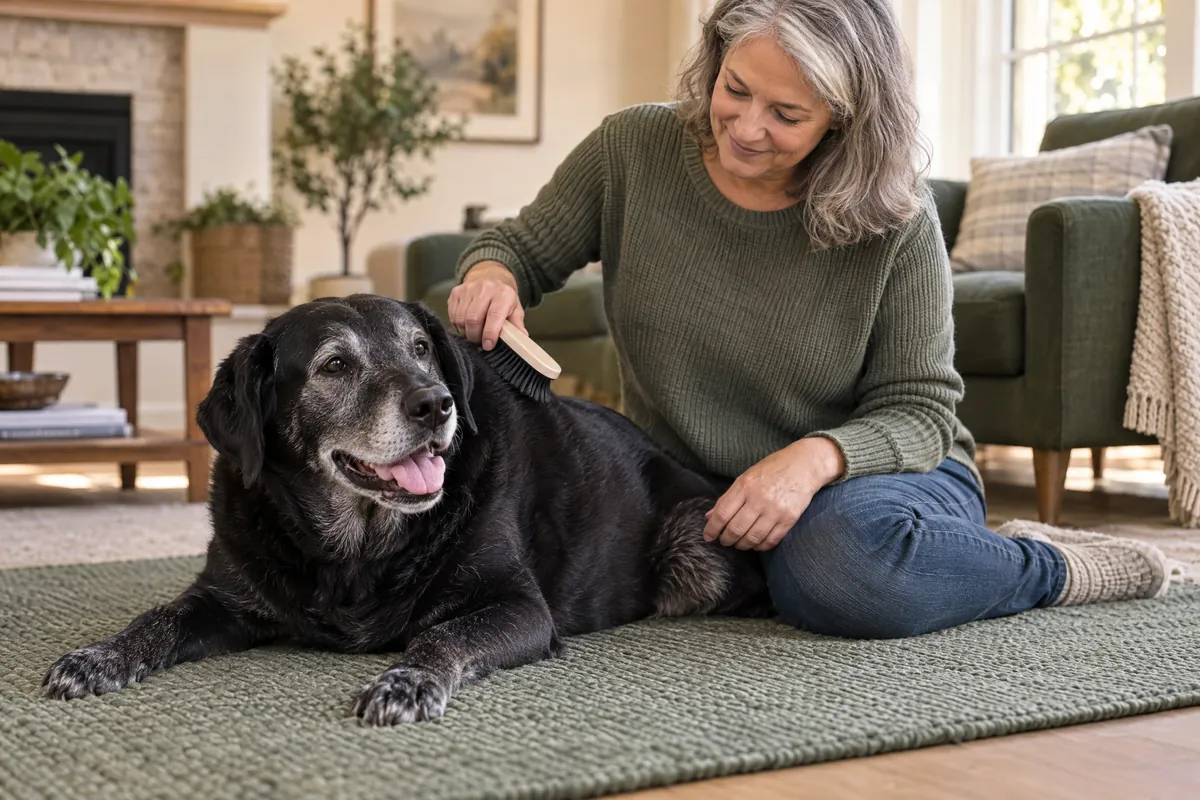
Coat care should be gentle and appropriate to your dog’s coat. VCA’s grooming guidance recommends avoiding excessive pulling during brushing and getting professional help with extensive mats or burrs (VCA’s grooming and coat-care guidance). Work only where the brush or comb moves through the coat without pulling. If you encounter resistance, stop and look at the area rather than repeatedly drawing the tool through it. Do not yank at tangles or try to make a tight clump separate by force.
Do not cut mats out with scissors. Mats can sit close to the skin, making it difficult to tell where the fur ends and skin begins. VCA advises professional help for extensive matting and veterinary attention when the skin beneath mats appears irritated. If a mat is tight, extensive, painful to handle, or close to the skin, leave it for a qualified groomer or veterinarian to assess.
You can make progress without completing the whole coat. Gently care for accessible areas and note where tangles remain. Arrange help for sections your dog cannot comfortably tolerate.
Approach nail care as a separate decision
Nail care may be part of your dog’s routine, but it should not become a task you force through when paw handling is uncomfortable. Consider whether your dog can remain in a natural position while you inspect or handle a paw gently. If they pull away, become distressed, or seem uncomfortable, stop rather than holding the paw in place.
This article is not a nail-trimming tutorial. If your dog is comfortable with nail care and you want step-by-step instructions, see our guide to how to trim a dog’s nails. If you cannot work safely without forcing the position, or the nails are difficult to manage, ask a qualified groomer or veterinarian for help. Do not use nail trimming as a way to treat pain or improve mobility.
Plan bathing and professional grooming around access
A bath or full grooming appointment can involve more movement and standing than a small home-care task. Consider what your dog can comfortably manage, what needs to be done, and whether a professional setting is the better option. Salons do not all offer the same setup. Ask how the groomer accommodates dogs who need breaks or cannot stand for long.
Before booking, explain that your dog is older and describe the specific limits you have observed. Ask whether the groomer can work with a dog who may need to remain on a stable, accessible surface, change position, or pause between tasks. If your dog has difficulty getting into a vehicle or entering the grooming space, mention that too so you can discuss realistic options in advance.
A professional appointment is not automatically easier for every dog, and home grooming is not automatically better. The right choice depends on the tasks required, your dog’s comfort, and the groomer’s actual capabilities. Home bathing or drying may require lifting, awkward positions, or more standing than your dog can tolerate. If so, discuss alternatives with your veterinarian or groomer. Do not improvise a risky setup.
For general service planning, our dog grooming services guide can help you think through what to discuss when choosing a provider. Confirm any specific accommodations directly; do not assume a particular table, bathing station, or drying method is available at every salon.
What to tell your groomer before the appointment
Useful information is specific and observable. Instead of saying only that your dog is “old” or “stiff,” describe what you have noticed and what helps your dog stay comfortable.
Comfortable positions: whether your dog usually prefers standing, sitting, or lying down for care.
Standing tolerance: whether they tend to need a break or change position during ordinary grooming tasks.
Areas they accept: for example, whether gentle brushing along the back is comfortable but paw handling is not.
Tasks to prioritize: the most important coat-care or hygiene needs for this visit.
Signals to pause: behaviors you have noticed when your dog is becoming uncomfortable, such as repeatedly moving away.
Recent changes: any new or persistent difficulty with rising, standing, walking, or being handled that you have discussed—or plan to discuss—with your veterinarian.
You can send a short note such as: “My dog accepts gentle brushing along the back while standing. However, prolonged standing and paw handling are uncomfortable for them. Please focus on coat areas my dog comfortably tolerates. Offer breaks as needed, and stop if my dog becomes uncomfortable.
Please contact me before attempting any difficult mats or tasks that require a position they cannot manage.” Adapt the note to your own observations. Do not promise that a groomer can complete every task; ask what is realistic based on their setup and experience.
When should you pause and ask for help?
Stop a grooming task if your dog shows discomfort, cannot remain in the position without struggle, or reacts as though an area hurts. Do not force the limb or body into a different position, hold your dog down, or continue simply to finish the checklist.
If your dog has new or persistent difficulty rising, standing, or walking, contact your veterinarian rather than assuming the change is normal aging. Seek veterinary guidance for an injury, skin that appears irritated beneath a mat, or a concern that cannot be safely assessed during ordinary grooming. Leave extensive mats, difficult burrs, and coat tangles that cannot be eased gently to a qualified groomer or veterinarian.
If the immediate task is not essential, postponing it is often the simplest choice. If it does need attention, explain the difficulty and ask for help rather than attempting a forceful home workaround.
Quick answers
Should every senior dog have shorter grooming sessions?
Not necessarily. Individual comfort matters more than age alone. Some dogs may tolerate their familiar routine. Others do better when you divide tasks and offer breaks. Watch the dog in front of you rather than following a fixed time target.
Is lying down always the best position for grooming?
No. Use a position your dog can enter and maintain comfortably. Some tasks may be easier while standing; others may be possible while sitting or lying down. Do not force a position or reposition your dog manually to reach a difficult area.
What if my dog will not let me brush a matted area?
Do not pull through the mat or cut it out with scissors. Leave difficult or extensive matting to a qualified groomer or veterinarian, and seek veterinary guidance if the skin beneath it looks irritated.
What if my dog has recently started struggling to stand?
Do not treat a new or persistent change as just a grooming inconvenience. Pause the difficult task and discuss the change with your veterinarian. In the meantime, adapt grooming to positions your dog can manage comfortably.
Sources
American Animal Hospital Association (AAHA), How to Assess Your Senior Pet’s Quality of Life
VCA Yorba Regional, Pet Grooming
VCA Animal Hospitals, Grooming and Coat Care for Your Dog
VCA Animal Hospitals, Taking the Stress Out of Nail Trimming for Dogs
Routine grooming education, not veterinary diagnosis or treatment. Contact your veterinarian about new or persistent difficulty moving, standing, or being handled. G1 and G2 are original AI-generated editorial illustrations, not photographs of an actual grooming session.