How to Wash Dog Bedding: A Practical Laundry Routine
1. Identify every part of the bed
Start by looking at how the bed is constructed. A “dog bed” may actually be several separate items: an outer cover, a cushion or insert, foam, a waterproof liner, a removable bolster, a blanket, or a built-in heating or cooling component. These parts may have different care requirements.
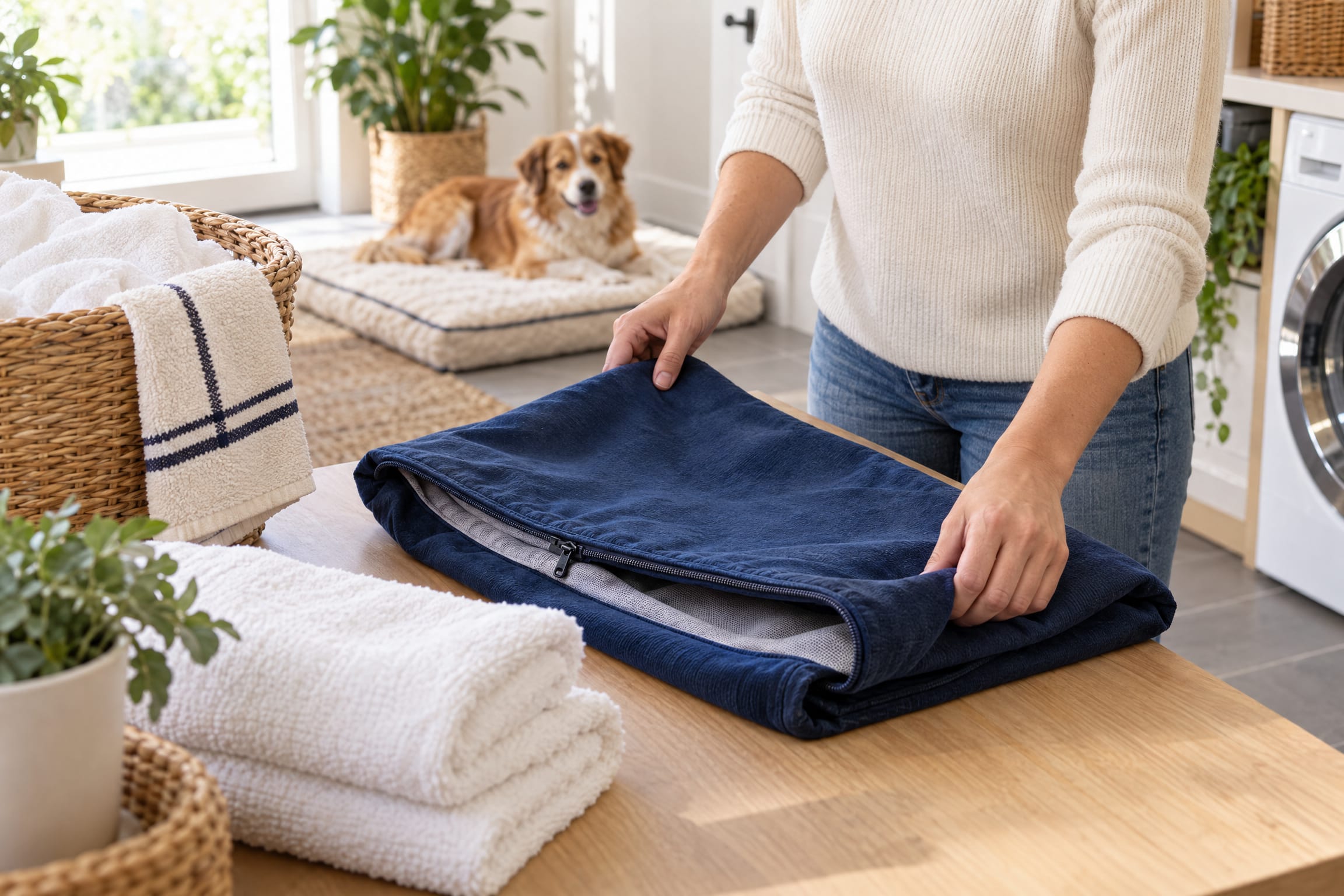
If the cover has a zipper, remove it only as the manufacturer intends. Check whether the cushion or insert has its own cover and whether the filling can be washed. A washable outer cover does not automatically mean the foam or inner cushion is machine-washable.
Read the care label on each removable component, not just the label attached to the outer cover. Look for instructions about machine washing, hand washing, spot cleaning, water temperature, cycle, detergent, and drying. Also check whether the label says not to wash or gives restrictions on tumble drying.
What if the label is missing or unclear?
Do not treat missing instructions as permission to try a machine cycle. Check the product paperwork or contact the manufacturer and ask how each component should be cleaned. This is especially important for foam, waterproof materials, structured inserts, and beds with electrical parts.
Never submerge an electrical component. If a bed includes a heating element, wiring, control, or other electrical feature, follow the manufacturer’s specific cleaning instructions for that model. If those instructions are unavailable, ask the manufacturer before cleaning it.
A few product examples show why it is worth checking the exact item. Kuranda’s care information distinguishes between accessories that may be machine-washed and a particular crate pad that calls for spot or hand washing and line drying. Those instructions apply to the specified products, not to dog beds generally. See the manufacturer’s care guidance for its bed pads and accessories .
2. Remove loose fur and dry debris first
Before adding bedding to the washer, remove as much loose fur and dry dirt as you reasonably can. Shake a removable cover or blanket outdoors if practical, or use a vacuum suitable for the material. Check seams, corners, and folds where fur tends to collect.
If the bed has a removable cover, take it off and deal with the cover and insert separately. Brush or vacuum only in a way that will not damage the fabric or surface. Do not pull at loose threads, scrape delicate coatings, or use a tool that could tear the material.
Removing loose debris first helps keep the washer load more manageable. It also makes it easier to see whether the item needs a full wash or whether the manufacturer allows a smaller spot-cleaning approach.
For muddy paws or outdoor dirt on the dog itself, use a separate pet-cleanup routine rather than turning the bedding wash into a dog-bathing task. Our guide to cleaning a muddy dog after a walk covers that separate job.
3. Choose detergent and a suitable wash cycle
Once you know which parts can be washed, check the care instructions again before choosing the cycle. The Centers for Disease Control and Prevention advises following the item’s care instructions and using detergent with a fabric-appropriate cycle and temperature. Its guidance on cleaning and disinfecting pet supplies treats ordinary cleaning as sufficient for routine situations; it does not mean every dog bed needs a special disinfecting process.
Choose detergent with the fabric and household routine in mind
Use a detergent suitable for the bedding material and follow the detergent label and washer instructions for the amount. More detergent is not automatically better. Avoid adding products simply to create a stronger scent or to make the bed seem more thoroughly cleaned.
If you prefer a simpler option, or someone in the household is sensitive to fragrance or dyes, a dye- and fragrance-free detergent may be a reasonable choice. The CDC notes this as a possible preference for sensitive skin, not as a treatment or a guarantee that irritation cannot occur.
Do not assume that a product marketed as “pet-safe” has one universal meaning or replaces the care label. Read the product directions and store laundry products securely. Do not add fabric softener or dryer sheets to the dog’s bedding; these are unnecessary for the routine described here.
Select a cycle and temperature the label permits
Use the cycle and water temperature allowed by the bedding’s care label. A fabric that tolerates one setting may be damaged by another. Maytag’s dog-bed washing guidance similarly advises checking the label and choosing a suitable cycle and water setting rather than assuming all beds can be washed alike.
Do not default to the hottest water or a particular cycle without checking. If the label allows a warmer setting, use it only as directed. If it specifies cold water or a delicate cycle, follow that instruction.
4. Wash only components that are suitable—and that fit
A bed must meet two conditions before it goes into the washing machine: the manufacturer must permit machine washing, and the item must fit comfortably in the washer. A bulky bed that is technically washable may still be too large for your machine.
Do not force a large cushion or packed bed into the drum, compress it to make the door close, or overload the washer with several bulky pieces. Bedding needs enough room to move through the wash as intended. If it does not fit, use a manufacturer-approved alternative, such as a suitable laundromat machine if the care instructions permit it, or ask the manufacturer about cleaning options.
Wash covers, blankets, and inserts separately when their labels call for different settings or when separating them helps the load fit properly. Do not machine-wash foam, waterproof layers, structured components, or electrical parts unless the instructions for that exact item explicitly allow it.
When spot cleaning or hand washing is the right option
Some components are not machine-washable. If the manufacturer allows spot cleaning, follow its instructions and use only the cleaning method it permits. If hand washing is specified, follow the stated method rather than transferring machine-wash instructions to that item.
For example, the Kuranda guidance linked above specifies spot or hand washing and line drying for one particular pad. That is a product-specific example, not a universal method for foam or waterproof dog bedding.
If you cannot confirm that a component is suitable for machine washing, do not experiment with a full wash cycle. Ask the manufacturer what to do.
5. Rinse appropriately and dry every layer completely
When the wash is finished, check the bedding before moving on. If the care instructions and your washer allow an extra rinse, it may be useful for a household routine where someone prefers additional rinsing. It is optional, not a treatment, and not a substitute for using the correct amount of detergent.
Drying needs just as much attention as washing. Check the care label for whether tumble drying is allowed and which settings are permitted. If machine drying is not allowed, use the manufacturer’s recommended air-drying method. Maytag’s guidance on washing dog beds advises following the product instructions and allowing the bed to dry fully before use.
Do not assume that every bed can tolerate high heat, or that every cover and insert should be dried the same way. Some fabrics, foams, waterproof layers, and structured parts may need different handling. Do not invent a drying time: thickness, material, airflow, and the manufacturer’s method all affect how long it takes.
Check the inside, not just the surface
A cover may feel dry while the cushion or filling underneath is still damp. Check every layer, including seams, folds, thick corners, and the center of an insert. If the bed has separate pieces, dry them separately when that is consistent with the care instructions.
Do not reassemble the bed or return it to your dog until all washable parts are fully dry. Damp filling can remain hidden beneath a dry-feeling cover. If you are unsure, give the item more time using the approved drying method.
6. Keep bedding manageable between washes
A laundry routine is easier when you deal with small messes before they become embedded in the bed. Shake out removable blankets, remove loose fur, and check the cover and seams when you tidy the dog’s resting area. If the manufacturer permits spot cleaning, follow those instructions for a small spill rather than automatically washing the entire bed.
The CDC gives weekly cleaning of pet beds and blankets as general household guidance, with more frequent cleaning when items are dirty or smell. That is a practical reference point, not a rigid schedule for every household or a guarantee against illness. Your dog’s use of the bed, visible dirt, odor, household needs, and the item’s care instructions all matter. See the CDC’s pet-supply cleaning guidance for its broader recommendations.
If your dog regularly rests on a removable blanket, washing that blanket may be simpler than repeatedly trying to fit a large bed into the machine. Keep a spare clean layer available if you have one, so the dog still has a familiar resting place while the main bedding dries.
For broader everyday coat, paw, and hygiene routines, see our dog hygiene guide . Bedding care is one part of keeping the dog’s resting area tidy; it does not replace cleaning the dog when they come home muddy.
7. Store laundry products and keep dogs away during washing
Laundry products need careful storage, especially in homes where a curious dog can reach shelves, baskets, or an open washer. Keep detergent containers, pods, softeners, and dryer sheets secured and out of reach. Do not leave a detergent pod, open liquid container, or used dryer sheet where a dog can chew or swallow it.
The ASPCA warns that detergent products and swallowed softeners or dryer sheets can cause serious injury. Its information on potentially poisonous household products is a useful reminder to keep laundry products secured and dogs away from them. If you suspect your dog has swallowed or been exposed to a laundry product, contact a veterinarian or animal poison-control service promptly rather than attempting home treatment.
Keep your dog away from the washer and dryer while they are operating, and do not let them play with wet laundry or loose sheets. Once the bedding is clean and fully dry, reassemble it according to the manufacturer’s design and return it to the dog’s resting area.
8. What to do when bedding is unusually soiled
For ordinary dirt, fur, and everyday odor, a normal wash using the care-label instructions and detergent is generally the appropriate starting point. Do not automatically add bleach, disinfectant, or multiple cleaning products to every load.
If the bedding is contaminated during an illness or by something unusual, ask your veterinarian what level of cleaning is appropriate and check the care label and relevant product directions. The right approach may depend on the nature of the contamination and the materials in the bed. Do not assume that a household recipe or a hotter wash is suitable for every situation.
Never mix bleach with other cleaners, including ammonia, or improvise chemical mixtures. If the manufacturer’s instructions and the veterinary advice do not clearly support a cleaning method, pause and ask for clarification rather than risking damage to the bed or using an unsuitable process.
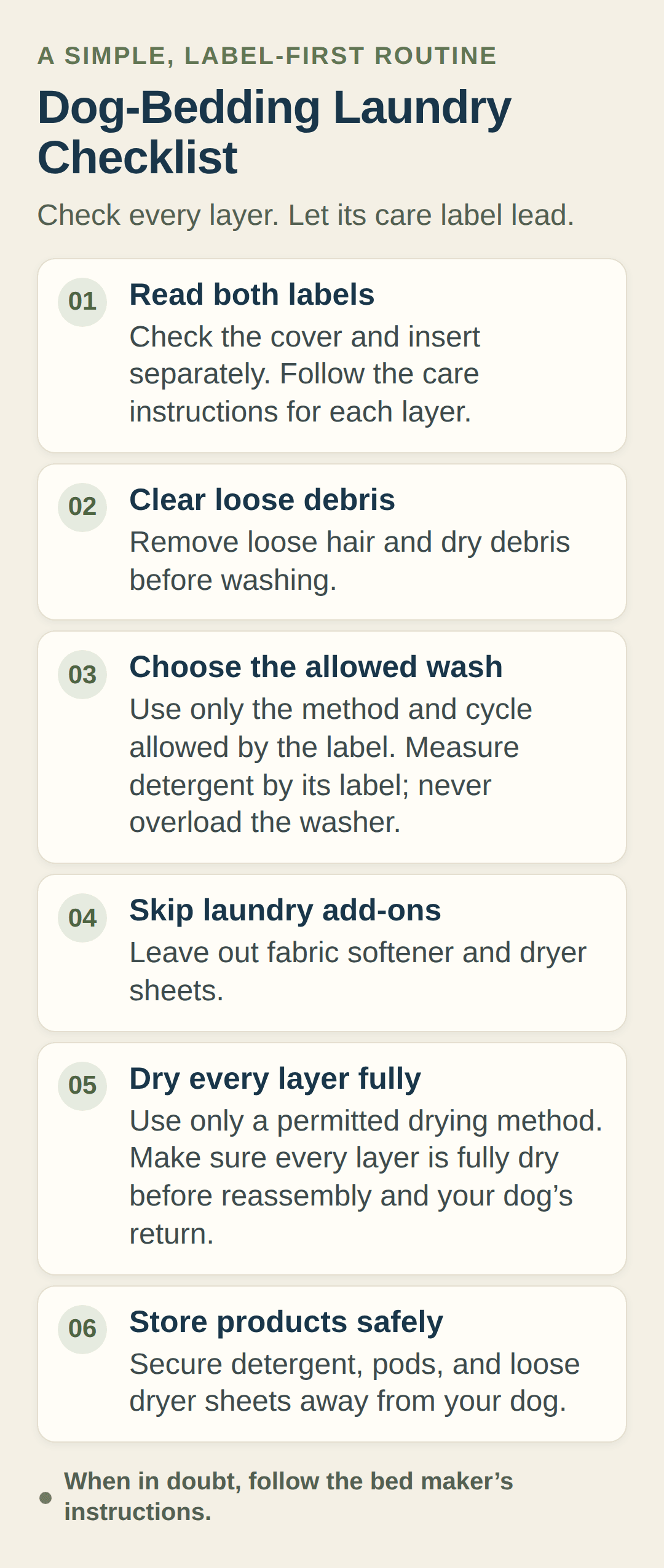
A practical dog-bedding laundry checklist
Before putting the bed back in your dog’s resting area, check that you have:
- Identified each removable part and read its care instructions.
- Confirmed which components may be machine-washed, hand-washed, or spot-cleaned.
- Removed loose fur and dry debris without damaging the material.
- Chosen detergent, cycle, and temperature suitable for the item.
- Checked that machine-washable pieces fit comfortably without overloading the washer.
- Used only the drying method allowed by the manufacturer.
- Checked that the cover, insert, seams, and every layer are completely dry.
- Stored detergent, pods, softeners, and dryer sheets securely away from your dog.
The most reliable dog-bedding routine is not a complicated cleaning formula. It is a careful sequence: identify the parts, follow each care label, remove loose debris, wash only what is suitable and fits, and dry every layer completely. When instructions are missing or a component is unusual, ask the manufacturer instead of guessing. That keeps the routine practical while respecting the materials your dog sleeps on.