Why Does My Dog Still Smell Bad After a Bath? Causes and What to Do
If your dog still smells bad after a bath, the problem may not be dirt on the coat. A persistent or quickly returning odor can come from damp fur, the ears, skin, mouth, anal sacs, or an underlying skin condition that shampoo alone cannot fix.
A bath should leave your dog smelling cleaner—not exactly perfume-fresh, perhaps, but noticeably better. So when the same unpleasant smell returns within hours or never really disappears, it’s understandable to wonder whether the shampoo failed.
Often, though, the shampoo isn’t the real issue.
The fastest way to figure this out is to stop asking, “How can I make my dog smell better?” and start asking:
“Where is the smell coming from?”
That one question can help you separate a normal temporary wet-dog odor from a problem that deserves attention.
First, Make Sure the Smell Is Actually Coming From Your Dog
Before assuming your dog’s body is the source, check the things closest to it.
A dirty collar, harness, bed, blanket, crate mat, or favorite couch spot can hold onto odor surprisingly well. If your dog comes out of the bath clean but immediately puts on the same smelly collar or lies on old bedding, the smell may seem to return instantly.
The American Kennel Club also recommends keeping collars, bedding, and other dog belongings clean because they can retain odors.
If the odor really is coming from your dog, try to identify the strongest area:
- Skin and coat
- Ears
- Mouth
- Rear end
- Paws or skin folds
The location and type of smell can provide useful clues.
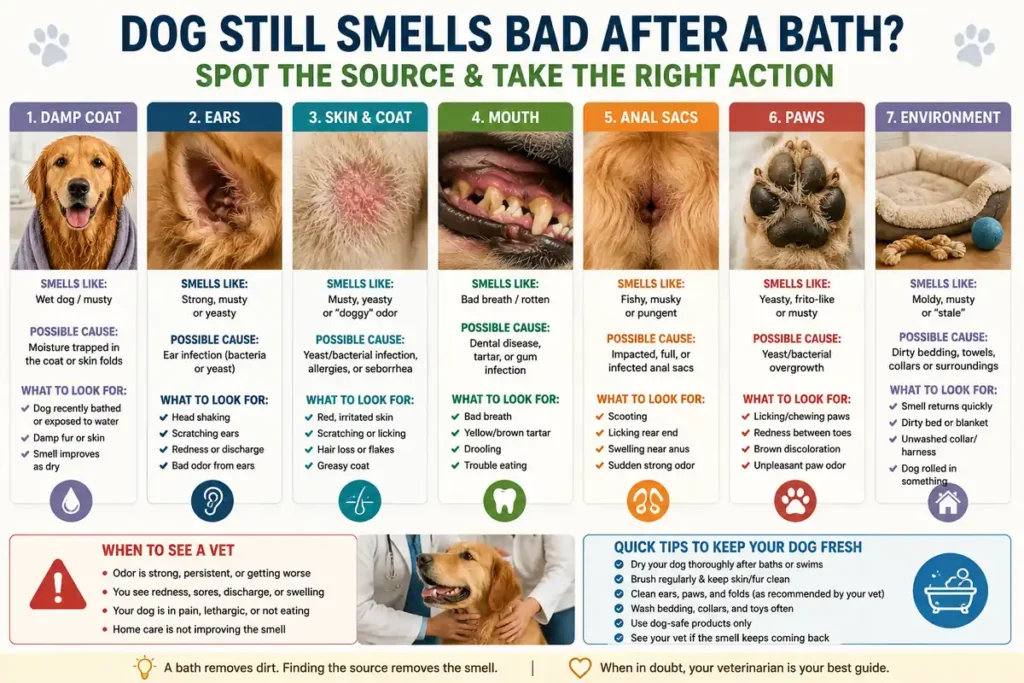
7 Reasons Your Dog May Still Smell Bad After a Bath
1. Your Dog Is Still Damp
A freshly bathed dog can develop the familiar “wet dog smell” while the coat is drying.
Dogs naturally carry microorganisms and oils on their skin and fur. When the coat gets wet, odor-producing compounds can become more noticeable. The smell should generally improve as the dog dries completely.
Dense coats, long hair, wrinkles, and skin folds can hold moisture longer. The AKC notes that some breeds and body types are more prone to odor because moisture can remain trapped in folds or around damp areas.
What you can do:
- Towel-dry thoroughly.
- Make sure dense areas are dry, not just the surface.
- Check under the collar and around skin folds.
- Keep the bedding and resting area clean.
If the smell disappears once your dog is completely dry, this is much less concerning than an odor that remains strong for days.
2. The Smell Is Coming From the Skin
If your dog smells bad even when completely dry, the skin deserves a closer look.
Yeast or bacterial overgrowth can produce a persistent unpleasant odor that bathing may temporarily mask without solving. The AKC identifies secondary yeast and bacterial infections on the skin or in the ears as common medical reasons for unpleasant dog odor.
You may also notice:
- Scratching
- Licking or chewing
- Red or darkened skin
- Crusting
- Hair loss
- Greasy-feeling areas
- A musty or unusually strong smell
A bath can wash the surface of the coat, but it cannot necessarily treat the underlying cause of a skin problem.
This is especially relevant if your dog also has itching, which may indicate a separate skin issue rather than a simple grooming problem.
3. Your Dog Has an Ear Problem
Sometimes the entire dog seems smelly, but the source is actually inside the ears.
According to VCA Animal Hospitals, ear infections can cause redness, inflammation, head shaking, scratching, discharge, and a bad odor.
Check whether the smell is strongest when you are near your dog’s head.
Possible warning signs include:
- Frequent head shaking
- Scratching at the ears
- Redness
- Dark, yellow, or unusual discharge
- Sensitivity when the ear is touched
- A strong odor from one or both ears
Don’t pour random cleaning products into an irritated ear. VCA specifically advises that the exact cause should be diagnosed before treatment because different infections and ear problems require different approaches.
4. Your Dog Has a Yeast or Bacterial Skin Infection
This is one of the reasons a dog can smell clean briefly after a bath and then develop the same odor again.
Yeast is normally present on canine skin, but under certain conditions it can overgrow. Skin allergies, inflammation, moisture, and other underlying problems can contribute to this process.
Current veterinary guidance published through Petco’s veterinary Q&A specifically identifies bacterial or fungal skin infections as possible reasons for persistent odor after bathing.
A strong musty odor combined with itching or skin changes is a good reason to schedule a veterinary examination.
The important point is simple:
If the source is a skin infection, more ordinary baths may not solve it.
5. The Smell Is Coming From Your Dog’s Mouth
A dog can be freshly washed from nose to tail and still smell unpleasant because the problem isn’t on the coat at all.
Bad breath can make owners think their dog’s entire body smells.
Get close enough to identify whether the odor is strongest around the mouth. Watch for other changes such as:
- Excessive drooling
- Difficulty chewing
- Dropping food
- Reluctance to eat
- Lip licking
- Visible dental buildup
Dental problems need veterinary attention rather than another bath.
If your dog’s breath has suddenly become unusually strong, don’t assume it is just “normal dog breath.”
6. Anal Sac Problems Can Create a Strong Fishy Smell
A distinctly fishy or musky smell near the rear end can point toward the anal sacs, often called anal glands.
Dogs have two anal sacs that produce a strong-smelling secretion. Cornell University College of Veterinary Medicine explains that this material normally releases when pressure is applied during defecation, but the sacs can sometimes fail to empty adequately and become impacted or inflamed.
You may also notice:
- Scooting
- Licking or biting around the rear end
- Discomfort
- Swelling near the anus
- A sudden release of very strong-smelling fluid
Don’t assume every fishy smell means an anal sac problem, but if the odor is clearly coming from that area, a veterinarian can examine your dog and determine what is happening.
7. Your Dog Is Picking Up the Smell Again
Not every odor is medical.
Dogs can quickly find something unpleasant to roll in, rub against, or walk through. Outdoor dogs may pick up odors from grass, mud, standing water, wildlife, or other environmental sources.
The AKC notes that dogs can also pick up scents from their surroundings.
Before assuming your dog’s shampoo isn’t working, think about what happened after the bath.
Did your dog:
- Roll in the yard?
- Go outside in wet weather?
- Lie on dirty bedding?
- Wear an unwashed collar?
- Rub against furniture or carpeting?
If the smell comes back only after specific activities, the environment may be part of the answer.
What Does the Smell Actually Smell Like?
The type of odor isn’t enough to diagnose your dog, but it can help you decide where to look first.
| Type of smell | Possible source to check |
| Temporary wet-dog smell | Damp coat |
| Musty or persistent skin odor | Skin or coat problem |
| Strong ear odor | Ear canal |
| Fishy or musky odor | Anal sac area |
| Bad breath | Mouth or teeth |
| Odor that returns after outdoor activity | Environmental exposure |
Think of this table as a starting point, not a diagnosis chart.
A veterinarian may need to examine the skin, ears, mouth, or anal sacs to determine the real cause.
What Should You Do if Your Dog Still Smells After a Bath?
Start with a calm inspection rather than immediately bathing your dog again.
Check That Your Dog Is Completely Dry
Feel beneath the outer layer of the coat.
Pay particular attention to:
- Neck
- Chest
- Armpits
- Groin
- Skin folds
- Under the collar
- Around the ears
A dog with a thick double coat may feel dry on top while remaining damp closer to the skin.
Find the Strongest Source of the Odor
Try to determine whether the smell is strongest around the:
- Ears
- Mouth
- Skin
- Paws
- Rear end
This information can also help your veterinarian or groomer understand the problem.
Look for Other Symptoms
Odor alone is one thing. Odor plus physical changes is more important.
Look for:
- Redness
- Scratching
- Excessive licking
- Hair loss
- Crusting
- Discharge
- Swelling
- Scooting
- Head shaking
The AKC advises paying attention to odor that becomes stronger and to accompanying changes such as redness, crusting, or discomfort.

Dog Odor Source Checker
Answer two quick questions to identify where your dog’s lingering smell may be coming from.
Where does the smell seem strongest?
Which description best matches the smell?
Don’t Keep Bathing Repeatedly to Cover the Smell
If a bath fixes the odor, great.
If the odor returns quickly every time, repeatedly washing your dog may only cover the symptom without identifying the source.
It can also make it harder to recognize whether an underlying skin problem is getting worse.
Instead, ask your veterinarian whether the odor requires an examination or whether a specific treatment is appropriate.
When Should You Call the Vet?
A veterinarian should check your dog when the smell is persistent, worsening, or accompanied by other symptoms.
Book an appointment if your dog has:
- Strong odor that quickly returns after bathing
- Red or inflamed skin
- Hair loss
- Crusting or sores
- Ear discharge or head shaking
- A painful or unusually swollen rear end
- Scooting combined with a strong fishy smell
- Significant bad breath with difficulty eating or chewing
- A sudden major change in normal body odor
Persistent odor isn’t always an emergency, but it can be an important clue.
Veterinary Q&A guidance on persistent post-bath odor repeatedly points to underlying issues—including skin infections, ear infections, and anal sac problems—when the smell doesn’t resolve with ordinary bathing.
How to Keep Your Dog Smelling Fresh Between Baths
Once you’ve ruled out a medical problem, basic grooming habits can help.
Keep the Coat Clean and Dry
Regular brushing removes loose hair and debris and gives you an opportunity to inspect the skin.
If your dog gets wet outdoors, dry the coat rather than allowing moisture to remain trapped for hours.
Wash Collars and Bedding
A clean dog can quickly pick up odor from dirty belongings.
Regularly wash:
- Collars
- Harnesses
- Beds
- Blankets
- Favorite washable toys
Use Products Made for Dogs
Human shampoos and heavily fragranced products aren’t automatically appropriate for canine skin.
If your dog has sensitive skin or has reacted to grooming products in the past, discuss suitable options with your veterinarian.
Keep Up With Regular Grooming
A consistent dog grooming schedule can help you spot changes in the skin and coat before they become harder to notice.
You can also review our guide on how to bathe a dog if you’re unsure whether your at-home bathing routine is covering the basics.
Frequently Asked Questions
If your dog is still wet, a temporary wet-dog smell may be normal. If the odor is strong and remains after the coat is completely dry, the source could be the skin, ears, mouth, anal sacs, or something in your dog’s environment.
Water can temporarily make existing odors more noticeable. If your dog consistently smells worse or quickly develops the same odor after bathing, check for skin, ear, or other health problems rather than simply switching shampoos repeatedly.
Yes. Yeast overgrowth on the skin can create an unpleasant persistent odor and may occur alongside itching or skin changes. A veterinarian can determine whether yeast is actually present and recommend appropriate treatment.
A fishy smell may come from anal sac secretions. If the odor is persistent or your dog is scooting, licking the area, or appears uncomfortable, have your veterinarian examine the area.
The answer depends on why your dog smells. More frequent bathing won’t necessarily solve an odor caused by an ear infection, skin infection, dental disease, or anal sac problem. If the smell keeps returning, identifying the cause is more useful than simply increasing the number of baths
The Bottom Line
If your dog still smells bad after a bath, don’t automatically blame the shampoo or assume your dog simply needs another wash.
First, make sure the smell isn’t coming from damp fur, bedding, or a collar. Then try to identify whether the odor is strongest around the skin, ears, mouth, or rear end.
A temporary wet-dog smell is one thing.
A strong odor that repeatedly returns—especially alongside itching, redness, discharge, head shaking, scooting, or other symptoms—is another.
In that situation, the best solution is usually not a stronger fragrance.
It’s finding the real source of the smell.