Dog Shampoo: How to Choose a Gentle Formula for Your Dog
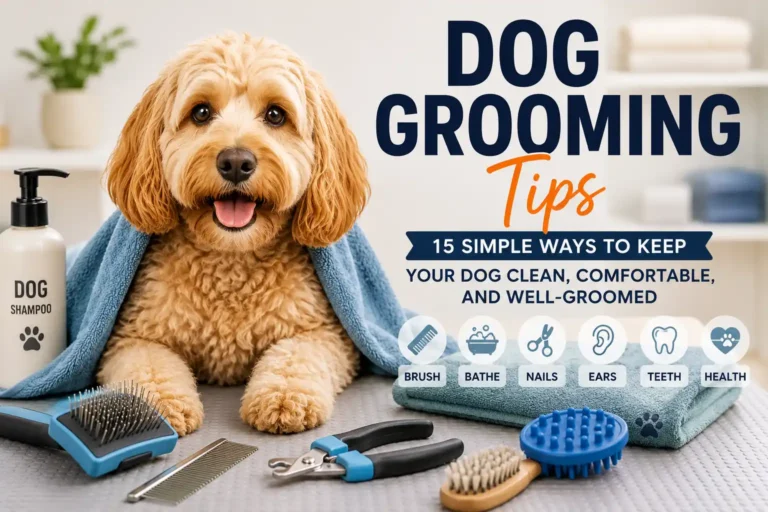
Featured image: AI-generated editorial illustration; an unlabeled bottle is not a product recommendation.
This guide covers ordinary, non-medicated dog shampoo. It explains what to look for on the bottle, how to think about different coats, and when a skin or coat concern calls for veterinary advice rather than another shampoo.
Start with a shampoo made for dogs
A product’s intended species matters more than whether its front label says “mild,” “natural,” or “gentle.” Dogs have different skin and coat-care needs from people, so human shampoo—including baby shampoo—is not a suitable substitute for a dog-formulated cleanser. VCA explains why owners should choose products made specifically for dogs in its guide to grooming and coat care.
Check that the bottle clearly identifies dogs as the intended species. Do not assume that a product is appropriate simply because it is marketed for pets or animals; products made for different species are not automatically interchangeable.
Also check what kind of product you are buying. This article is about an ordinary grooming shampoo, not a medicated cleanser, flea product, or other treatment product. Those products have different purposes and directions. If you think your dog may need a specialized product, discuss that with your veterinarian rather than choosing one as a stronger version of routine shampoo.
How to read a dog-shampoo label
The front of a bottle may emphasize fragrance, coat shine, or a “natural” image. The practical information is usually found in the directions and cautions. Before buying or using a shampoo, take a moment to check the following.
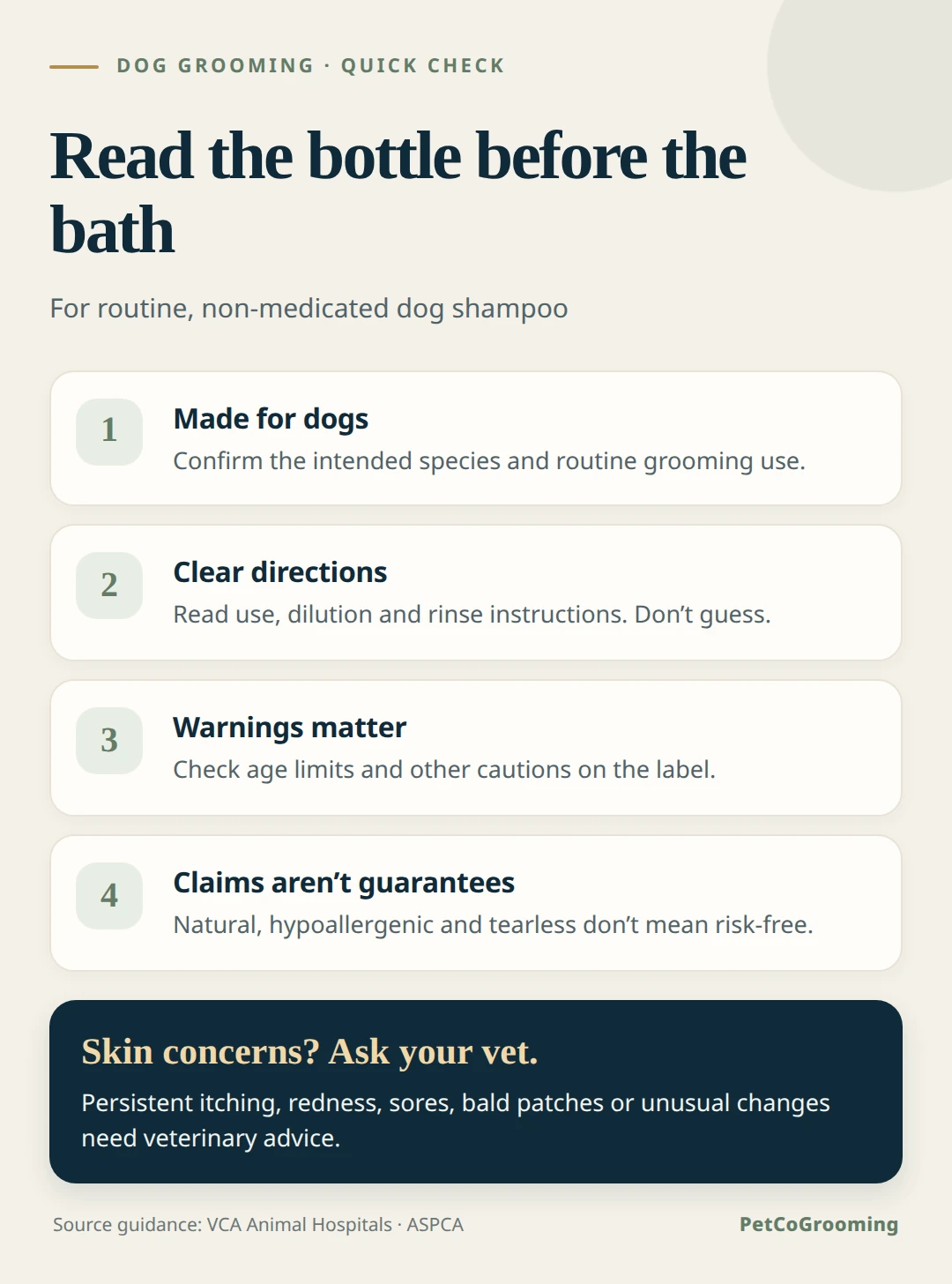
1. Confirm the intended species and use
Look for clear wording that the shampoo is made for dogs and intended for ordinary coat cleaning. If the label is unclear about the species or purpose, do not guess. Choose a clearly identified dog shampoo or ask the manufacturer or your veterinarian for clarification.
2. Read the complete directions
Check how the product should be applied and rinsed, along with any precautions or restrictions. Directions can vary between products, so do not borrow instructions from another bottle. In particular, do not invent a contact time or leave shampoo on longer in the hope that it will clean better. Follow the directions on the product you actually have.
If the instructions are missing, confusing, or difficult to follow, choose a product with clear directions or seek clarification before using it.
3. Check the warnings
Read cautions about the face, eyes, nose, ear openings, or irritated skin. A shampoo intended for the coat should not be treated as a face wash or used inside the ears. Keep the label available so you can refer to its instructions and warnings during the bath.
4. Consider fragrance and sensitivity claims realistically
For routine grooming, VCA identifies hypoallergenic or perfume-free products as options owners may consider. You can read its coat-care guidance for that recommendation and its broader advice on matching grooming to the individual dog.
These labels are preferences, not guarantees. “Hypoallergenic,” “fragrance-free,” and “natural” do not mean that a shampoo cannot irritate a particular dog. A product may still be unsuitable for an individual pet, regardless of how reassuring its marketing sounds. Choose based on the intended use and directions, then pay attention to how your dog responds.
Match the choice to your dog’s coat
Dogs do not all have the same coat or grooming needs. A short, smooth coat may be easier to wash and rinse than a long, dense one, while a curly or textured coat may need more attention during routine grooming. VCA’s guidance on dog coat care emphasizes that coat needs vary and that care should be individualized.
For shampoo selection, that does not mean you need a special ingredient list for every breed or coat type. Start with a dog-formulated routine shampoo whose label is clear and whose directions you can follow. Think practically about the coat you will be washing:
- Short or smooth coats: Choose an ordinary dog shampoo with clear directions. There is no reason to select a stronger cleanser simply because the hair is short.
- Long, dense, or double coats: Plan for careful, thorough rinsing. A coat that holds more water or product may take more time to rinse completely. Do not rush this part of the bath.
- Curly, wavy, or textured coats: Consider the coat’s grooming needs and whether you can distribute and rinse the shampoo as directed. Avoid relying on broad marketing claims that one formula is best for every textured coat.
If your dog’s coat is difficult to manage, has changed noticeably, or you are unsure what routine is suitable, ask a veterinarian or an experienced groomer for individualized guidance. The useful question is not “Which ingredient is best for this breed?” but “Can I use this dog-specific product as directed and rinse it thoroughly for this coat?”
What if your dog seems to have sensitive skin?
Some owners look for a different shampoo because their dog seems uncomfortable with a strongly scented product. In that situation, a perfume-free or hypoallergenic dog shampoo may be a reasonable routine preference. It is still important to remember that those terms do not promise that a product will be irritation-free for every dog.
Persistent itching, redness, sores, bald patches, or unusual changes in the skin or coat are different from a simple preference for less fragrance. The ASPCA advises owners to consult a veterinarian about signs such as persistent itching, redness, sores, bald patches, or unusual changes. Do not keep switching ordinary shampoos in an attempt to resolve those signs.
A routine cleanser cannot tell you what is causing a skin problem. If your dog already has ongoing symptoms, contact your veterinarian before choosing a new shampoo. If a veterinarian recommends a particular product, follow that individualized advice and the product’s own directions.
Use the shampoo carefully—and rinse it out fully
Even a suitable product can be uncomfortable if it is applied carelessly or not rinsed away. Keep the process calm, use lukewarm water, handle your dog gently, and follow the shampoo label. Do not use extra product or scrub harder to try to get a better result.
Thorough rinsing is especially important when a coat is long or dense. Work methodically and continue rinsing until the shampoo has been removed according to the product directions. VCA’s dog grooming and coat-care advice also stresses thorough rinsing as part of appropriate coat care.
Take extra care around the face
Keep shampoo away from the eyes, nose, and ear openings. For the face, the ASPCA recommends using a damp cloth rather than applying shampoo directly. Its dog grooming tips provide this practical precaution.
Do not assume that a “tearless” label makes a product safe to use near the eyes. The American Kennel Club notes in its puppy bathing guide that even tearless shampoo can irritate a dog’s eyes. The useful takeaway is simple: keep shampoo away from the eyes, regardless of the wording on the bottle.
If your dog becomes distressed, pause rather than forcing the bath or holding your dog down to finish it. If you cannot complete grooming calmly and safely, ask your veterinarian or a suitable grooming professional about another approach.
For a full walkthrough of the bathing process, see our guide to how to bathe a dog. Shampoo choice is only one part of coat care; the right bathing interval also varies between dogs. Our article on how often you should bathe your dog discusses why a single fixed schedule does not suit every pet.
Common dog-shampoo selection mistakes
A few habits make shampoo shopping more confusing than it needs to be.
Choosing by fragrance alone
A pleasant scent does not tell you whether a shampoo is formulated for dogs or appropriate for your dog’s coat. Check the intended species, product type, directions, and warnings first. Fragrance should not be the main test of suitability.
Treating “natural” as a safety guarantee
“Natural” is a broad marketing description, not proof that a product is suitable for every dog. It does not replace clear species labeling or careful use according to the directions.
Assuming “hypoallergenic” means no dog can react
A hypoallergenic claim may help you identify the kind of routine product you prefer, but it is not a guarantee. Watch how your dog responds, and stop using a product if you suspect it is causing a problem.
Using human shampoo or baby shampoo
A mild-sounding human product is still not a substitute for a shampoo formulated for dogs. Choose a dog-specific product instead.
Replacing dog shampoo with household products or DIY mixtures
Dish soap, household cleaners, bleach, vinegar, baking soda, and essential-oil mixtures are not appropriate substitutes for dog-formulated grooming shampoo. Do not experiment with household ingredients or homemade recipes on your dog’s coat or skin.
Buying a treatment product for an ordinary bath
A medicated shampoo or flea product is not simply a more powerful everyday cleanser. It has a different purpose and its own directions. If you think your dog needs something beyond routine grooming, ask your veterinarian rather than making that choice based on marketing language.
Rushing the rinse
A shampoo that remains in the coat has not been rinsed away properly. Allow enough time to follow the label and rinse thoroughly, especially when your dog has a long or dense coat.
When shampoo is not the answer
The same caution applies if your dog seems uncomfortable during bathing or you notice a reaction after using a product. Stop using the shampoo if you suspect it is causing a problem and ask your veterinarian what to do next. Do not try to counteract a reaction with another cleanser or a homemade mixture.
If you are wondering whether your dog needs a medicated shampoo or another specialized product, let your veterinarian guide that decision. Ordinary shampoo-selection advice cannot replace an individual assessment.
A simple final checklist
Before choosing an ordinary dog shampoo, work through these questions:
- Does the label clearly say the product is formulated for dogs?
- Is it an ordinary grooming shampoo rather than a treatment product?
- Have I read the full directions and warnings?
- Does the product suit the coat-care routine I can carry out?
- Can I keep it away from the eyes, nose, and ear openings and rinse it out thoroughly?
- Are there ongoing skin or coat changes that should be assessed by a veterinarian first?
The best choice is not necessarily the most expensive, most fragrant, or most heavily advertised bottle. It is a clearly labeled dog shampoo that fits ordinary grooming needs, can be used exactly as directed, and can be rinsed thoroughly. If your dog has persistent skin symptoms or an unusual coat change, get veterinary advice before treating a shampoo switch as the solution.